Best Home EV Chargers: Compare Features and Compatibility
The best home EV charger is the Level 2 unit that fits your car’s connector, overnight energy need and professionally assessed electrical setup. For mixed J1772/NACS households, consider Tesla’s Universal Wall Connector. ChargePoint Home Flex offers configurable output and app features; Emporia Pro emphasizes home energy management; Grizzl-E Classic favors a simpler connected-free setup. Verify the exact model, supply method and availability before buying.
A product’s maximum amps are not a guarantee of faster charging for your car. Vehicle limits, the circuit, installation method and your parking hours matter. Below is a U.S. desk-research comparison based on current manufacturer specifications and public guidance, not hands-on testing. There are no paid placements or affiliate links in this draft; check current prices and warranty terms at purchase.
How we chose these home Level 2 chargers
We compared four distinct use cases: a household with different vehicle connectors, a flexible smart charger, a home that may benefit from dynamic energy management, and a straightforward non-Wi-Fi charger. We checked manufacturer documentation for connector options, maximum output, installation choices and smart features. We also used ENERGY STAR guidance for safety certification and professional assessment. This is a shortlist, not a lab ranking of durability, charging efficiency or customer service.
| Model | Best fit | Connector / headline output | Installation and key distinction |
|---|---|---|---|
| Tesla Universal Wall Connector | Household with NACS and J1772 cars | Integrated J1772 adapter; up to 48 A | Hardwired; app schedule and usage, 24-foot cable |
| ChargePoint Home Flex | Flexible output and app control | Choose the model/cable for J1772 or NACS; up to 50 A in supported hardwire setup | Hardwire or compatible plug-in variant; output set to site |
| Emporia Pro | Energy monitoring and managed charging | J1772 or NACS version; up to 48 A in supported setup | Energy monitor and dynamic load features in Pro bundle |
| Grizzl-E Classic 40A | Simple, rugged charger without app dependence | J1772; up to 40 A | Plug-in NEMA 14-50 or 6-50 versions; stated indoor/outdoor enclosure |
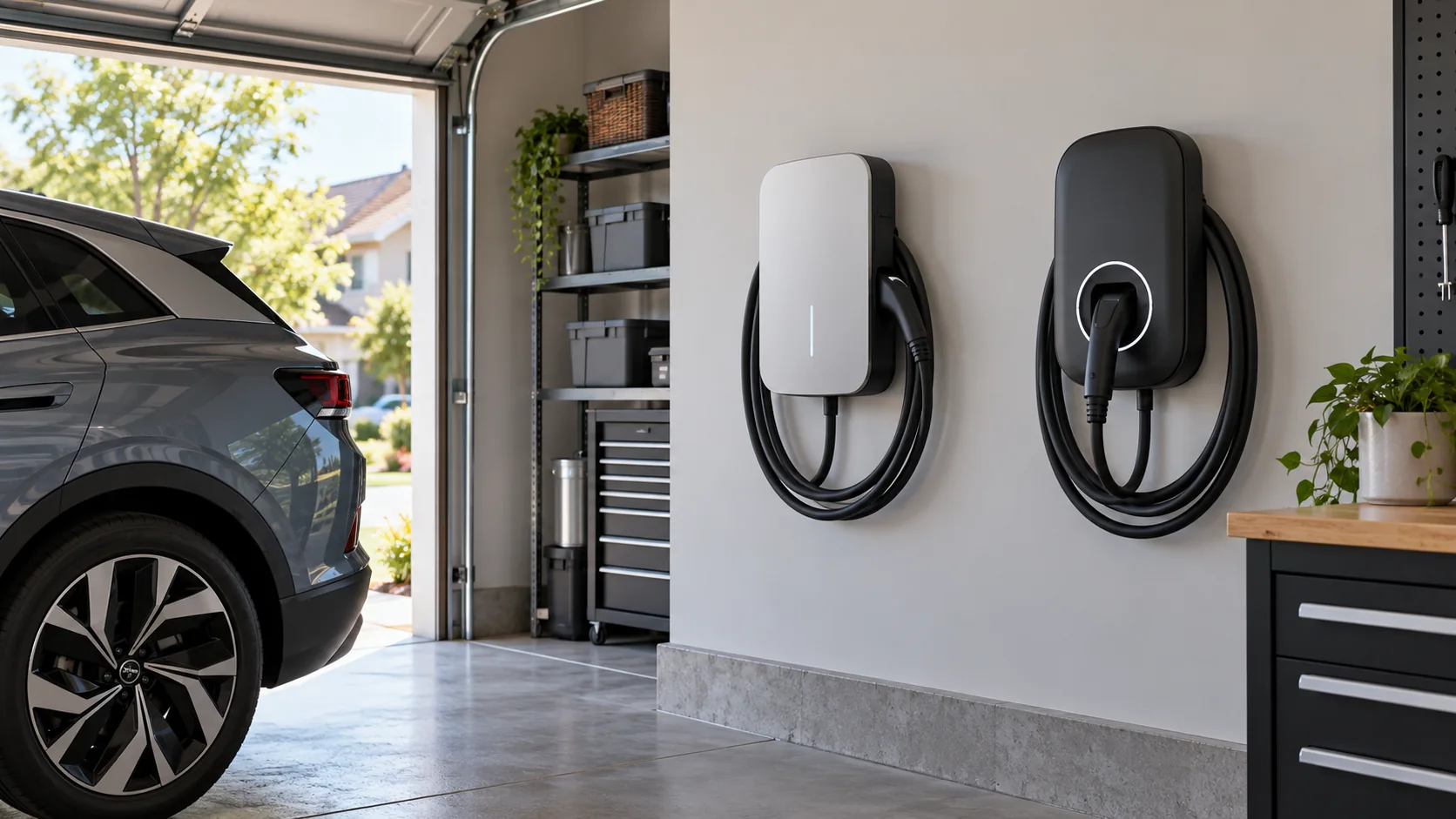
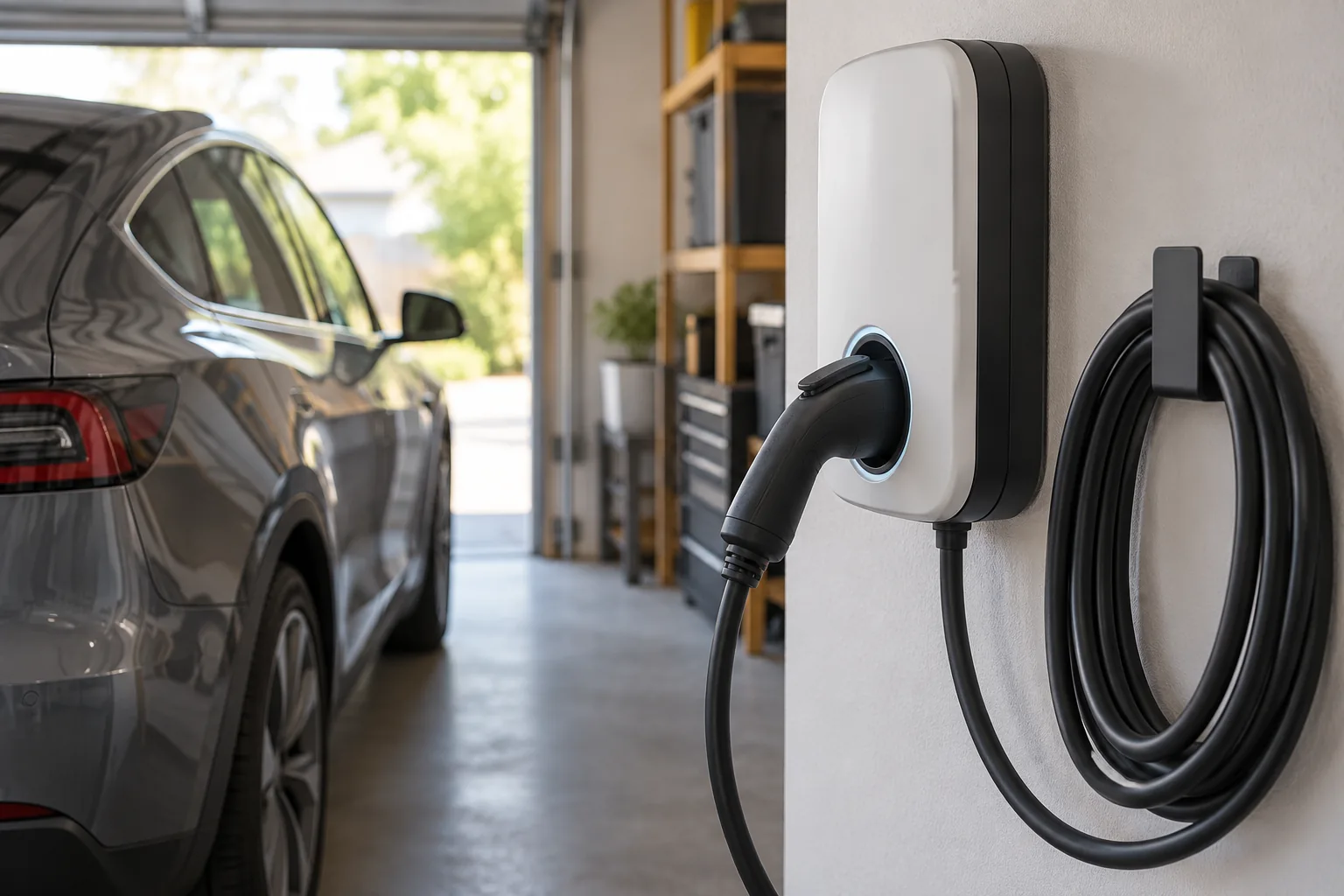
Specifications are model- and configuration-dependent, and availability changes. Use the maker’s exact product page and installation manual for your selected version. A licensed electrician must establish the allowed output; the vehicle may accept less than a unit’s maximum. The photos in this article are generic illustrations, not photographs of the named products.
Tesla Universal Wall Connector: for a mixed-connector household
Tesla’s Universal Wall Connector has an integrated J1772 adapter around its NACS handle, allowing an eligible car with either AC inlet type to use the same installed unit. Tesla states output up to 48 A / 11.5 kW depending on the vehicle and installation, a 24-foot cable, Wi-Fi, app scheduling and a four-year residential warranty. A qualified electrician installs it.
This is a sensible first look if your household already has one NACS car and one J1772 car, or you expect that mix. Check the exact vehicle’s AC inlet and any adapter instructions; “universal” does not mean every car charges at 48 A. Tesla’s shop listing showed stock or purchase eligibility restrictions when checked, so confirm availability and buying terms before making plans. The hardware cost and a site-specific installation quote are separate.
ChargePoint Home Flex: adaptable output and app control
ChargePoint Home Flex can be configured across a range of outputs, with a stated maximum of 50 A in a suitable hardwired installation. Its documentation explains that plug-in NEMA 6-50 or 14-50 configurations use the lower supported settings and that a licensed electrician selects the correct site setting. Select the J1772 or NACS cable/model offered for your car rather than assuming one handle fits both without an approved adapter.
It suits a household that values charging schedules, app controls and an output matched to the home’s assessed capacity. Wi-Fi enables connected features, but the product’s offline behavior and setup requirements are worth reading in advance. Ask the installer whether hardwired or plug-in is appropriate, and compare the full circuit and permit cost. The maximum 50 A is not a reason to demand that output if your car or home cannot benefit.
Emporia Pro: for home energy management
Emporia’s Pro bundles a home energy monitor and dynamic load-management features, plus scheduling and solar-related controls. The manufacturer offers J1772 and NACS models and describes up to 48 A in an appropriate hardwired setup. The pre-purchase checklist distinguishes plug-in and hardwired arrangements and asks buyers to confirm car and panel details.
This is worth comparing when the electrical assessment suggests that managed charging may make better use of existing capacity. It is not a blanket promise that no panel work will ever be needed. The Pro bundle has more components and setup than a simple EVSE; ask the installer what the monitor measures, who configures it, and how charging behaves if connectivity is lost. The lower-cost Emporia Classic offers basic scheduling, while dynamic load features are a separate upgrade path.
Grizzl-E Classic 40A: straightforward charging
The manufacturer’s Grizzl-E Classic 40A specifications list a J1772 vehicle connector, plug-in NEMA 14-50 or 6-50 variants, an indoor/outdoor-rated enclosure, and adjustable output below its 40 A maximum. Its technical specifications say it has no internet connection. If you prefer simple overnight charging over another account and app, that is a legitimate feature.
Check the exact product variant and current certification/warranty at checkout. For a NACS-inlet car, confirm an approved AC adapter or choose a matching-connector model elsewhere. A plug-in charger still needs a suitable professionally assessed receptacle and circuit. Product durability cannot be concluded from a housing description alone; this guide has not independently endurance-tested it.
Five checks before you order
- Vehicle-side connector: Verify the exact model-year car’s AC inlet and the product’s handle or manufacturer-approved adapter. NACS/J3400 and J1772 are not wall outlet types.
- Daily energy need: Estimate miles and parking hours. An appropriately installed lower output can often replace daily use overnight.
- Professional electrical assessment: Have an electrician check service capacity, route, selected output, hardwired versus plug-in arrangement and local permits.
- Cable and location: Measure from the proposed mounting point to the car’s normal charge port without stretching over traffic or a walkway.
- Features and support: Decide whether Wi-Fi scheduling, energy reporting, load management, offline charging behavior and warranty are worth the cost.
The ENERGY STAR page recommends safety-certified EVSE and a licensed electrician to evaluate the home’s wiring and outlets. Certification of a model and the presence of an app are separate questions. Verify the exact SKU, not simply a brand name.
What will installation add to the purchase price?
Electrical labor, materials, a new circuit, permit fees, distance from panel to parking and possible capacity changes can exceed the price difference between chargers. Get the electrician’s recommendation before ordering an output or supply plug. Our readiness checklist explains the site assessment; the installation cost guide shows how to read a quote. The outlet guide separates plug-in wall connections from vehicle connectors.
If your car came with a suitable Level 1 cord and your daily driving is modest, test whether that routine meets your needs before buying Level 2. For portable dual-voltage equipment, our separate portable charger guide will cover travel use cases. This comparison is for fixed-location home Level 2 choices.
Sources and review method
- Tesla: Universal Wall Connector product details
- ChargePoint: Home Flex installation FAQ
- Emporia: Classic versus Pro guide
- Emporia: Pre-purchase checklist
- United Chargers: Grizzl-E Classic specifications
- ENERGY STAR: EV chargers
Research checked October 2026. Features and stock are subject to change; this comparison relies on manufacturer pages and official consumer guidance and includes no hands-on performance claims.
Frequently asked questions
What is the best Level 2 EV charger for a home?
Choose for the car’s connector, parking hours, assessed circuit, features you will actually use and total installed cost. A mixed J1772/NACS home may favor a dual-connector solution; another home may value energy management or simple offline operation.
Is a 48- or 50-amp home charger always better?
No. The car’s onboard AC limit, available electrical capacity and overnight time may make a lower output fully adequate. A licensed electrician should set and verify the installation.
Can a J1772 home charger work with a NACS car?
Sometimes, with a compatible, manufacturer-approved AC adapter. Confirm the vehicle and equipment instructions for your exact model; a DC fast-charging adapter is a different product.
Do I need a smart Wi-Fi charger?
No. Basic EVSE can charge a car without app features. Smart scheduling, monitoring and managed load may be valuable for some tariffs or electrical setups, but assess the cost and offline behavior.
Should I buy the charger before the electrician’s visit?
Shortlist models first, then confirm the car connector, available capacity, supply method and installation cost with the electrician before purchasing.