How to Charge an Electric Car at Home: The Complete Guide
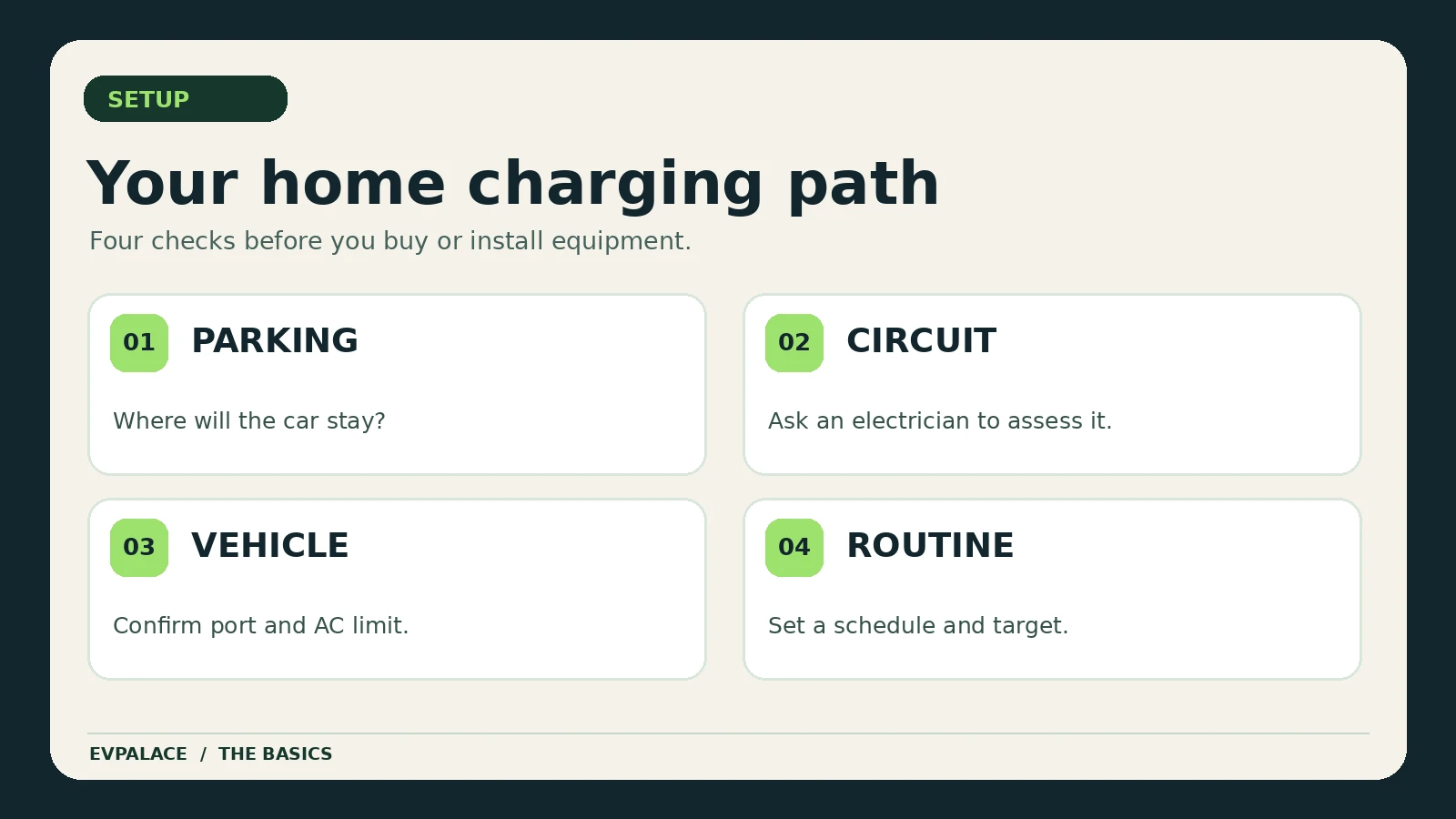
Quick answer: You can charge an electric car at home with suitable Level 1 (120-volt) charging or faster Level 2 (240-volt) equipment. Start by checking where you park, how many miles you need to replace each day, your vehicle’s charging connector and the electrical circuit. Have a qualified electrician assess any proposed new circuit or Level 2 installation. Then plug in using approved equipment and set a charging schedule and target in the car or its app.
Most home charging is a routine, not a race to refill an empty battery. A car parked for eight or ten hours gives you time to add back the energy used that day. This guide helps you decide whether an existing setup is enough and what to ask before paying for an upgrade. It is a U.S. overview, so your local utility, building rules and the equipment manuals still govern the details.
Start with your parking and daily driving
Where will the car reliably park overnight? A garage or driveway near a suitable outlet can make home charging straightforward. In a shared building or rental, first check permission, parking access and who pays for electricity. If you cannot count on a particular space, a dedicated home setup may not be practical; map workplace and public options before choosing a car.
Next, estimate how much driving you normally do between charging opportunities. A driver covering 25 miles a day may have a different need from someone covering 90 miles and arriving late. A plug-in hybrid’s smaller battery also changes the calculation. The U.S. Department of Energy’s AFDC home-charging guide notes that many drivers can meet daily needs with overnight Level 1 when a suitable dedicated branch circuit is available; others choose Level 2 for faster replenishment.
Level 1 versus Level 2 at home
| Option | Typical U.S. supply | Good starting use | What to verify |
|---|---|---|---|
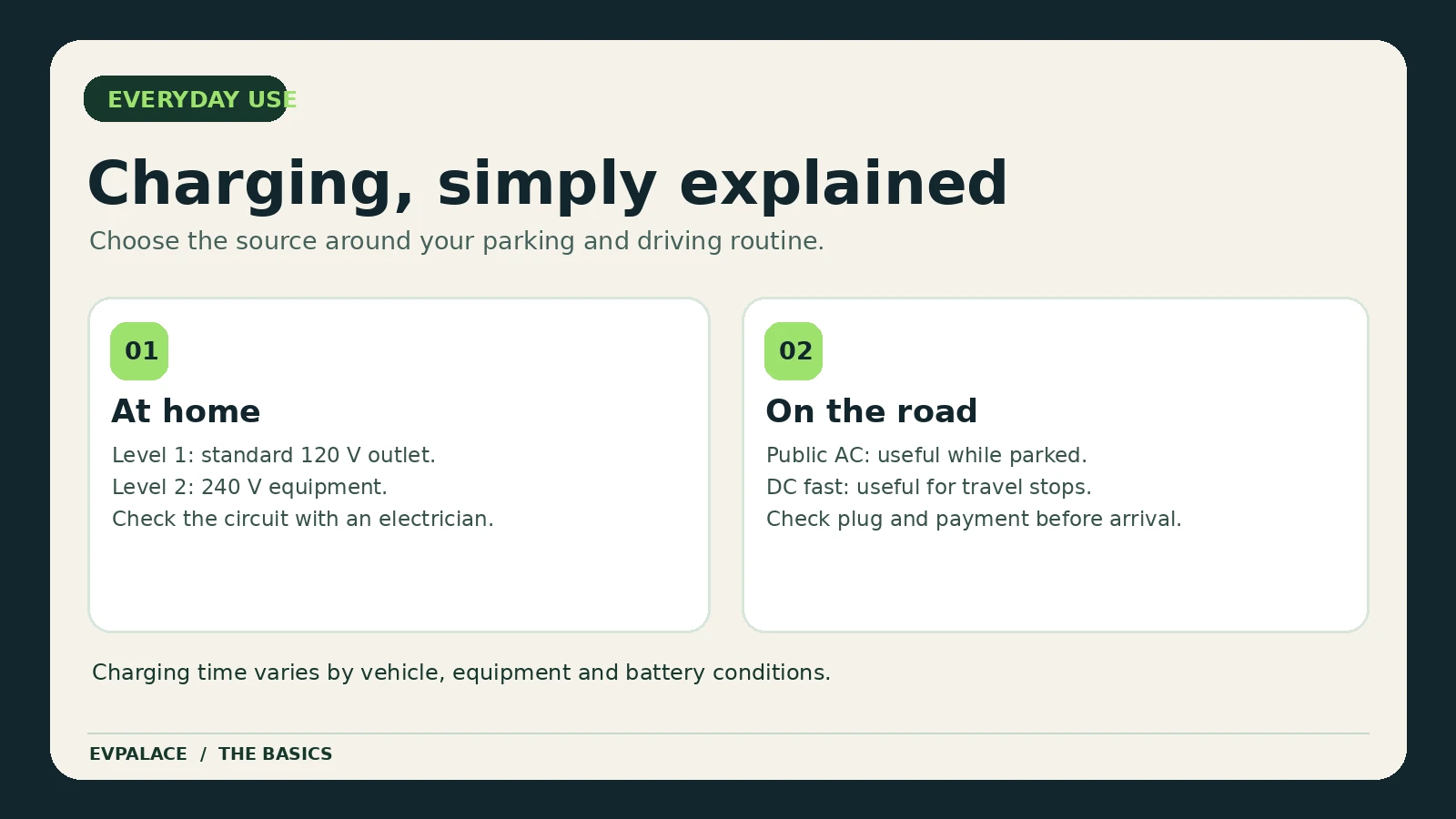
| Level 1 AC | 120 V outlet with compatible cordset | Shorter daily driving, PHEVs, long parking windows | Outlet and circuit suitability; vehicle cordset and manufacturer guidance |
| Level 2 AC | 240 V equipment, hardwired or an appropriate outlet | More daily miles, shorter overnight window, two-EV plans | Electrical capacity, installation, equipment rating, connector and car’s AC limit |
The EPA’s home-charging guide gives broad illustrations of about 3–5 miles of range added per hour with Level 1 and 25–40 with Level 2. Your result can differ substantially with power setting and vehicle efficiency. A Level 2 unit rated for more power than the vehicle can accept will not force the vehicle to charge faster. Use the specific car’s onboard AC charging limit for realistic expectations.
DC fast charging is mainly a public travel option. It requires compatible vehicle hardware and a much larger electrical supply than an ordinary home Level 1 or Level 2 setup. Do not treat a public DC charger’s advertised speed as a home-installation requirement. Our charging levels guide will compare all three in greater depth.
How much charging power do you actually need?
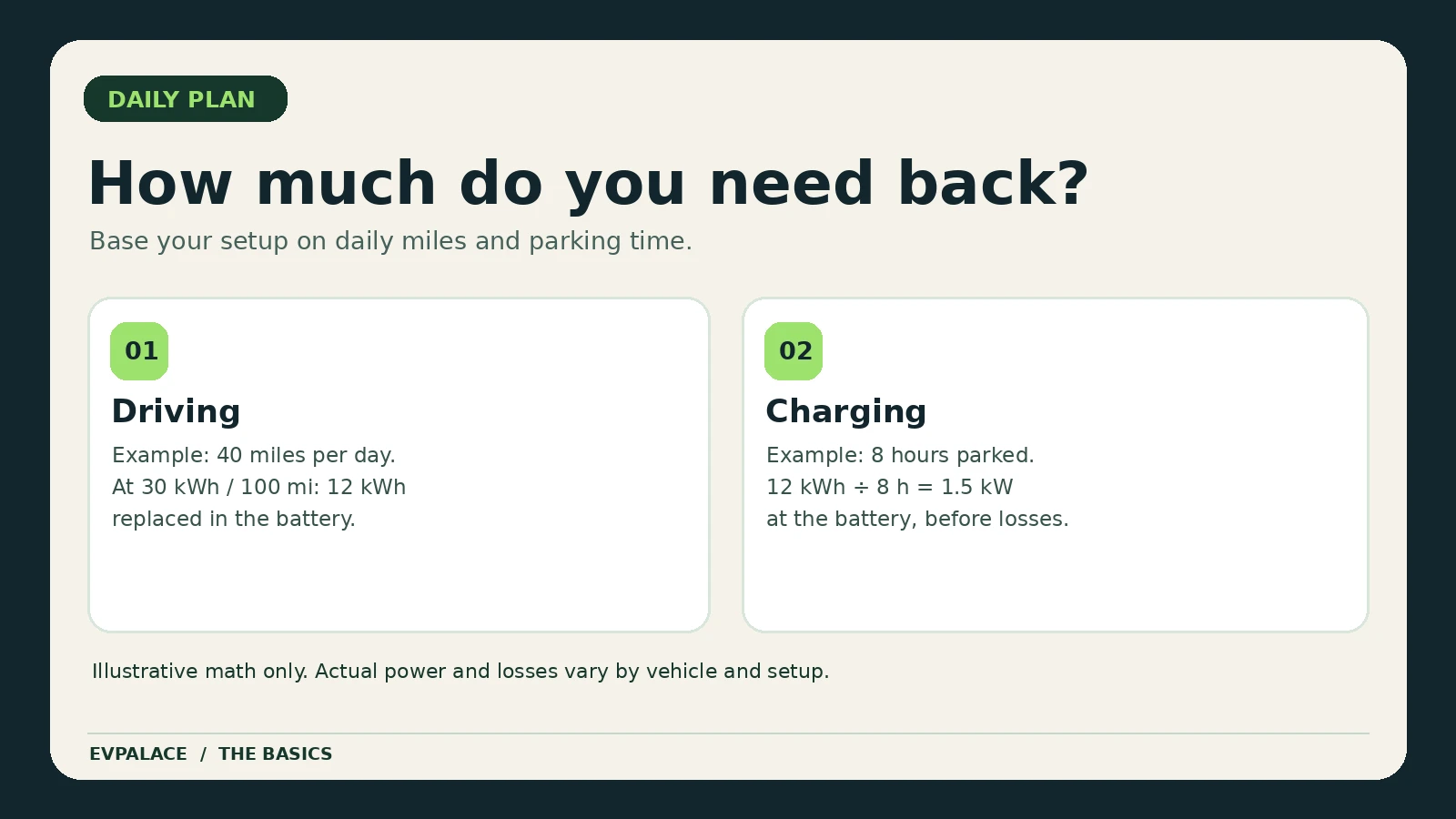
Work backward from daily miles. As a simple example, a car that consumes 30 kWh per 100 miles would use about 12 kWh to drive 40 miles in the same conditions. If it parks for eight hours, the average energy reaching its battery would need to be around 1.5 kW to replace that 12 kWh. The wall must deliver more because charging has losses. This is a planning example, not a promise that a particular 120 V outlet can deliver that power continuously.
Actual charging time depends on the vehicle’s AC charger, equipment, electrical service, battery state and temperature. The AFDC charging-station overview explains these variables. It is usually more useful to ask whether the setup replaces your daily use by departure time than how long it takes to fill a nearly empty battery to 100%.
Check the outlet, circuit and electrical capacity
A convenient-looking outlet is not proof that it is suitable for repeated EV charging. The condition, circuit, other loads, breaker, wiring and equipment instructions matter. The AFDC specifically refers to a dedicated branch circuit for Level 1 use and advises qualified electrical work for a Level 2 circuit. Ask an electrician to assess the installation, including any local permit or inspection requirements, before adding or changing wiring.
For Level 2, discuss the parking location, cable reach, equipment rating, hardwired versus plug-in setup, panel capacity and possible future loads. A larger advertised amperage is not automatically better for your house or car. A professional can size the circuit and charging equipment together under the applicable code and manufacturer instructions. We will cover the quote line items separately in the installation cost guide; this page is the readiness overview.
Do not use an ordinary household extension cord or improvised adapters as a substitute for a suitable installation. Follow the vehicle and EVSE manuals. If a plug, outlet or cord becomes unusually hot or damaged, stop using it and have the setup checked.
Choose equipment that works with your car
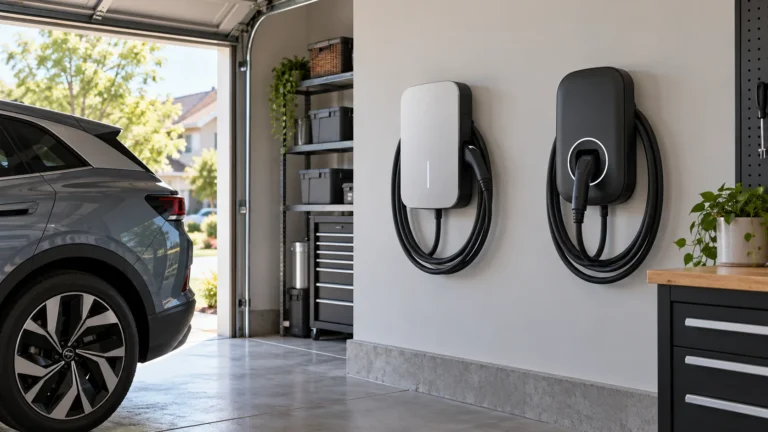
A home charging device is often called EVSE, short for electric vehicle supply equipment. It provides a controlled connection to the car; for AC charging, the vehicle’s onboard charger converts AC electricity to the DC energy stored in the battery. Before buying, confirm the equipment’s connector, power rating, cable reach, location rating and compatibility with the vehicle.
In the U.S., J1772 and J3400/NACS are common AC connector families. An approved adapter may bridge some combinations, but availability and use depend on the vehicle, equipment and manufacturer guidance. Verify your specific car and adapter rather than assuming every plug works everywhere. An outdoor installation should use equipment rated for the intended conditions and a professionally planned location. Our connector guide will cover the details.
Wi-Fi, scheduling, energy reports and power sharing can be useful, but decide first whether the unit is compatible and whether your electrical setup supports it. Some cars already offer charge scheduling; you may not need to pay for every feature twice. For two EVs, an electrician can assess the total load and whether managed charging helps.
Set a simple charging routine
- Park and connect: Follow the vehicle and equipment instructions; make sure the connector is seated and the session starts.
- Set the target: Use the automaker’s recommendation for your specific battery and daily driving. Do not assume one percentage limit fits every chemistry or model.
- Schedule if useful: If your utility has time-of-use rates, set the car or EVSE to charge during the less expensive period while still meeting departure needs.
- Check the first sessions: Confirm the car added the expected energy and no equipment or outlet issue appeared. Revisit the schedule when your driving changes.
There is no universal cheapest hour. Read your utility’s actual rate plan and check whether a special EV tariff, meter requirement or incentive applies. Electricity cost is roughly kWh drawn from the wall × your effective electricity price per kWh, plus any applicable fees. Charging losses mean wall energy exceeds energy stored in the battery. Our charging cost guide will show examples using explicit assumptions.
What if you rent or cannot install a charger?
Ask the property owner or manager what charging is permitted and how electricity would be measured. A shared Level 2 station, a workplace charger or a reliable public charger near errands may help, but availability, connector, payment and time limits vary. Test the realistic weekly routine before buying a vehicle that depends on a station you have not used. A PHEV may offer more flexibility for some drivers, but its electric benefit depends on plugging in regularly.
A home EV charger is also not synonymous with a wall-mounted box. Compatible manufacturer-approved portable equipment can be appropriate when the supply and use conditions are suitable. Avoid assuming a portable unit makes an unverified outlet safe.
Home charging checklist
- Confirm where the vehicle parks and whether the cable reaches without crossing a walkway.
- Record the vehicle’s connector, onboard AC charging limit and manufacturer charging guidance.
- Estimate typical daily miles and available overnight hours.
- Have an electrician assess the existing circuit or a proposed Level 2 installation, including permits and future loads.
- Compare equipment for compatibility, installation type and appropriate location rating.
- Check the utility tariff and any verified local incentives before setting a schedule.
Sources
- U.S. Department of Energy, AFDC: Charging Electric Vehicles at Home
- U.S. EPA: Getting Started with Home EV Charging
- AFDC: Electric Vehicle Charging Stations
- U.S. EPA: Plug-In Electric Vehicle Charging Details
Frequently asked questions
Can I charge an electric car from a regular outlet?
Many EVs can use compatible Level 1 equipment on a suitable 120 V circuit. Check the vehicle and cordset instructions and have the outlet and circuit evaluated if their condition or capacity is uncertain. It is slower than Level 2.
Do I need Level 2 charging at home?
Not necessarily. Compare daily miles with hours parked and the vehicle’s efficiency. Level 1 may cover a shorter commute or a PHEV; Level 2 provides more flexibility when you need to replace more miles overnight.
How long does home charging take?
It depends on how much energy you need to add, the car’s charging limit, equipment power and conditions. Estimate daily replenishment first. Published miles-per-hour figures are broad illustrations, not a guarantee for your car.
Can I install a Level 2 charger myself?
A new 240 V circuit and equipment installation require an assessment of service capacity, wiring and local rules. Use a qualified electrician and follow permits, inspections and the equipment manufacturer’s instructions.
Is charging every night necessary?
Only if your driving and desired battery target call for it. Many owners plug in as part of a routine, but charging frequency and targets should follow the specific vehicle’s recommendations and your usage.