Portable Charger for Electric Car: Level 2 & Travel Guide
Quick answer: A portable EV charger is usually a mobile EVSE cordset, not a battery pack. It still needs a suitable external outlet. Some units work only on 120 V Level 1; dual-voltage models use manufacturer-approved adapters for 120 V or a professionally assessed 240 V Level 2 connection. Match the car-side connector, supply plug, outlet, current setting and cable reach before buying.
Portable equipment can travel with the car or serve a home without a permanent wall-mounted charger. Its flexibility is useful only when you know the available electrical supply at each destination. This U.S. comparison covers current dual-voltage options and a few planning scenarios based on manufacturer documentation, not hands-on testing or a claim that an arbitrary outlet is safe.
What “portable” does and does not mean
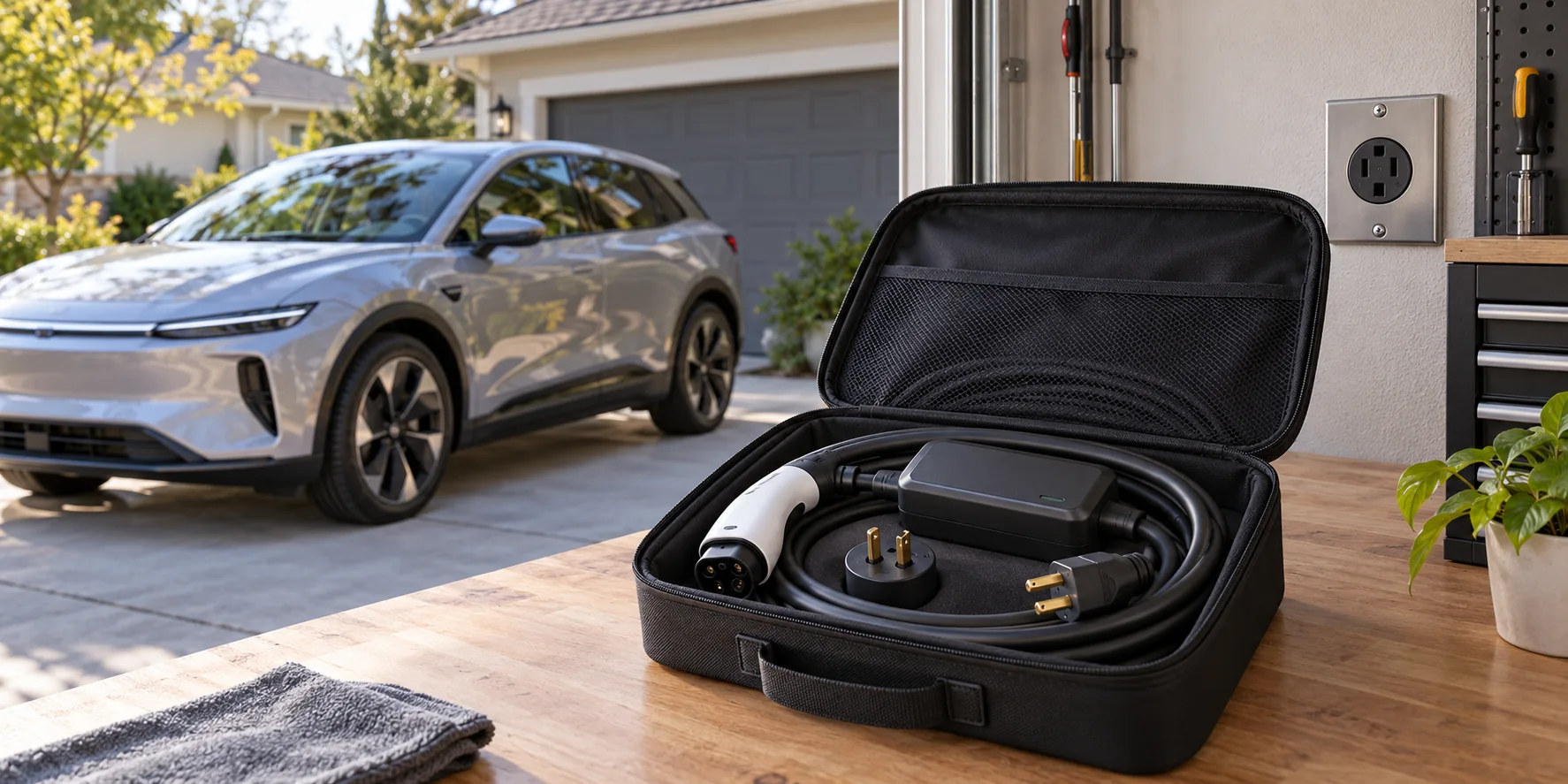
A portable charging cordset contains EV supply equipment (EVSE) that communicates with the vehicle and manages a charging session. The wall provides the electricity. The case and interchangeable adapter do not store enough energy to charge a car on their own. If you are looking for emergency battery-based roadside service, that is a different topic.
A 120 V household supply gives Level 1 charging; a compatible 240 V setup can provide Level 2. The DOE’s home charging guide says Level 1 can cover many daily needs where an appropriate dedicated circuit exists, while Level 2 can suit longer commutes or shorter parking windows. Never choose a plug or current setting from appearance alone. The unit’s manual and a qualified electrician govern suitability.
Dual-voltage options to compare
| Option | Vehicle-side fit | Included or offered supply choices | Why consider it |
|---|---|---|---|
| Tesla Mobile Connector | Tesla/NACS handle; verify exact vehicle | Current bundle lists NEMA 5-15 and NEMA 14-50 adapters | OEM portable option for compatible Tesla owners |
| Lectron Explorer J1772 | J1772 | NEMA 5-15 and NEMA 14-50; manufacturer lists 12 A Level 1 and 24 A Level 2 | Dual-voltage aftermarket option for J1772 cars |
| Lectron Explorer NACS | NACS | NEMA 5-15 and NEMA 14-50; manufacturer lists 12 A Level 1 and 24 A Level 2 | Matching-handle alternative for NACS cars |
| Vehicle manufacturer’s optional mobile cord | Varies by model year and package | Check actual kit; Ford has offered a 120/240 V Mobile Power Cord option on certain Mach-E model years | May provide an OEM-supported fit |
The manufacturer-listed choices are examples, not a universal ranking. Prices, stock, accessories and specifications can change. For the exact SKU, confirm the safety listing, manual, warranty and return terms. An adapter at the vehicle end is different from a supply-side adapter for the wall. No affiliate links or paid placements appear in this draft.
Tesla Mobile Connector: one kit with common adapters
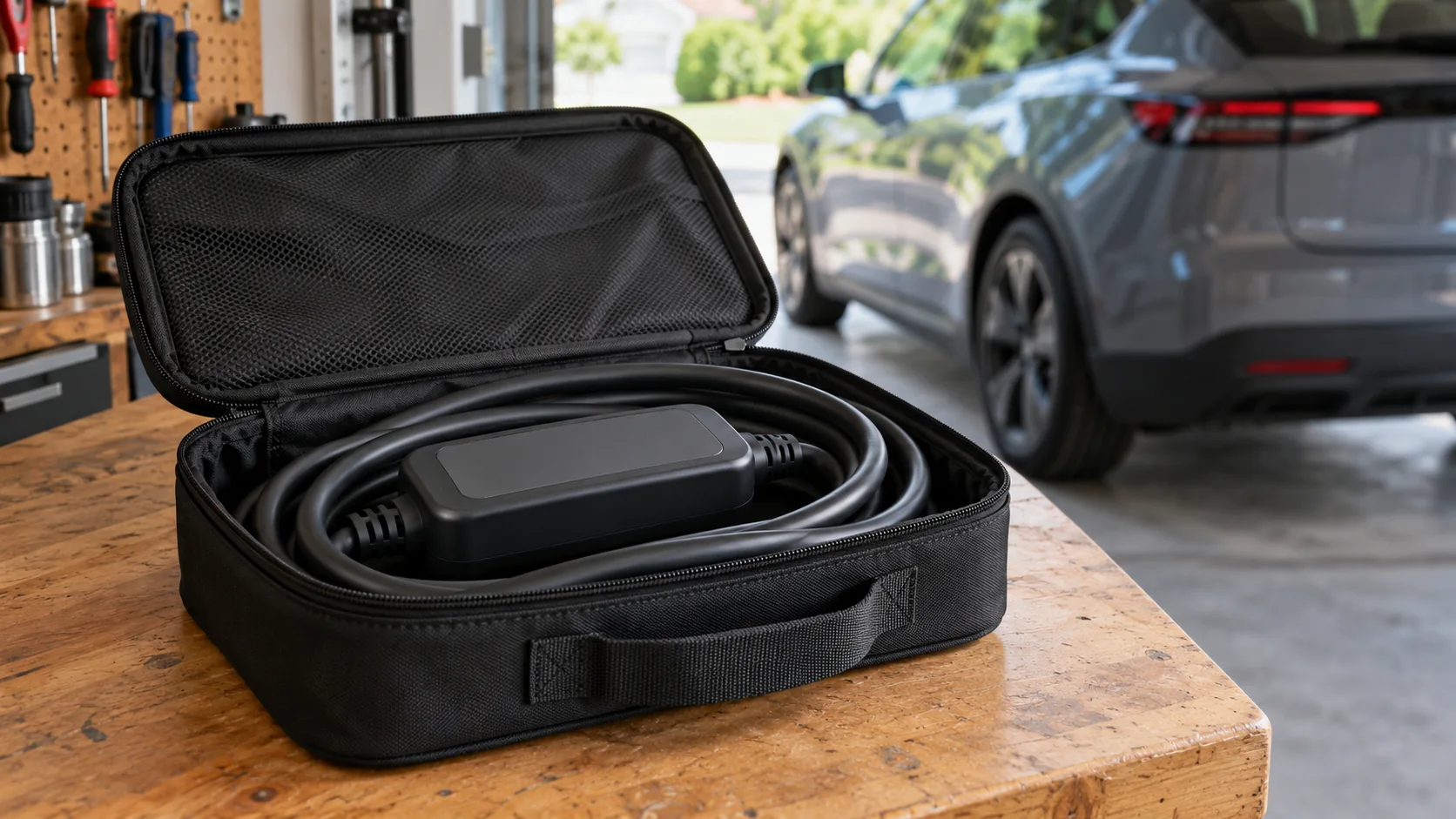
Tesla lists a 20-foot Mobile Connector, a NEMA 5-15 adapter for a standard 120 V outlet, a NEMA 14-50 adapter for an appropriate 240 V connection, and a carry bag in its current bundle. It is a natural comparison for a compatible Tesla/NACS owner who wants one portable kit for Level 1 at a suitable home outlet and Level 2 where a correctly installed connection exists.
It is not automatically included with every new Tesla purchase. Check the vehicle order and current product listing. Tesla publishes different range-per-hour estimates by vehicle; do not apply one car’s number to another. With any optional outlet adapter, follow Tesla’s instructions and have a new or questionable 240 V connection assessed professionally.
Lectron Explorer: J1772 or NACS versions
Lectron sells separate J1772 and NACS Explorer versions. The current product listings describe 12 A on 120 V and 24 A on 240 V with NEMA 5-15 and NEMA 14-50 supply choices. That is a useful option if you want a matching vehicle connector and a lower-output dual-voltage kit.
Select the car-side version first, then verify the exact supplied adapter and intended outlet. The manufacturer’s safety certification claims should be checked against the exact model’s listing; do not infer certification from another Lectron product. At 240 V, the output is limited to the unit’s stated setting even if the wall receptacle has a higher rating. A suitably installed receptacle and a compatible vehicle are still required.
What about an OEM mobile cord from another carmaker?
Some manufacturers offer mobile EVSE with a new vehicle or as an option. For example, Ford’s 2025 Mach-E specifications listed an optional Mobile Power Cord with 120 V and 240 V cord ends. Do not infer that the same kit ships with every current Ford, or that a Ford cord should be used on another brand’s car without approval. Check your exact vehicle’s documentation and included accessories before purchasing a third-party unit.
An OEM option can simplify compatibility and support, but it does not replace the outlet inspection. If your daily charging location is fixed, compare a permanent home EVSE as well: our home Level 2 charger guide covers those choices.
Five checks before using a travel outlet
- Permission: Ask the property owner or host before using a receptacle and learn any parking or billing rules.
- Condition and circuit: An outlet may be old, shared, damaged or unsuitable for sustained EV charging. A matching shape does not prove capacity.
- Exact adapter: Use only the equipment maker’s approved supply adapter for the specific outlet type. Do not use extension cords or improvised conversion plugs.
- Output setting: Follow the EVSE manual and the professionally assessed supply. The vehicle’s AC charging limit can also be lower.
- Weather and placement: Check the entire equipment and supply connection are approved for the environment. Keep cables out of walkways and protect the unit from strain.
The ENERGY STAR guidance recommends safety-certified equipment and a licensed electrician to assess wiring and outlets. If the plug or outlet is loose, hot or damaged, stop and obtain qualified help. For home planning, see our outlet guide and installation readiness checklist.
Should you buy portable Level 1, dual-voltage or a wall unit?
If you need only a 120 V backup and already own a suitable cordset, a second purchase may be unnecessary. Our Level 1 comparison focuses on that need. A dual-voltage kit makes sense when you have confirmed access to suitable connections at both voltages. A fixed Level 2 wall unit may be more convenient for daily use at one parking spot, particularly if the portable kit would otherwise be handled and packed repeatedly.
Installation cost still matters. A new 240 V outlet is an electrical project with potential permits, circuit work and panel assessment. The cost guide helps compare its one-time price with the charger itself. Portability is a feature of the EVSE, not a way around electrical requirements.
A mobile cordset is useful only where suitable power is available. Review home charging planning. Use Level 1 and Level 2 compared and home wall chargers to check the related decisions before choosing equipment or a charging routine.
Sources and method
- U.S. DOE AFDC: Home charging
- ENERGY STAR: EV chargers
- Tesla: Mobile Connector
- Lectron: Explorer J1772
- Lectron: Explorer NACS
- Ford: 2025 Mach-E technical specifications
Desk research checked October 2026. We did not perform hands-on product tests; verify current stock, model specs and safety listing before buying.
Frequently asked questions
Can a portable EV charger charge a car without an outlet?
Ordinary portable EVSE cannot. It needs a suitable external electrical source. A battery-based roadside charging service is a different product.
Can I use the same portable EVSE on 120 V and 240 V?
Only if the specific unit is rated for both voltages and you have the manufacturer-approved supply adapters, suitable outlets and correct settings.
Are portable Level 2 chargers as fast as wall-mounted ones?
Not inherently. Output depends on the unit’s rated setting, vehicle, outlet and professionally assessed electrical setup. Some portable dual-voltage kits have lower maximum output than hardwired wall units.
Does a NEMA 14-50 adapter fit any 240-volt outlet?
No. The receptacle type must match, and its circuit and condition must be suitable. An electrician should assess an uncertain or newly installed connection.
Is a portable charger safe outdoors?
Only when the exact equipment, plug connection and placement meet manufacturer instructions and applicable local rules for that environment.