How Much Electricity Does an Electric Car Use?
How much electricity does an electric car use? The most useful answer is in kilowatt-hours per mile, not the battery’s total size. An EV using 30 kWh per 100 miles consumes 0.30 kWh per mile while driving. At 1,000 miles a month, that is roughly 300 kWh used by the vehicle for driving, plus any energy lost during charging and other parked uses. The exact figure depends on the model and conditions.
Understand kWh, kW and miles per kWh
A kilowatt-hour (kWh) measures energy, while a kilowatt (kW) measures the rate at which energy is delivered or used. A vehicle’s efficiency may be displayed as kWh/100 miles, Wh/mile or miles/kWh. They describe the same relationship in different directions. Lower kWh per mile means less energy used for each mile; higher miles per kWh means more miles from each kWh.
To convert kWh/100 miles to kWh/mile, divide by 100. To convert Wh/mile to kWh/mile, divide by 1,000. To convert miles/kWh to kWh/mile, take its reciprocal. For instance, 3.33 miles/kWh is about 0.30 kWh/mile. Check whether the vehicle display measures battery energy used while driving or electricity drawn from the wall. Those figures are not always identical.
A practical monthly electricity calculation
Driving energy (kWh) = miles driven × vehicle kWh/mile. If the example vehicle uses 0.30 kWh/mile and drives 1,000 miles, it uses about 300 kWh for driving. A 500-mile month is about 150 kWh on the same assumption, while 1,500 miles is about 450 kWh. These numbers describe the illustrative vehicle, not a universal average.
To estimate wall electricity, divide the battery energy you need to replace by a realistic charging efficiency assumption. If all 300 kWh is replenished at home at an illustrative 90% wall-to-battery efficiency, approximately 333 kWh is drawn from the wall. If only 80% of that driving energy is replaced at home and 20% at public stations, track the two sources separately. The vehicle may also consume energy while parked for battery conditioning, cabin preconditioning, software or other functions.
Where the efficiency number comes from
EPA rating
A vehicle’s EPA window sticker and FuelEconomy.gov listing provide a standardized consumption figure useful for comparing models. Actual use can differ. The U.S. Department of Energy notes substantial variation among EV models, and the Alternative Fuels Data Center commonly discusses consumption in kWh per 100 miles. Verify the exact trim and model year, not just the brand.
The vehicle’s own trip data
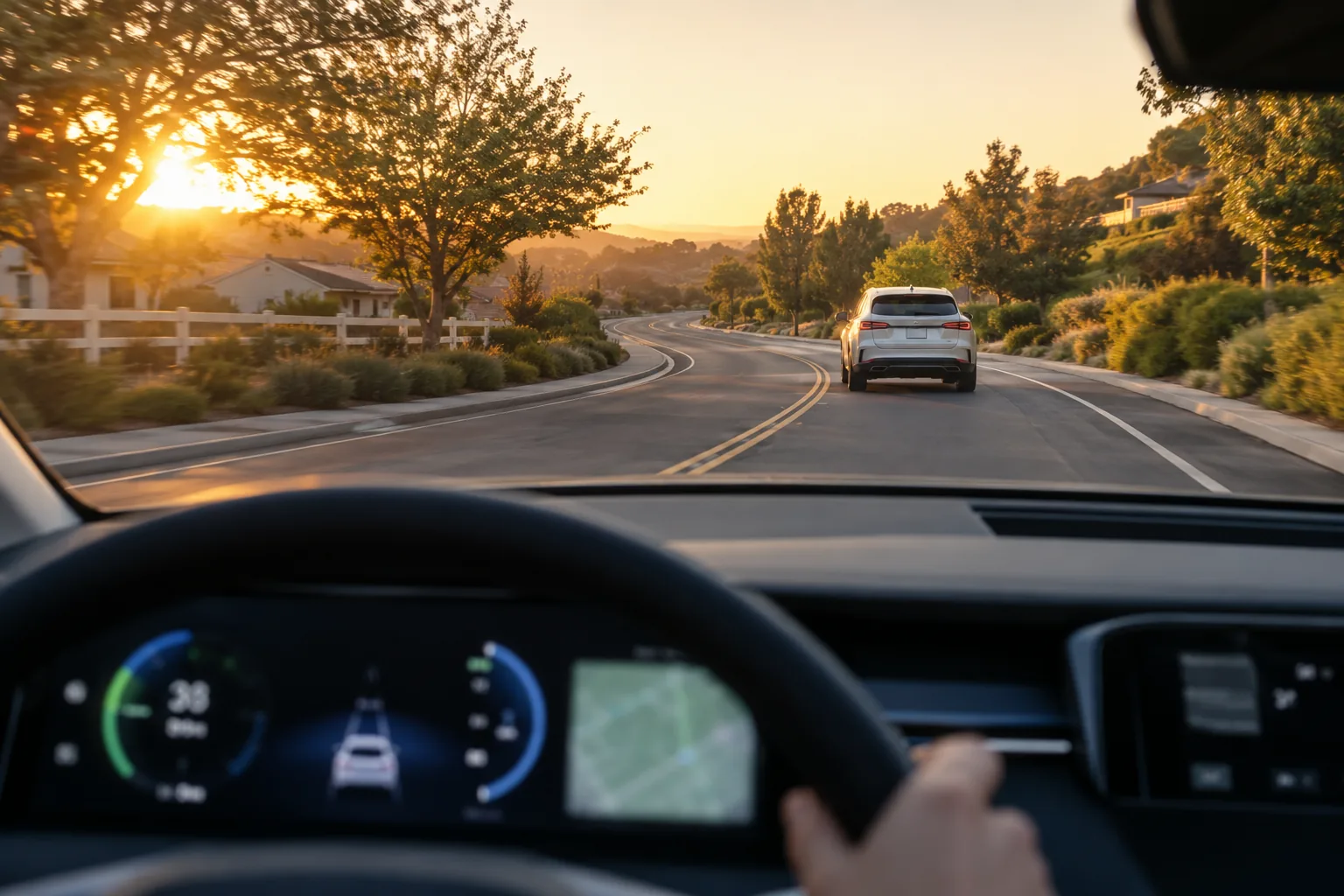
A trip or energy screen can show recent Wh/mile or kWh/100 miles. Average several weeks with ordinary routes rather than relying on a single short trip. Resetting a trip meter at the beginning of a month helps reveal the household’s pattern. If the screen reports total energy rather than efficiency, divide that kWh by the miles covered.
Charger and utility records
Charging equipment may report delivered kWh, while a utility meter records grid energy for the house. Those can help estimate electricity supplied to the car, but whole-house consumption includes everything else. A dedicated submeter or EVSE energy log can give a clearer view than subtracting two household bills affected by weather and other appliances.
Why your kWh per mile changes
- Speed and aerodynamics: sustained high-speed driving usually uses more energy per mile than moderate-speed travel.
- Temperature and cabin climate: heating, cooling and battery conditioning can change energy use, especially on short trips.
- Terrain, wind and load: hills, headwinds, roof cargo, towing and a heavy load can increase consumption.
- Tires and road conditions: pressure, tire choice, wet or snowy roads and stop-start patterns affect the figure.
- Regenerative braking: it can recover some energy, but it cannot erase the energy needed to move the car.
The rated range is a test-based comparison point. For a real trip, use the vehicle’s recent efficiency and route planner, with a margin for conditions. Our EV battery guide explains usable capacity and battery basics. A future range-factors guide will cover the difference between rated and real-world range in more detail.
Battery capacity is not monthly consumption
A 75 kWh usable battery is a storage amount, not a claim that the car uses 75 kWh every day. A driver who uses 15 kWh on a commute only replaces the energy used, subject to losses. Likewise, a smaller battery can use more electricity over a month if the car is driven farther or is less efficient. Do not multiply the battery capacity by 30 days to estimate a bill.
For electricity cost, apply your actual tariff to grid kWh. Our electric car charging cost guide does the dollar calculations and compares home with public rates; this page stays focused on energy use.
A simple tracking routine
- Record monthly miles from the odometer or trip screen.
- Write down the car’s observed kWh/100 miles or Wh/mile over the same period.
- Multiply to estimate driving kWh, then compare with charger-recorded kWh.
- Separate home and public charging if you want an accurate home-electricity estimate.
- Repeat across seasons and use a range instead of one permanent number.
If your car shows 28 kWh/100 miles during mild weather and 36 kWh/100 miles in a colder month, both readings can be valid. At 1,000 miles, those translate to 280 and 360 kWh of driving energy before charging losses. This is why a real household log beats a one-size-fits-all answer.
Sources
- U.S. DOE AFDC: Home charging and vehicle efficiency
- U.S. DOE: EV model efficiency variation
- U.S. DOE AFDC: EV energy use and benefits
Frequently asked questions
How many kWh does an electric car use per mile?
Divide its kWh/100 miles figure by 100, or its Wh/mile figure by 1,000. For example, 30 kWh/100 miles equals 0.30 kWh per mile. Actual use changes with car and conditions.
How much electricity does an EV use per month?
Multiply monthly miles by the vehicle’s observed kWh per mile, then account separately for charging losses and parked energy. A 1,000-mile month at 0.30 kWh/mile uses about 300 kWh for driving.
Is the energy shown by the car the same as the electricity billed at home?
Often not exactly. Charging and conditioning can use additional grid electricity. A charger energy log or dedicated meter helps measure what was drawn from the wall.