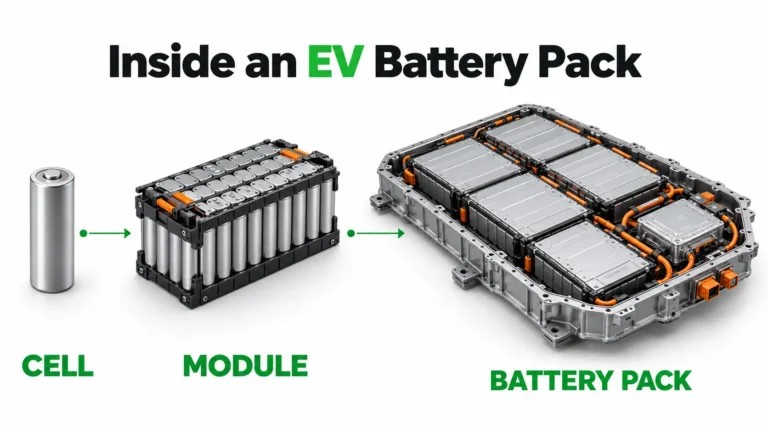
Lithium Battery for Electric Car: LFP, NMC and NCA
The term lithium battery for electric car usually refers to a rechargeable lithium-ion traction pack-the large battery that powers the motor. LFP, NMC and NCA are different lithium-ion chemistries, not interchangeable replacement options. For a buyer, the useful comparison is the whole vehicle: usable range, charging behavior, battery condition and manufacturer guidance.
The U.S. Department of Energy’s Alternative Fuels Data Center says most battery-electric cars and plug-in hybrids use lithium-ion batteries. This guide focuses on chemistry choices; our EV battery overview covers pack construction and general ownership basics.
Choosing a lithium battery for electric car ownership
You normally choose a car with a factory-engineered battery, rather than selecting a loose battery from a catalog. Start with the trips you need to make, then compare the exact model year, trim and pack. A chemistry label is useful context, but it cannot tell you whether a particular car fits your routine.
Keep the traction pack separate from the smaller low-voltage battery that supports vehicle electronics. A listing for a 12-volt lithium battery is not an EV driving-battery replacement, even if its description includes “automotive.” Ask a qualified service provider to identify the correct part before discussing replacement.
What makes a battery lithium-ion?
Inside a rechargeable cell, lithium ions move between two electrodes-the materials that store and release charge-while electrons travel through the outside circuit to do useful work. Charging reverses the process. The DOE’s explanation of battery science describes why changing the electrode materials changes battery behavior.
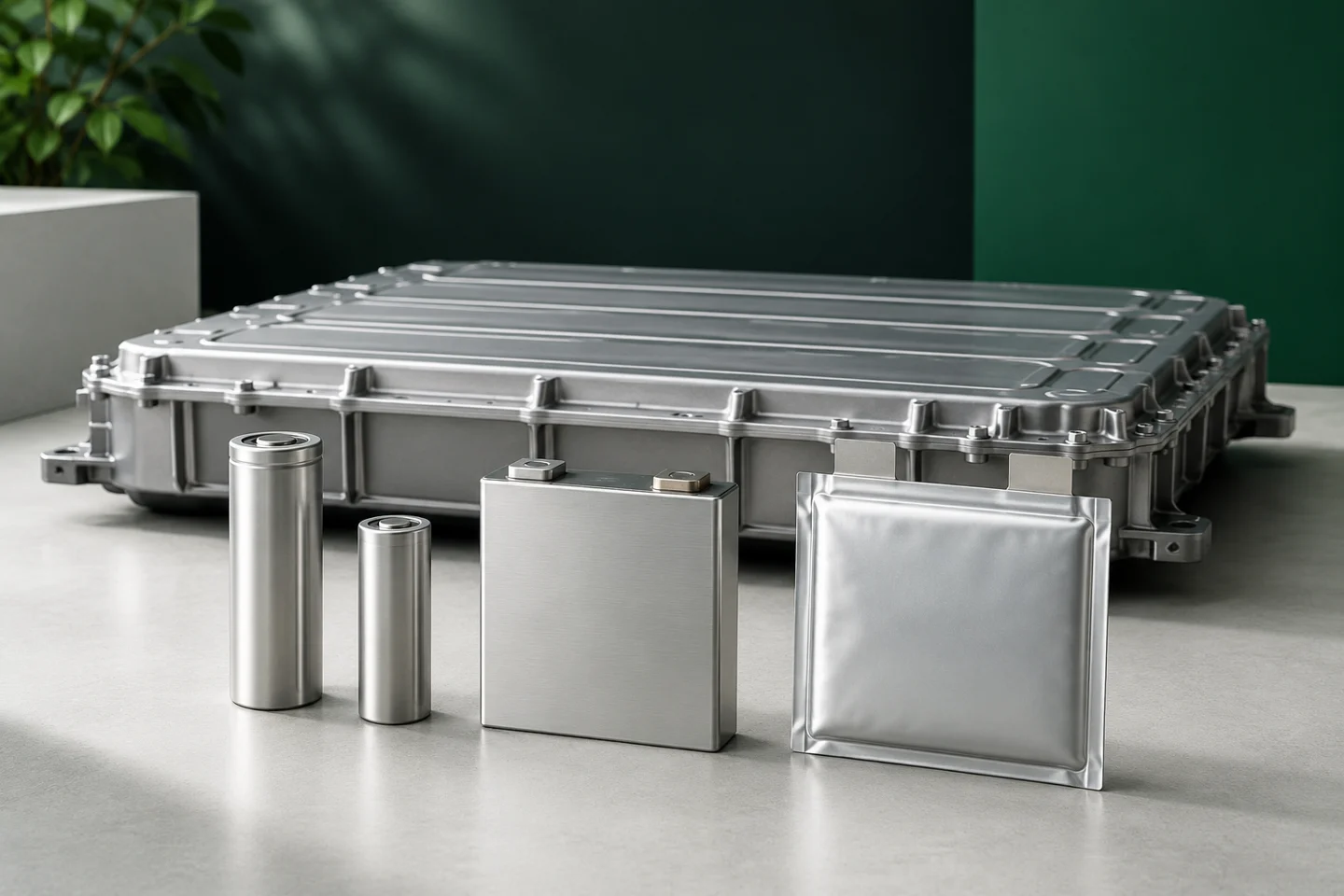
LFP, NMC and NCA refer to different positive-electrode, or cathode, materials. Think of lithium-ion as a family name and these labels as different recipes within that family. They do not identify cell shape: a cylinder, rectangular metal case or pouch is a packaging format, not proof of chemistry.
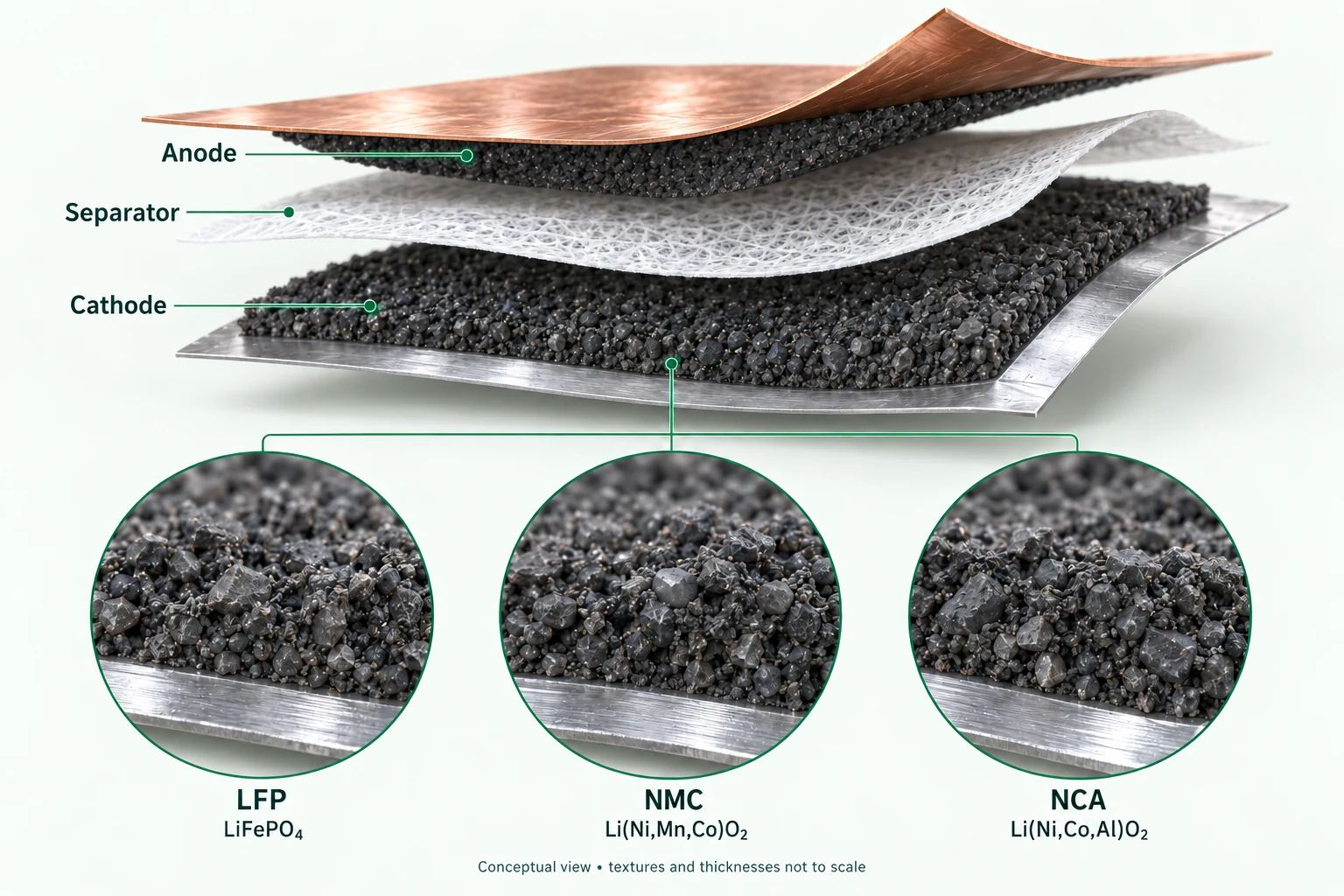
LFP vs. NMC vs. NCA: the practical differences
| Chemistry | What the name describes | Useful buyer takeaway |
|---|---|---|
| LFP | Lithium iron phosphate; no nickel or cobalt in the cathode | Often selected for cost-focused designs; compare actual range and charging guidance. |
| NMC / NCM | Lithium nickel manganese cobalt oxide; letters may appear in a different order | Typically offers higher energy density than LFP; exact formulations vary. |
| NCA | Lithium nickel cobalt aluminum oxide | A nickel-based chemistry; confirm vehicle-specific performance rather than assuming it matches NMC. |
The IEA’s chemistry analysis explains the material differences and LFP’s generally lower energy density relative to NMC. These are engineering tendencies, not a ranking of finished cars. That historical report is used here for chemistry fundamentals, not current market shares or prices.
Higher energy density means storing more energy for a given mass or volume. It does not automatically mean more range: a vehicle can use a different pack size, and its weight, aerodynamics and efficiency still matter. Comparing cell-level density with a complete pack’s density also gives a misleading result.
For durability, avoid treating an advertised laboratory cycle count as a vehicle-life guarantee. A cycle-test result needs its test temperature, charging limits and end-of-life definition to mean much. For a used car, documented condition and remaining warranty are more useful than a chemistry-based promise of a certain number of years.
Cell shape: cylindrical, prismatic or pouch
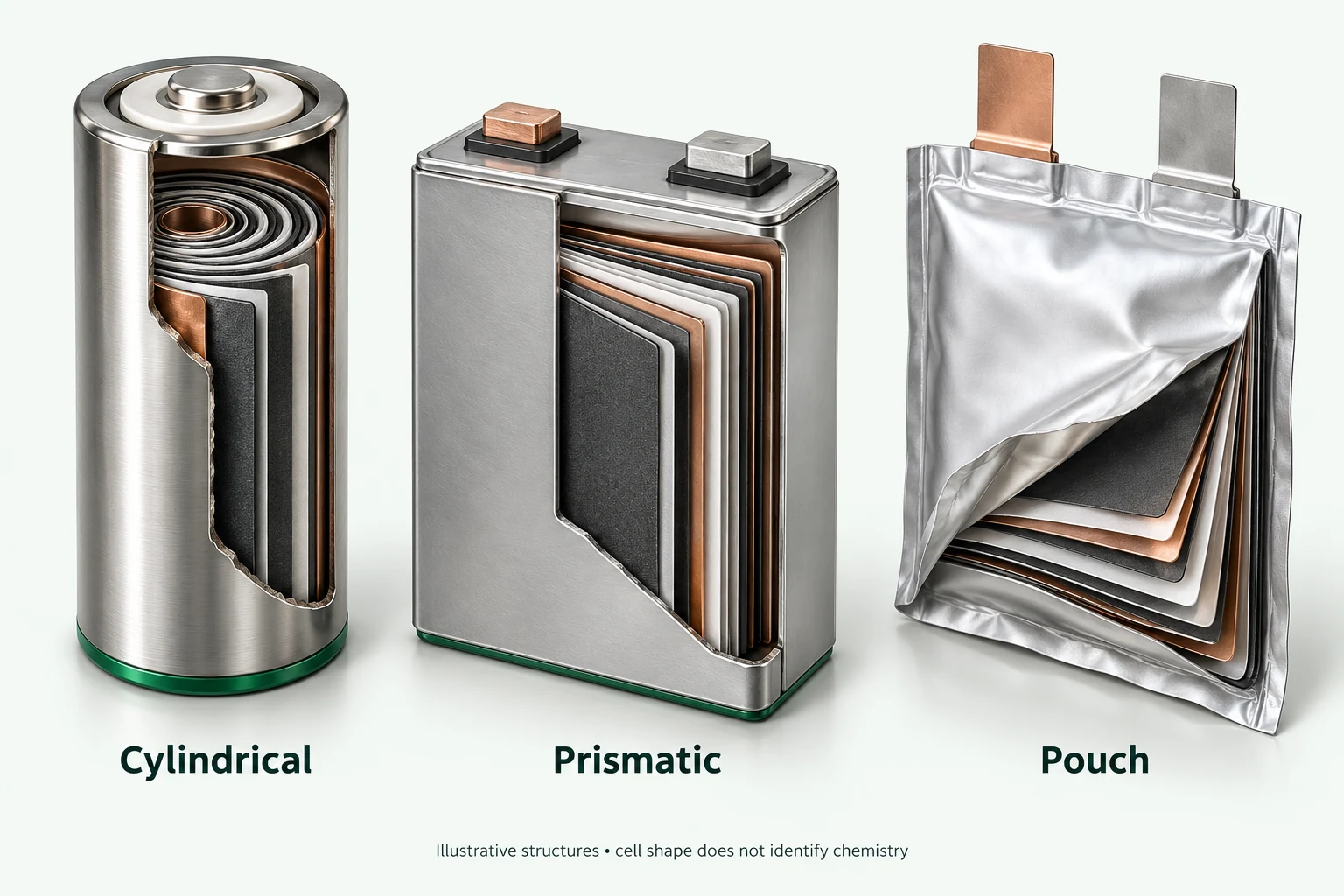
A cylindrical cell wraps thin electrodes and separators into a roll. A prismatic cell uses a rigid rectangular case, while a pouch cell uses flexible laminated packaging; their electrodes can be stacked or wound depending on the design. The cutaways below show example structures, not a universal layout or a way to tell LFP, NMC and NCA apart.
Separate capacity, energy density and charging speed
Battery capacity in kilowatt-hours (kWh) tells you how much energy is available. Energy density in watt-hours per kilogram (Wh/kg) relates energy to weight, while charging power in kilowatts (kW) describes the rate at which energy moves. A large number in one column cannot substitute for the others.
For example, a battery can have a generous usable capacity but a charging curve that makes your highway stops longer than expected. Compare model-specific charging information over a useful battery-percentage window, not only the peak kW headline. Our charging levels guide explains the difference between home AC and public DC charging.
A worked example: compare your usable driving window
Illustrative scenario, not measured vehicle data: suppose two hypothetical EVs each consume 0.30 kWh per mile in the same conditions. Car A has 60 kWh of usable capacity and Car B has 75 kWh. Assume, only for this calculation, that you plan to leave at 80% and arrive at 20%.
| Calculation | Car A | Car B |
|---|---|---|
| Usable capacity at a full charge | 60 kWh | 75 kWh |
| Planned battery window | 60 percentage points | 60 percentage points |
| Energy within that window | 60 × 0.60 = 36 kWh | 75 × 0.60 = 45 kWh |
| Distance at assumed 0.30 kWh/mile | 36 ÷ 0.30 = 120 miles | 45 ÷ 0.30 = 150 miles |
If your planned leg is 135 miles, Car A would need a wider departure-to-arrival window, a charging stop or another vehicle choice under these assumptions. Car B clears the arithmetic with 15 miles left over, which is not a guarantee of an adequate real-world reserve. Repeat the calculation with conservative conditions relevant to your route.
Neither calculation identifies which chemistry is better. It shows why pack capacity and the window you actually use matter more than a label. The 80% departure is an example, not a universal charging instruction; weather, speed and terrain can change consumption, as our EV range factors guide explains.
Should you charge an LFP battery to 100%?
Use the instructions for your exact vehicle and battery. Some LFP-equipped cars have periodic full-charge guidance, while a different pack in the same model family can have a lower everyday target. Instructions for daily charging, a road trip and long-term storage can also differ.
For example, the Ford U.S. owner-manual section on preserving the high-voltage battery gives separate instructions for its covered standard-range LFP and extended-range NCM configurations. It specifies a 100% limit and at least one full charge per month for the LFP configuration to maintain range accuracy, versus 90% for everyday NCM use.
That is an example of why identification matters, not advice for every Ford or every LFP battery. Retrieve the manual matched to your model year and VIN, then check current in-car guidance. Do not copy another model’s VIN-decoding rule or assume a range estimate proves the chemistry.
A five-step checklist for comparing actual cars
- Confirm the battery variant. Ask for manufacturer documentation matched to the VIN, model year and market. If the pack has been replaced, request the replacement records too.
- Compare usable range. Check the exact trim’s EPA rating and consider your highway use, winter conditions and arrival reserve. Do not compare a total capacity figure with another car’s usable figure.
- Check your charging routine. Can you replenish your daily energy at home, and are suitable chargers available on longer trips? Confirm compatibility and model-specific charging limits.
- Ask for condition evidence. For a used car, request a manufacturer-supported or qualified battery-health assessment and service history. A dashboard mileage estimate alone is insufficient.
- Read the warranty. Verify the in-service date, mileage limit, any capacity-retention threshold, transfer terms and exclusions in the applicable warranty document.
For a shortlist of actual vehicles, use our used-EV buying guide. Battery chemistry should help you ask better questions, while charging access, condition and total ownership cost determine whether a particular deal works for you.
Can you replace one chemistry with another?
Do not assume a pack advertised with the same kWh rating will fit or work. A replacement must be compatible with the vehicle’s electrical controls, physical installation and manufacturer-approved service requirements. Ask a qualified EV repair provider for a diagnosis and a VIN-specific repair or replacement proposal.
The AFDC maintenance and safety guidance describes high-voltage precautions and the importance of qualified personnel. Do not open, probe or modify the traction pack yourself. A chemistry explainer cannot establish that a damaged battery is safe to use or charge.
Choose the car that fits your driving
The right lithium battery for electric car ownership is the factory-supported pack in a vehicle that meets your needs. Use chemistry to understand the trade-offs, then verify range, charging guidance, condition and warranty on the actual car. A documented fit for your routine is more useful than declaring one chemistry the winner.
Research method and limitations
This is a source-based explainer, prepared with AI assistance and checked against the linked primary sources; it is not a hands-on battery test or a qualified engineering review. The featured image and cutaway illustrations are AI-generated conceptual views of generic hardware, not manufacturer photographs or microscopy. The cutaways simplify construction, use illustrative textures and are not to scale. The calculation uses stated hypothetical inputs. It does not forecast a specific car’s range, battery life, repair cost or charging performance.
By Sam Wilson, EV Palace’s editorial Team for practical, source-based EV guides.
Sources
- DOE Alternative Fuels Data Center: Batteries for Electric Vehicles – battery types and applications.
- DOE Office of Science: First-Person Science, Esther Takeuchi on Batteries – ions, electrons and electrode materials.
- IEA: Global EV Outlook 2023, Trends in Batteries – chemistry definitions and material trade-offs; historical report.
- Ford U.S. owner manual: Preserving Your High Voltage Battery – configuration-specific charging example.
- DOE Alternative Fuels Data Center: Maintenance and Safety of Electric Vehicles – servicing and high-voltage safety.
Frequently asked questions
Is LFP a lithium-ion battery?
Yes. Lithium iron phosphate is one lithium-ion chemistry. Comparing “LFP versus lithium-ion” mixes a specific recipe with the larger family it belongs to.
Which is better for an electric car: LFP or NMC?
Neither is universally better. Compare the actual vehicle’s usable range, charging instructions, battery condition, warranty and price. Material-level trade-offs do not determine the best finished car for every driver.
Are NMC and NCM different battery types?
The abbreviations commonly describe the same nickel-manganese-cobalt cathode family, with the letters in a different order. They do not guarantee an identical formulation or pack specification.
Does lithium-ion mean the battery will charge quickly?
No. Check the specific vehicle’s charging capability and behavior. The chemistry family name alone does not establish a peak rate or a charging time.
Can I buy a generic lithium battery to replace my EV pack?
Do not assume a generic battery is compatible. Get a qualified diagnosis and a vehicle-specific proposal covering the supported pack, installation and service requirements.