How to Winterize an Electric Car: Cold-Weather Checklist
To winterize an electric car, check tires and visibility equipment, follow the manufacturer’s winter charging advice, precondition before departure when supported and plan extra range for cold conditions. Keep charging equipment accessible and carry winter supplies. Use your vehicle’s manual for charge limits, snow equipment and frozen-port procedures.
An EV does not need engine warm-up, but winter still changes the journey. A cold battery, cabin heating and difficult roads can affect energy use and charging. Preparing before the first freeze helps you separate ordinary seasonal behavior from a problem that needs service.
Start with the manual and a vehicle check
Find the winter, tires, charging and storage sections for your exact model and year. Confirm how to schedule cabin preheating, whether battery preconditioning is available, and what the car recommends for daily charge limits. Menu paths and features differ, even between vehicles from the same brand.
Check outstanding warning messages before severe weather arrives. Arrange service for problems with tires, brakes, climate control or charging. An EV still has wear items and low-voltage electrical equipment; the absence of an engine does not remove the need for inspection.
| Before winter | Before each difficult-weather trip |
|---|---|
| Inspect tires, wipers and washer-fluid suitability | Check charge level and weather |
| Learn preconditioning and defrost controls | Clear glass, lights, roof and sensors |
| Review charging-cable storage | Confirm charger access and backup |
| Prepare emergency supplies | Allow travel and charging time |
Check tires for grip and correct pressure
Choose tires appropriate for your climate and follow the vehicle’s approved sizing and load requirements. Where sustained snow and ice are normal, discuss suitable winter tires with a qualified tire specialist. All-wheel drive can help a car move, but it does not eliminate the need for appropriate grip when braking or turning.
Check cold tire pressure against the vehicle placard rather than the maximum on the tire sidewall. Temperature changes can alter pressure, so a reading from a warm afternoon may not reflect an early-morning freeze. Inspect tread and damage as well. For chains or other traction devices, follow the manual’s exact restrictions.
Prepare windows, wipers and washer fluid
Replace worn wipers and choose washer fluid rated for the conditions you expect. Clear snow from the roof, lights and camera or sensor areas as well as the windows. A warm cabin does not prove every exterior surface is safe and visible.
Do not force frozen handles, windows or charging hardware. Use the manufacturer’s approved defrost method and give it time to work. Procedures described for one Tesla model, for example, should not be assumed to apply to a different EV.
Preheat before departure when your car supports it
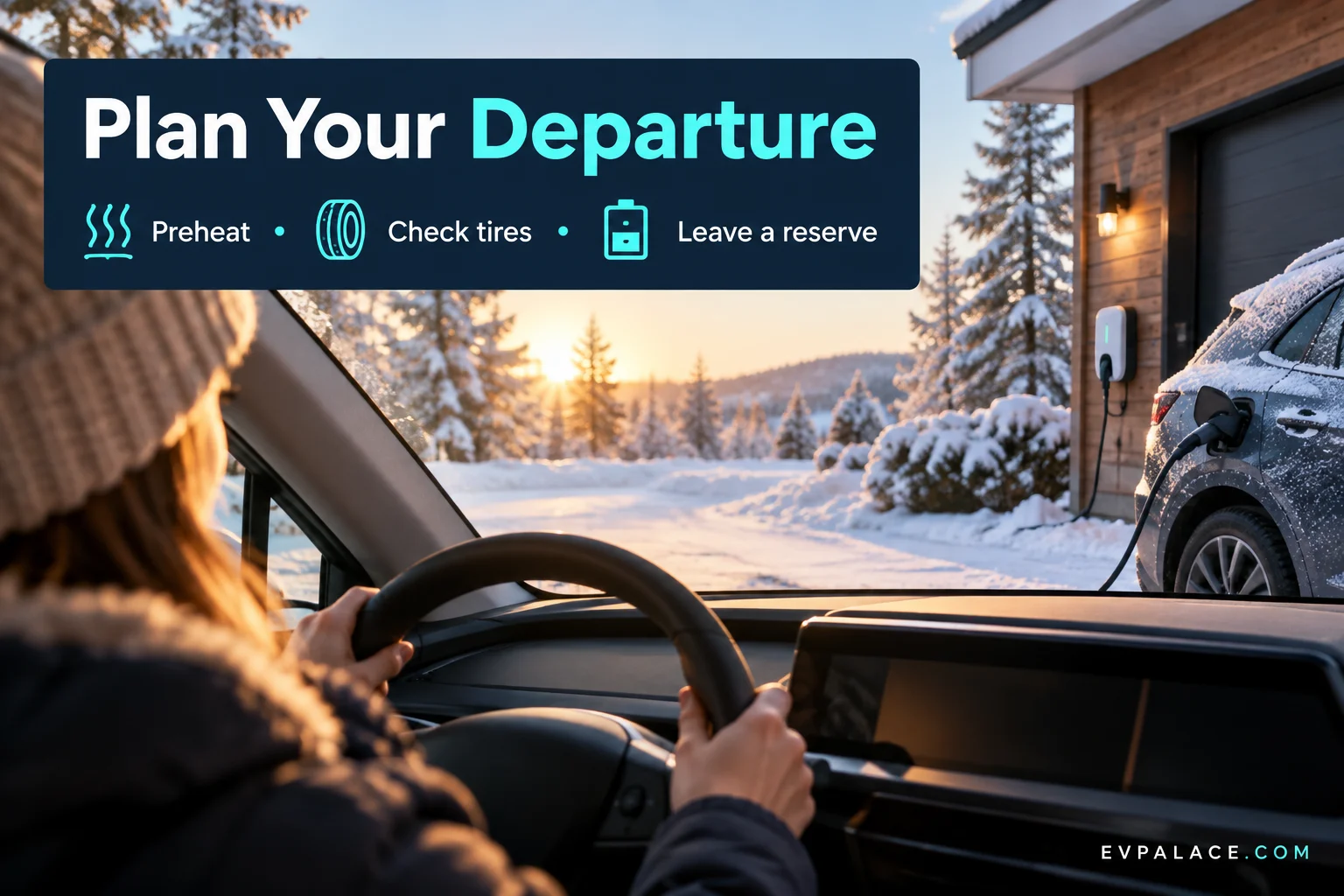
FuelEconomy.gov recommends preheating a plug-in vehicle’s cabin while connected to help preserve driving range. Some vehicles can also prepare the battery through a departure schedule. Set the schedule using your actual departure time and confirm the feature is enabled.
This is preparation, not free energy. The electricity still comes from somewhere, and a low-power connection may not cover every heating demand. Check the vehicle’s displayed charge level before leaving. Avoid assuming that every cabin heating button also preconditions the battery for fast charging.
Adjust your charging routine for winter
Keep enough energy for the planned trip, a reasonable reserve and possible delays. Use the manufacturer’s charge-limit guidance rather than a blanket instruction to charge every EV to 100%. If you need a higher departure charge for a long journey, use the scheduling and recommendations supplied for that vehicle.
On a road trip, select a fast charger through the vehicle navigation when that is the supported way to trigger battery preparation. Tesla’s documentation gives model-specific examples of this behavior. Other cars may require a separate setting or may not provide that feature. Read your own manual rather than copying another car’s timing.
Expect a cold fast-charging session to differ from a warm one. Allow schedule flexibility and check a backup station. Our DC fast charging guide explains why headline station power is not a guaranteed charging speed.
Keep the home charger and cable usable
Store the connector as the manufacturer directs, keep the cable clear of driving paths and make sure snow removal does not damage the equipment. Check for visible damage before using it. Do not improvise heating methods on a frozen connector or use force to release a locked handle.
If a connector will not unlock, stop the session as directed and follow the vehicle and equipment instructions. Contact support when the approved process does not work. For siting and weather suitability, see our outdoor charger planning guide.
Plan the journey with a winter margin
Treat the displayed range as an estimate. High-speed driving, hills, precipitation and heating can change it. Review the arrival battery estimate during the journey and adjust before the reserve becomes uncomfortable. A charger reachable in mild weather may need a different stop plan during a storm.
Avoid applying one winter range-loss percentage to every EV. Published tests describe particular vehicles and conditions, while your route and heating needs can be different. Use your own recent winter consumption, together with the car’s route prediction, to set realistic stops.
For illustration, a 100-mile drive using 0.35 kWh per mile needs about 35 kWh for that assumed driving consumption. If your car is consuming more, the plan needs more energy. This is planning arithmetic, not a prediction for any particular model. See EV range factors for the broader explanation.
Carry supplies and prioritize visibility
- Warm clothing, blankets and footwear suitable for being outside the car.
- A scraper, snow brush and practical winter emergency supplies.
- A charged phone and the operator support details for planned charging stops.
- Any traction equipment approved for the vehicle and conditions.
Use heated seats or steering-wheel heating efficiently where equipped, but keep enough cabin heat and defrost for safe visibility. Never trade a clear windshield for a small energy saving. Adapt speed and following distance to road conditions, and recognize that regenerative braking behavior may change with battery temperature.
Winter readiness is a repeatable routine: appropriate tires, working visibility equipment, a prepared departure and a route with alternatives. Check those basics before trying to diagnose normal seasonal energy changes as a battery failure.
Prepare both the vehicle and your charging routine before winter trips. Review battery health and care. Use home charging routines and public charging planning to check the related decisions before choosing equipment or a charging routine.
Sources
- DOE/EPA cold-weather guidance
- DOE/EPA EV operating tips
- Tesla Model S cold-weather practices: model-specific example
Frequently asked questions
Do electric cars work in cold weather?
Yes, but cold can affect energy use, available range and charging. Follow the vehicle’s winter guidance and plan a reserve.
Should I charge to 100% every winter night?
There is no universal rule. Use your model’s battery guidance and the energy needed for the next journey.
Does preheating the cabin warm the battery?
It can on some models, but controls and behavior differ. Check the manual for battery preconditioning.
Do EVs need winter tires?
The need depends on climate and road conditions. Choose vehicle-approved tires suitable for local winter conditions.