
EV Batteries Explained: Packs, Capacity and Ownership Basics
Quick answer: An EV battery is a rechargeable traction battery pack that stores electricity for the motor. Its capacity is measured in kilowatt-hours (kWh); more usable energy can help range, but the car’s efficiency and driving conditions matter too. Most current battery-electric cars use lithium-ion cells. The pack also has monitoring and temperature-control systems. It gradually loses some capacity with age, so check the specific car’s warranty and condition.
A battery is often the most discussed part of an electric car, but the numbers on a spec sheet can be easy to misread. This guide explains what is inside the pack, what capacity means in everyday driving, how charging and aging work, and what an owner should check. Detailed battery replacement prices belong in our separate cost guide.
What is an EV battery pack?
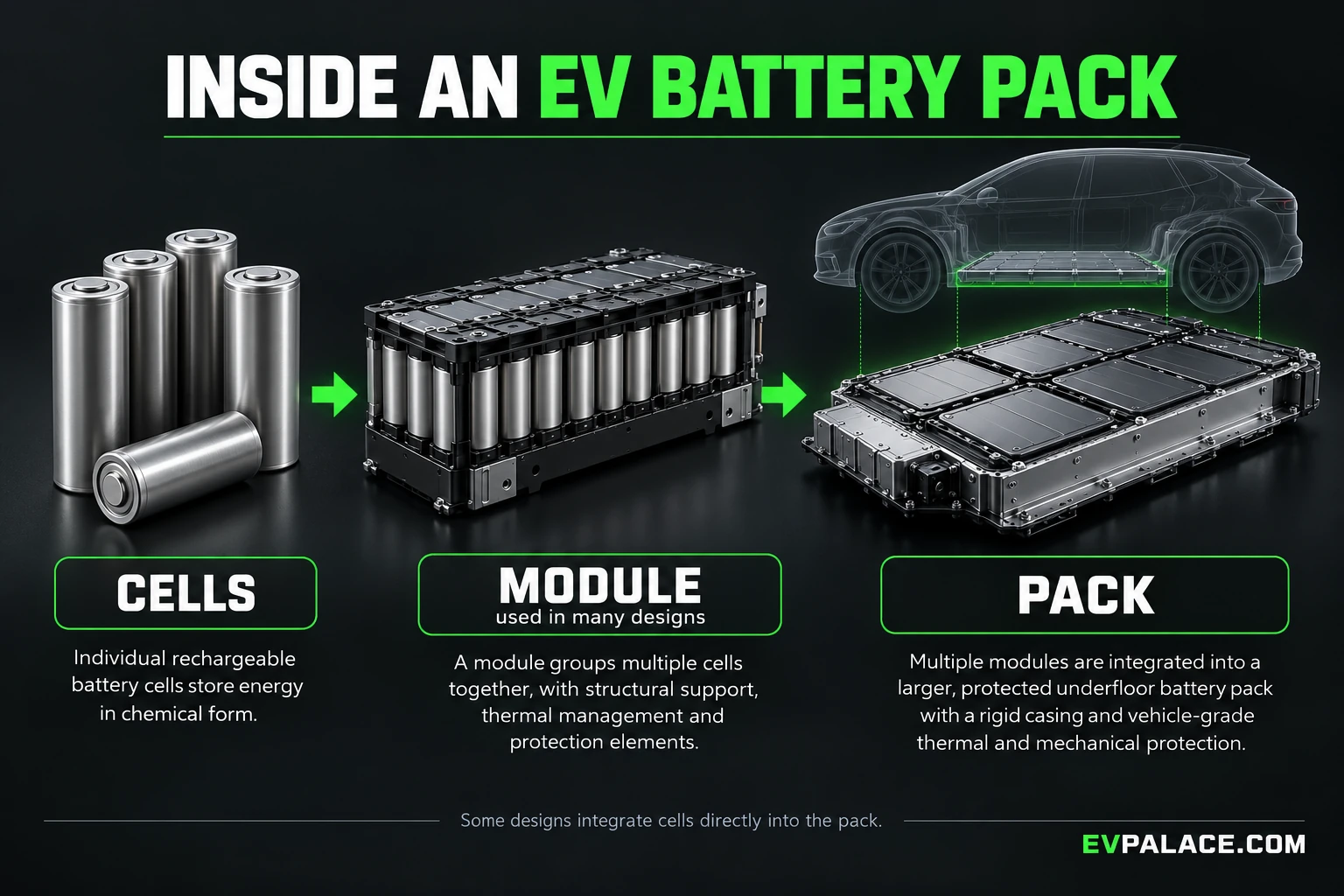
A battery-electric vehicle (BEV) carries a large, high-voltage battery for propulsion. Its cells store energy chemically and release it as electrical energy when the car drives. The pack has structural protection, electrical connections, control electronics and a thermal system as required by the design. A battery-management system monitors conditions such as voltage and temperature and helps keep operation within the manufacturer’s limits.
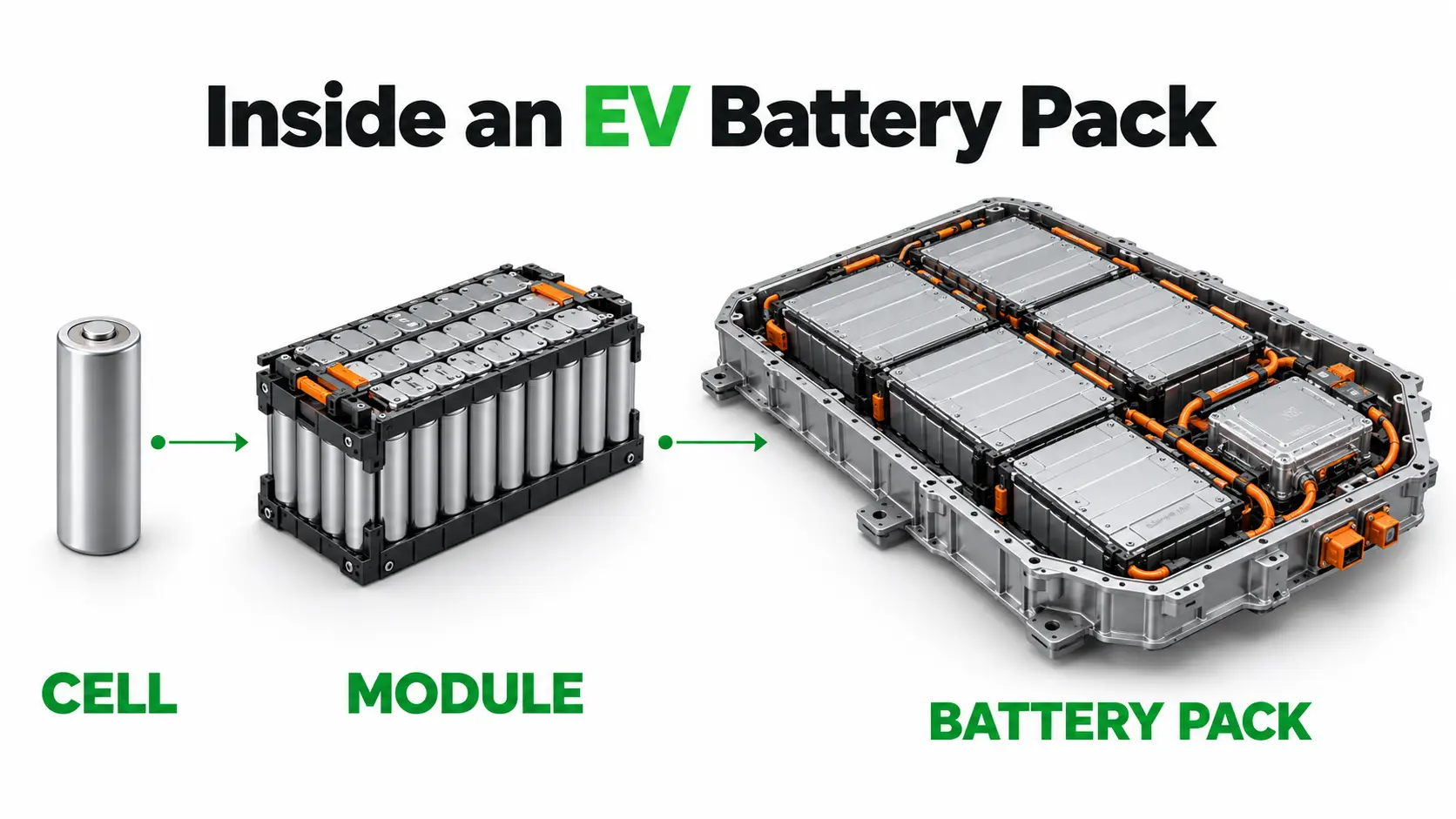
Many packs arrange cells into modules and modules into a larger assembly. Some designs instead integrate cells more directly into the pack. The pictured hierarchy is conceptual, not a service diagram for every model. The U.S. Department of Energy’s Alternative Fuels Data Center (AFDC) describes the battery technologies used in electric-drive vehicles.
The traction pack is different from the smaller low-voltage auxiliary battery. The latter supports accessories and vehicle electronics. A DC/DC converter connects the high-voltage system to the lower-voltage system. Our electric-car power-flow guide follows energy from battery to wheels.
What does battery capacity in kWh tell you?
Kilowatt-hours measure energy. A 60 kWh battery description is about an amount of stored energy, while kilowatts (kW) measure the rate of power delivery or charging. Think of kWh as the quantity available and kW as how quickly energy can move. Battery size does not directly tell you charging speed or miles of range.
Manufacturers may describe gross capacity, the pack’s total nominal capacity, and usable capacity, the portion the vehicle makes available to the driver. The vehicle can reserve some capacity for pack management. Check which number a review or listing quotes. Comparing a gross figure on one car with a usable figure on another can mislead.
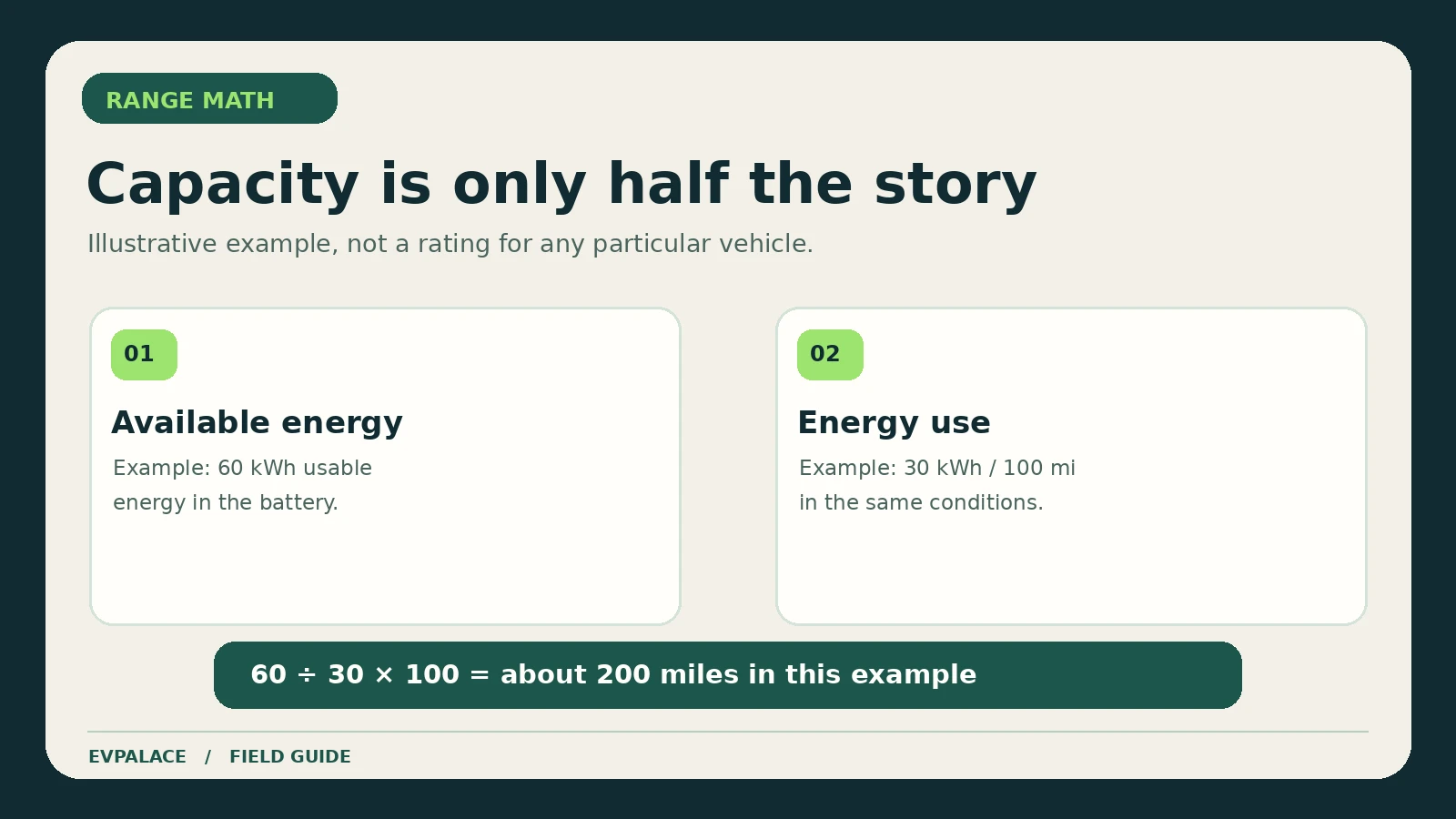
To estimate an illustrative range, divide usable energy by energy consumption. If a car had 60 kWh usable and used 30 kWh per 100 miles in a given set of conditions, the arithmetic would suggest roughly 200 miles in those same conditions. That is not an EPA rating or a promise that the car will travel exactly 200 miles. Speed, weather, terrain, tires, heating and battery condition can change consumption.
A larger pack can add range, but it may also add mass and cost. A more efficient vehicle can travel farther on the same energy. When shopping, compare the exact model’s EPA range and efficiency data rather than using pack size alone. Our planned range factors guide will go deeper into real-world conditions.
What chemistry do electric car batteries use?
Most current BEVs and plug-in hybrids use some form of lithium-ion battery, according to the AFDC battery overview. “Lithium-ion” is an umbrella label, not a single identical recipe. Cell materials, architecture and management differ among vehicles, and automakers can change suppliers or chemistry by model year and trim.
You may see labels such as lithium iron phosphate (LFP) or nickel manganese cobalt (NMC). Chemistry affects engineering trade-offs, including energy density, cost and charging guidance, but a label alone cannot tell you a specific vehicle’s actual range or lifespan. Consult the automaker’s documents for the model you own. We will keep chemistry-level detail on a dedicated article rather than treating every EV battery as interchangeable.
How does charging reach the battery?
With Level 1 or Level 2 AC charging, the vehicle’s onboard charger converts incoming AC electricity into DC energy the battery can store. At a compatible DC fast charger, the station supplies DC energy through the vehicle’s charging system. The battery-management system and thermal controls influence what the pack can accept. The charging rate may slow as the battery fills or when it is cold or hot. Read our home charging guide for the daily routine and charging levels explainer for the equipment types.
Battery capacity also determines how much energy a low battery needs to receive, but dividing capacity by a charger’s maximum kW does not give a reliable full-charge time. Charging losses, power limits and the changing charge rate all matter. A useful owner question is how much energy you need to replace before your next drive.
What is battery health, and how does it change?
Battery health often refers to how much energy a pack can store now relative to its earlier capacity, sometimes expressed as state of health (SoH). Capacity generally declines gradually with use and time; the rate differs by chemistry, management, temperatures and charging patterns. Reduced capacity may shorten the distance available on a full charge, but it does not automatically mean the battery has failed.
The AFDC ownership overview notes that climate, driving and charging patterns, chemistry, design and thermal management can affect battery life. A dashboard range estimate is not a battery-health test: it also responds to recent driving and weather. For a used EV, request a model-appropriate diagnostic or battery-health report and compare it with the vehicle’s records.
A fixed rule such as “always stop at 80%” is too broad. Daily charging targets and occasional full-charge instructions can differ by battery chemistry and vehicle. Follow the owner’s manual and software guidance for your exact model. If a car has battery preconditioning or scheduled charging, learn what those features do before changing habits based on general internet advice.
Will an EV battery need replacement?
A traction battery is built for years of vehicle use, and losing a little capacity is different from a sudden failure. The EPA’s EV myths page cites a study of about 15,000 vehicles through model year 2023 in which replacements due to failure averaged 2.5% outside major recalls. That historical sample is not a forecast for every present or future model, and its age mix matters.
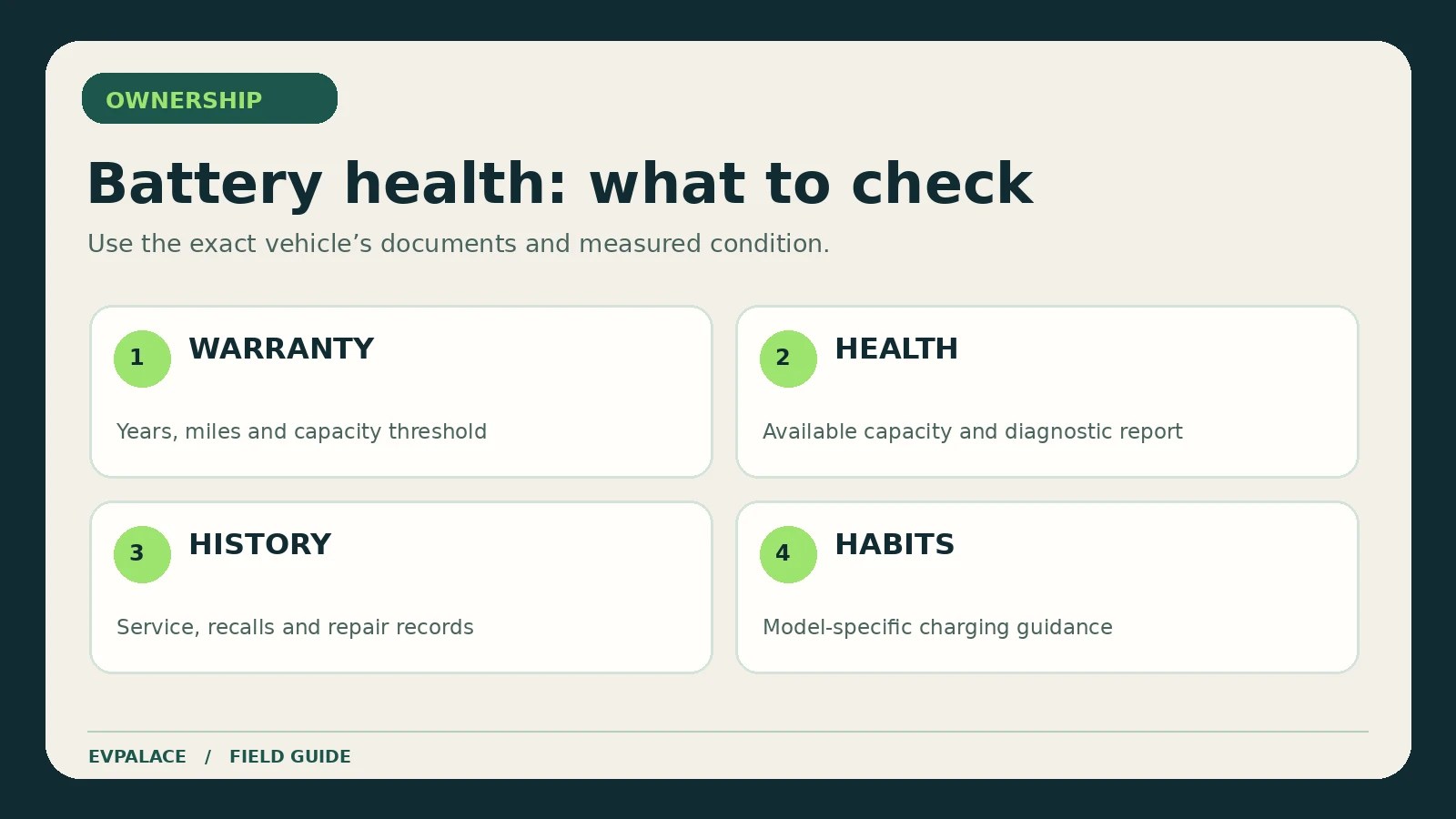
Many manufacturers offer battery warranties around eight years or 100,000 miles, but the exact duration, capacity-retention threshold, exclusions, transferability and claim process vary. Read the warranty for the specific model and market; do not assume every loss of range qualifies for replacement. A battery problem may also be repairable without replacing an entire pack. Diagnosis comes first. For an out-of-warranty replacement, obtain an itemized, model-specific quote after a qualified diagnosis.
What should you check when buying a used EV?
- Exact battery warranty: Confirm the start date, mileage, capacity threshold and whether it transfers to the next owner.
- Health evidence: Ask for any manufacturer or qualified diagnostic report. Understand what its metric means before comparing cars.
- Service and recall history: Look for battery or charging-system work and confirm any open campaigns.
- Real charging behavior: If feasible, check that the car charges successfully on a compatible AC source and ask about DC capability where relevant.
- Vehicle context: Compare model year, trim, EPA rating, tires and use history. A displayed range number alone is not proof of battery capacity.
The pack is a high-voltage component. Do not open, probe or attempt a repair yourself. Use trained service personnel and manufacturer guidance for diagnostic or safety concerns.
What happens to a battery after vehicle use?
A pack removed from a vehicle may be evaluated for repair, reuse in another application or recycling, depending on its condition and local processing options. The EPA’s lithium-ion recycling overview explains why recovering materials matters and how reuse may be possible. It is inaccurate to assume every retired pack goes directly to a landfill or that every pack can automatically serve a second life.
For an owner, the immediate practical steps are straightforward: maintain the car according to the manufacturer, understand the warranty, and use an authorized process if a pack is damaged or removed. Battery recycling and disposal should be handled by appropriate professionals.
Sources
- U.S. Department of Energy, AFDC: Batteries for Electric Vehicles
- AFDC: Electric Vehicle Benefits and Considerations
- AFDC: Maintenance and Safety of Electric Vehicles
- U.S. EPA: Electric Vehicle Myths
- U.S. EPA: Lithium-Ion Battery Recycling
Frequently asked questions
How many batteries does an electric car have?
A BEV has a large traction battery pack for driving and commonly a separate low-voltage auxiliary battery for electronics. The pack itself contains many cells; the arrangement depends on the model.
Does a bigger battery always mean more range?
No. More usable energy can help, but efficiency, vehicle design and conditions also determine distance. Compare the exact model’s EPA range and energy use.
What is the difference between kWh and kW?
kWh is an amount of energy stored or consumed. kW is a rate of power delivery. A pack’s kWh rating does not tell you its maximum charging kW.
Do EV batteries fail after eight years?
Eight years is a common warranty duration, not an expiry date. Packs can remain useful beyond warranty, while individual problems can occur earlier. Check the particular vehicle’s warranty and condition.
Should every EV be charged only to 80%?
No universal target applies to every model and chemistry. Use the vehicle manufacturer’s recommendations for daily use and longer trips.
One Comment