How Do Electric Cars Work? Motors, Batteries and Power Flow
Quick answer: A battery-electric car stores energy in a rechargeable battery pack. Power electronics control electricity from that pack and feed an electric motor, which turns the wheels through a drivetrain. Plugging in replenishes the battery; regenerative braking can return some energy while slowing down. A fully electric car has no gasoline engine or tailpipe.
From the driver’s seat, an EV seems straightforward: press the accelerator and it moves. What happens between the battery and the wheels? This guide traces that path, then tackles charging, braking, and the questions that tend to come up when you’re new to electric cars.
The short version: follow the energy
| When | Energy path | What happens |
|---|---|---|
| Charging on AC | Outlet or charging equipment → charge port → onboard charger → battery | The car converts incoming AC electricity into DC electricity the battery can store. |
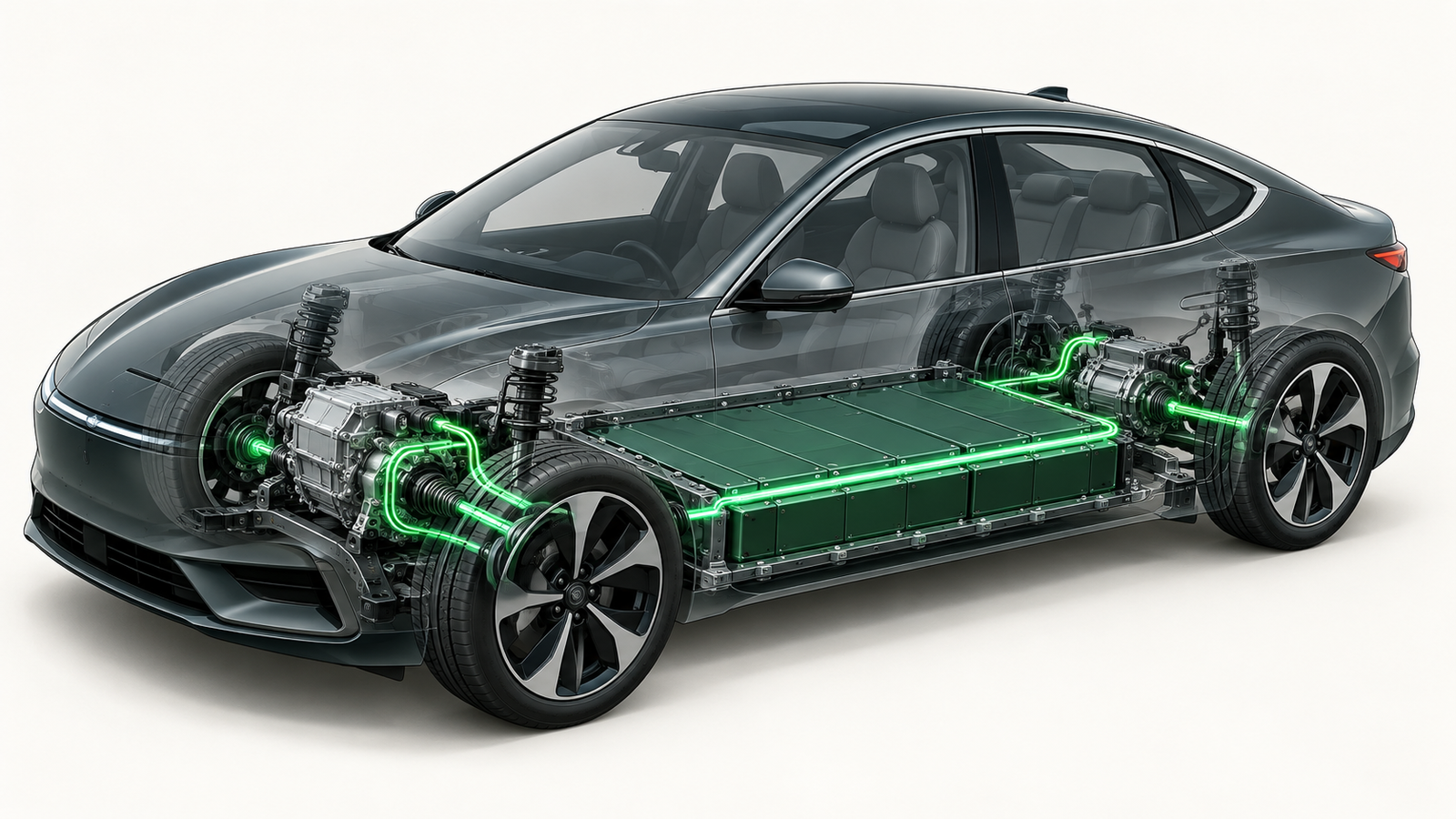
| Driving | Battery → power electronics/inverter → motor → drivetrain → wheels | The motor turns electrical energy into motion. |
| Slowing down | Wheels → motor acting as generator → battery | Regenerative braking recovers some motion energy; friction brakes remain available. |
This is a simplified view of a battery-electric vehicle (BEV), also called an all-electric car. Layouts differ among models. The U.S. Department of Energy’s Alternative Fuels Data Center (AFDC) identifies the battery, charge port, onboard charger, power electronics, electric traction motor, transmission and thermal system as core components.
What powers an electric car?
A BEV carries a large rechargeable traction battery pack. Its capacity is usually expressed in kilowatt-hours (kWh), a unit of energy. You can think of kWh as the amount stored, while kilowatts (kW) describe the rate at which energy is used or delivered. A 60 kWh pack is an energy-capacity description, not a promise of 60 miles, 60 hours or any fixed charging time. For pack capacity and battery health, see our EV battery guide.
The battery stores direct-current (DC) electricity. When you press the accelerator, a controller requests torque from the drive system. In the common AC-motor arrangement, an inverter converts battery DC into controlled AC for the motor. The motor produces rotational force, and the drivetrain delivers it to the wheels. The exact motor type, number of motors and control strategy depend on the vehicle. The Department of Energy explains the inverter and power electronics in its electric-drive overview.
Most cars also carry a smaller low-voltage auxiliary battery for accessories and control systems. A DC/DC converter steps down energy from the traction system to support that lower-voltage electrical system. The large battery that drives the car and the auxiliary battery therefore serve different jobs.
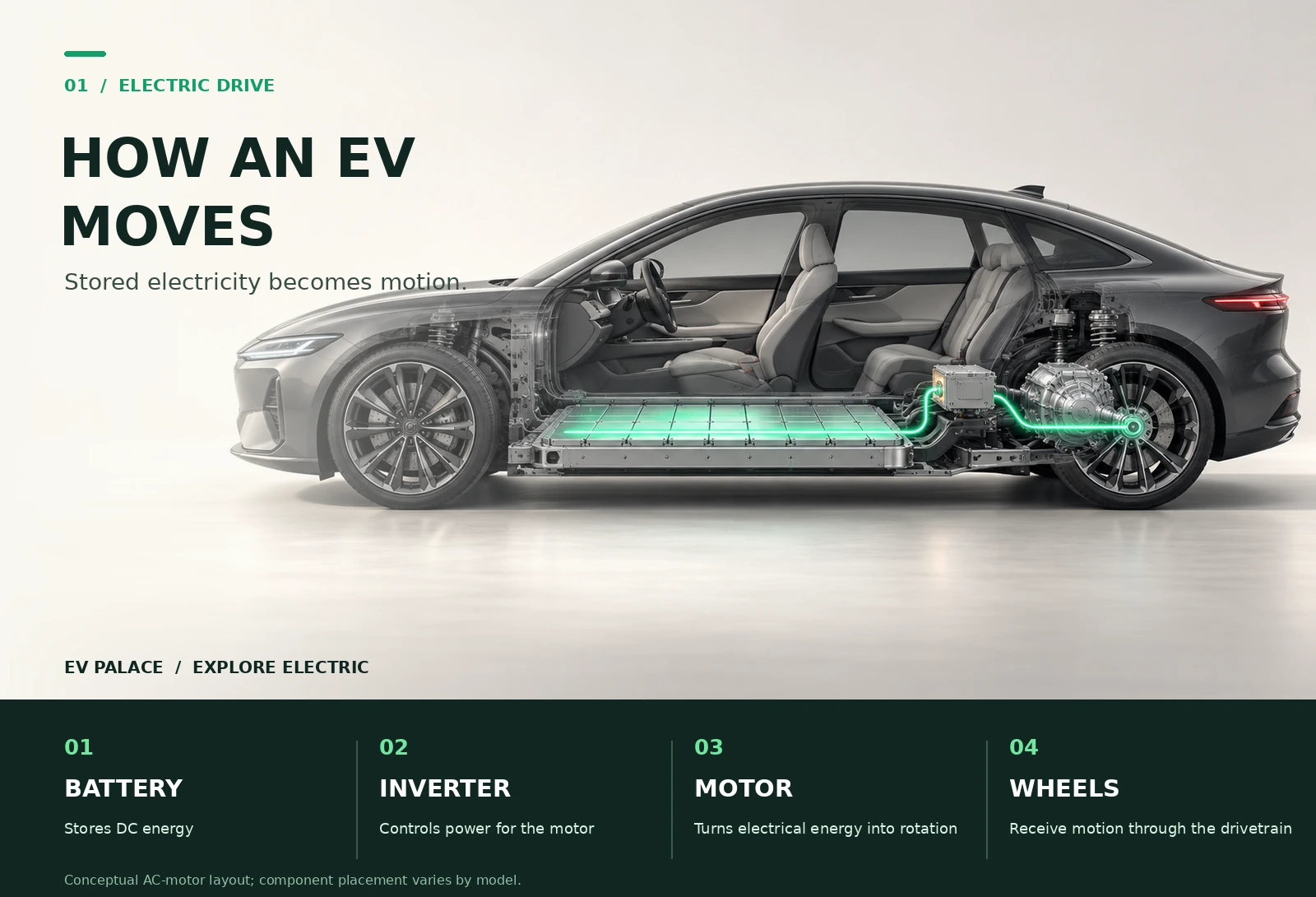
The major components, in plain English
| Component | Job | Why it matters to a driver |
|---|---|---|
| Traction battery pack | Stores energy for propulsion. | Capacity and efficiency together influence usable range. |
| Power electronics and inverter | Regulate energy flow and, in many designs, convert DC to AC for the motor. | Control acceleration and the response of the drive system. |
| Electric traction motor | Converts electrical energy into mechanical rotation. | Moves the car; some motors also recover energy during braking. |
| Reduction gear or transmission | Transfers motor rotation to the wheels. | Typically simpler than a gasoline car’s multi-speed automatic, though designs vary. |
| Onboard charger | Converts incoming AC power to DC to charge the pack. | Its rating can limit AC charging speed even when equipment can supply more. |
| DC/DC converter and auxiliary battery | Supply lower-voltage electronics and accessories. | The car still has a separate low-voltage system. |
| Thermal management | Keeps the battery and drive components within suitable temperatures. | Temperature can affect performance, charging and range. |
An electric vehicle can have more than one motor, for example to drive separate axles. Do not assume that every EV has the same physical arrangement or that the pictured layout of one model applies to another.
What happens when you press the accelerator?
In a gasoline car, burning fuel creates motion inside an engine. In an all-electric car, the drive system instead draws energy from the battery and commands the motor to turn. Electric motors can deliver strong torque over a broad operating range, which helps explain the immediate response many drivers notice. Accelerator position is a request to the control system; the vehicle decides how much power to deliver based on available traction, battery conditions and its programming.
The motor’s rotation passes through a gear reduction and differential or another drivetrain layout to the driven wheels. An EV does have a transmission in the broad sense of transferring power, but many passenger EVs do not use the familiar sequence of shifting through several forward gears. A given model can still have specialized gearing, so check its specifications rather than treating a single layout as universal.
How does charging put energy back in the battery?
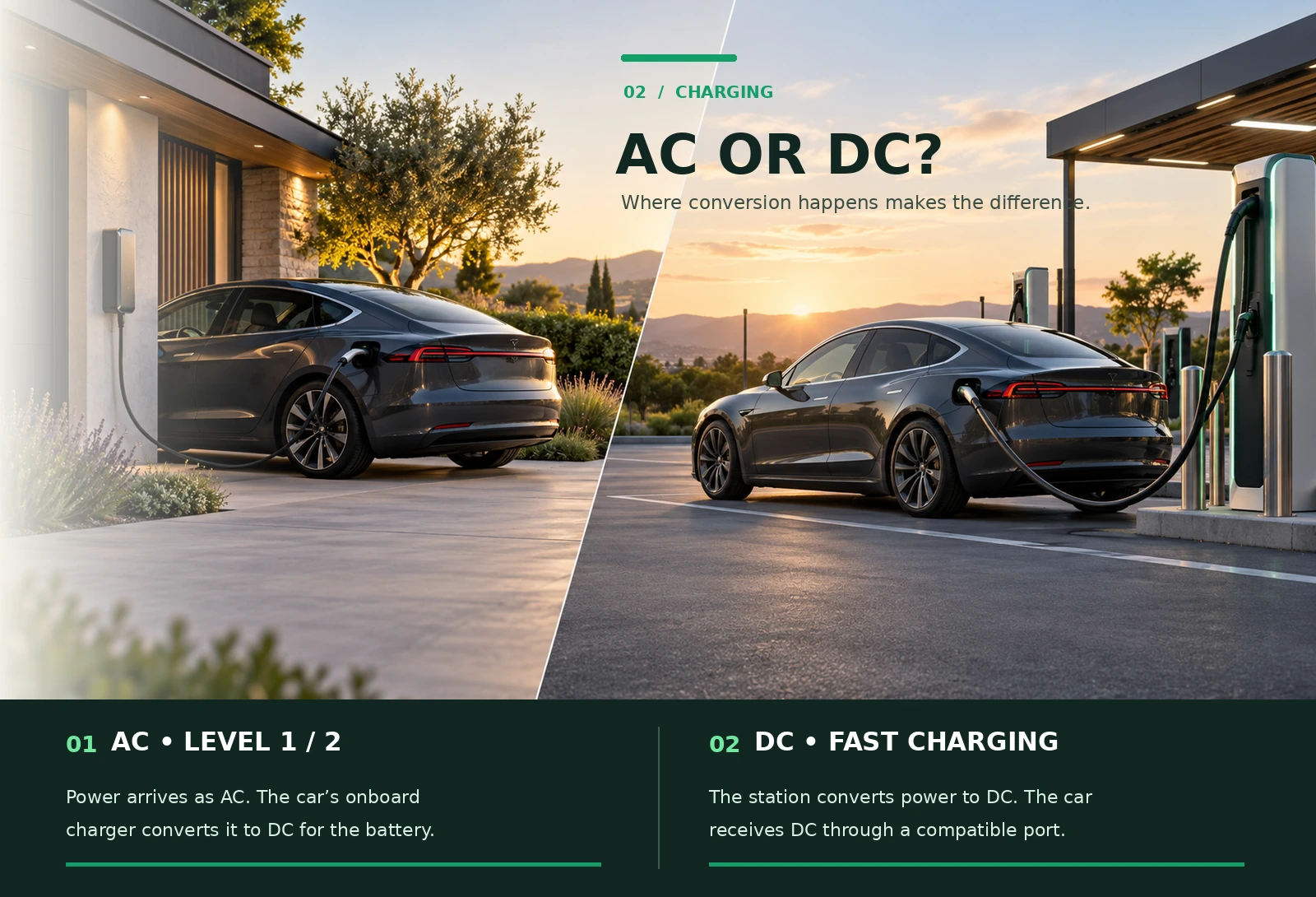
The car connects to an external power source through its charge port. With Level 1 or Level 2 AC charging, the charging equipment supplies AC power, and the vehicle’s onboard charger converts it into DC power the battery can accept. Charging equipment and the vehicle communicate to manage the session. The battery-management and thermal systems help control charging according to the vehicle’s conditions. Our home-charging guide explains how to plan a daily setup.
At a compatible DC fast charger, conversion happens mainly in equipment outside the car, and DC energy is delivered to the battery through the appropriate path. DC fast charging does not use the vehicle’s onboard AC charger in the same way. Actual charging power is limited by the car, station, battery state of charge, temperature and other conditions; the station’s advertised maximum is not a guaranteed rate for every vehicle. See the AFDC charging-station guide for these variables.
Charging is a separate topic from how the motor propels the car. Our EV Charging guides cover home setup, charging levels, compatibility and public stations in more detail. For home wiring or installation, consult a qualified electrician and the equipment manufacturer.
Does regenerative braking charge an EV while driving?
Yes, but only by recovering some of the vehicle’s existing motion energy. As you slow down, the wheels can drive the motor as a generator. The resulting electrical energy can be stored in the traction battery instead of all that motion energy becoming heat at the friction brakes. Regeneration cannot create energy from nothing, replace plugging in, or recover everything spent accelerating.
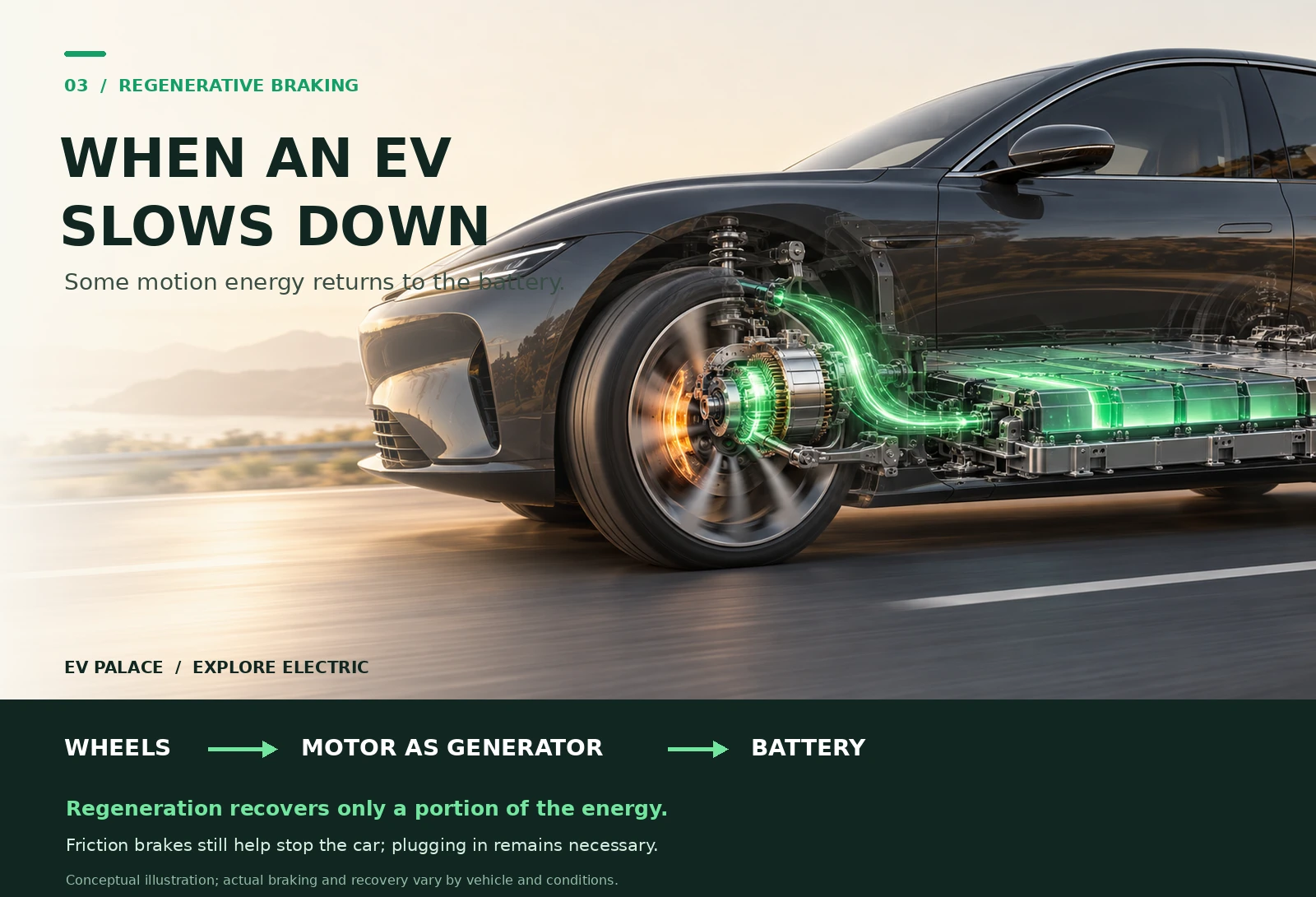
How much regeneration is available depends on the model, battery charge level, temperature, traction and braking demand. The friction brakes still matter for strong stops and conditions where regeneration is limited. The AFDC notes that frequent stops can make city driving more favorable to EV efficiency, while high-speed highway travel generally uses more energy against aerodynamic drag.
Does an electric car have an engine, exhaust or gas tank?
A fully electric BEV has an electric motor rather than an internal-combustion engine. It does not carry a gasoline fuel tank for propulsion or emit exhaust from a tailpipe. In everyday conversation people may call its motor an “EV engine,” but motor is the more precise term for this drive unit. The car still has mechanical parts, tires, brakes, cooling and maintenance needs.
Terminology matters here. A plug-in hybrid has both an electric drive system and a combustion engine, so it can use gasoline and produce tailpipe emissions while that engine runs. A conventional hybrid also has an engine and electric components, but it is not charged from an external plug in the same way as a BEV. The U.S. EPA’s EV and PHEV explanation sets out this distinction.
Where does the energy go while driving?
Not every kilowatt-hour stored in a battery becomes wheel motion. Energy is also used by heating and air conditioning, electronics, battery conditioning and losses in the battery, inverter, motor and drivetrain. Speed, weather, terrain, tires, payload and driving style change how far a charge takes you. That is why two cars with similarly sized batteries can have different ranges—and why the same car can travel different distances under different conditions. We break down speed, weather and terrain in the EV range factors guide.
A simple example: if a car uses 30 kWh per 100 miles in one set of conditions, traveling 50 miles would use about 15 kWh from the battery under those same conditions. This is an illustrative calculation, not an efficiency rating for a particular car. Charging from the wall generally requires more electricity than the battery receives because charging has losses. EPA range estimates are comparison guides, not a fixed distance on every trip. Read our Batteries & Range guides for a deeper look.
What changes for everyday ownership?
- Charging replaces refueling: Think about where you can plug in regularly and whether your usual driving can be replenished there.
- The experience is quieter: The absence of a running gasoline engine changes sound and acceleration, though tire and wind noise remain.
- Maintenance changes: There is no engine oil to change in a BEV. Tires, brake components, filters, coolant where specified and other items still need attention according to the owner’s manual.
- Trip planning still matters: Longer drives can require a compatible charging stop; conditions affect range and charging time.
The AFDC reports that all-electric cars generally have fewer moving parts and fluids to maintain than combustion vehicles, while regenerative braking can reduce brake wear. It does not mean “maintenance-free.” For a purchase decision, compare the vehicle, charging access, warranty and total ownership costs rather than judging the drivetrain alone.
Sources and methodology
This is a research-based explainer, not a hands-on road test. It was checked against the U.S. Department of Energy AFDC component guide, DOE power-electronics overview, AFDC all-electric vehicle guide, AFDC charging guide, U.S. EPA EV overview and AFDC maintenance guide. Last research review: October 11, 2026. Individual vehicle designs and owner instructions take precedence over this general explanation.
The takeaway
An all-electric car moves by sending stored battery energy through power electronics to an electric motor and then the wheels. Plugging in restores energy, while regenerative braking recovers a portion during slowing. Once that flow is clear, questions about charging, range and ownership become easier to evaluate for your own driving.
Frequently asked questions
Can an electric car run without a battery?
A battery-electric car relies on its traction battery to supply propulsion energy. Its small auxiliary battery serves other electrical needs and cannot substitute for the traction pack to drive the vehicle.
Do electric cars use gasoline?
A fully electric BEV does not use gasoline for propulsion. Plug-in hybrids and conventional hybrids have combustion engines and can use gasoline, so check the vehicle type when someone uses the broad label “EV.”
Do electric cars have a transmission?
Yes in the general sense that a drivetrain transfers motor power to the wheels. Many BEVs use a relatively simple single-speed reduction arrangement instead of a conventional multi-speed automatic, but designs vary by model.
Do electric cars charge themselves?
Regenerative braking returns some energy during deceleration, but the energy originally came from the car’s motion. It cannot fully replenish the battery. A BEV ordinarily needs external charging.
Does a bigger battery always mean more range?
No. Battery capacity matters, but vehicle efficiency and driving conditions matter too. Compare the vehicle’s EPA range and energy-use figures, then allow for your own weather, speed, load and route.
Is an EV free of emissions?
A BEV produces no tailpipe exhaust while driving. Electricity generation and vehicle or battery production can still produce emissions. The balance depends on the electricity mix and other assumptions; “no tailpipe emissions” is the precise claim.