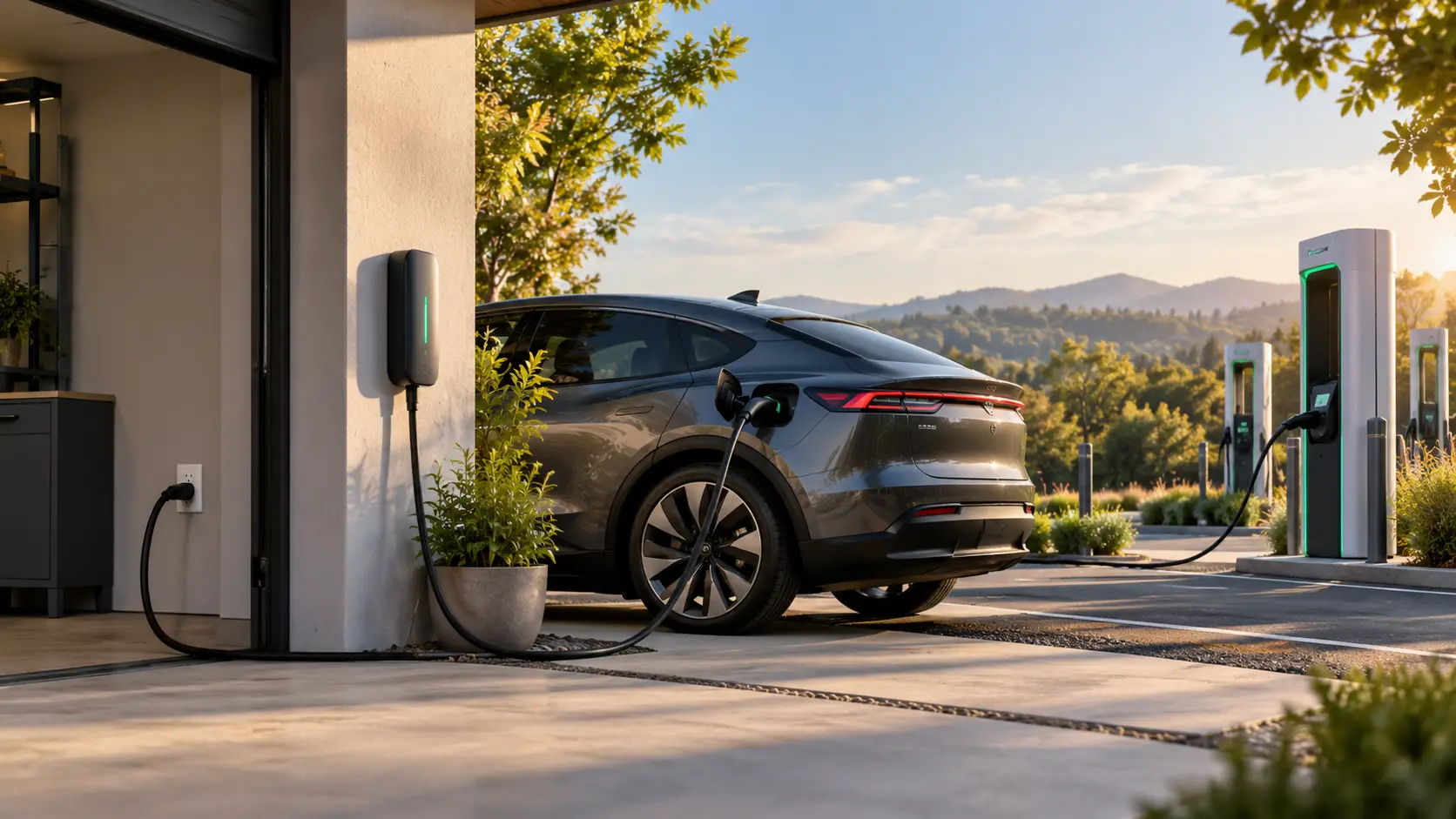
EV Charging Levels Explained: Level 1, Level 2 and DC Fast Charging
Quick answer: U.S. EV charging is commonly described as Level 1 (120-volt AC), Level 2 (240-volt AC at home, often 208 V at commercial sites), and DC fast charging at compatible public stations. Level 1 is slow but may replenish a short commute overnight. Level 2 adds more energy while parked. DC fast charging serves travel stops. Actual speed depends on the car, equipment, battery and conditions.
The levels tell you the kind of electrical supply and charging approach, not whether a plug fits your car or what you will pay. Start with how long the car will be parked and how much energy you need back. Then check vehicle compatibility and station power. This guide compares the levels without turning an advertised maximum into a guaranteed charging time.
The three charging options at a glance
| Charging type | Typical U.S. supply | Where it is useful | Main limit to check |
|---|---|---|---|
| Level 1 AC | 120 V household circuit | Long overnight parking, short daily drives, many PHEVs | Suitable dedicated circuit, EVSE and time available |
| Level 2 AC | 240 V residential; commonly 208 V commercial | Home, work and destination parking | Equipment output and vehicle’s onboard AC charger |
| DC fast charging | High-power station supplies DC | Compatible BEV road-trip or time-sensitive stops | Vehicle DC capability, station, battery temperature and charge level |
The U.S. Department of Energy’s Alternative Fuels Data Center (AFDC) describes these types and notes that charging time depends on how depleted the battery is, its capacity and type, the vehicle’s internal charger, equipment output and electrical service. The EPA’s charging basics also distinguishes the three common categories.
Level 1: charging from 120 volts
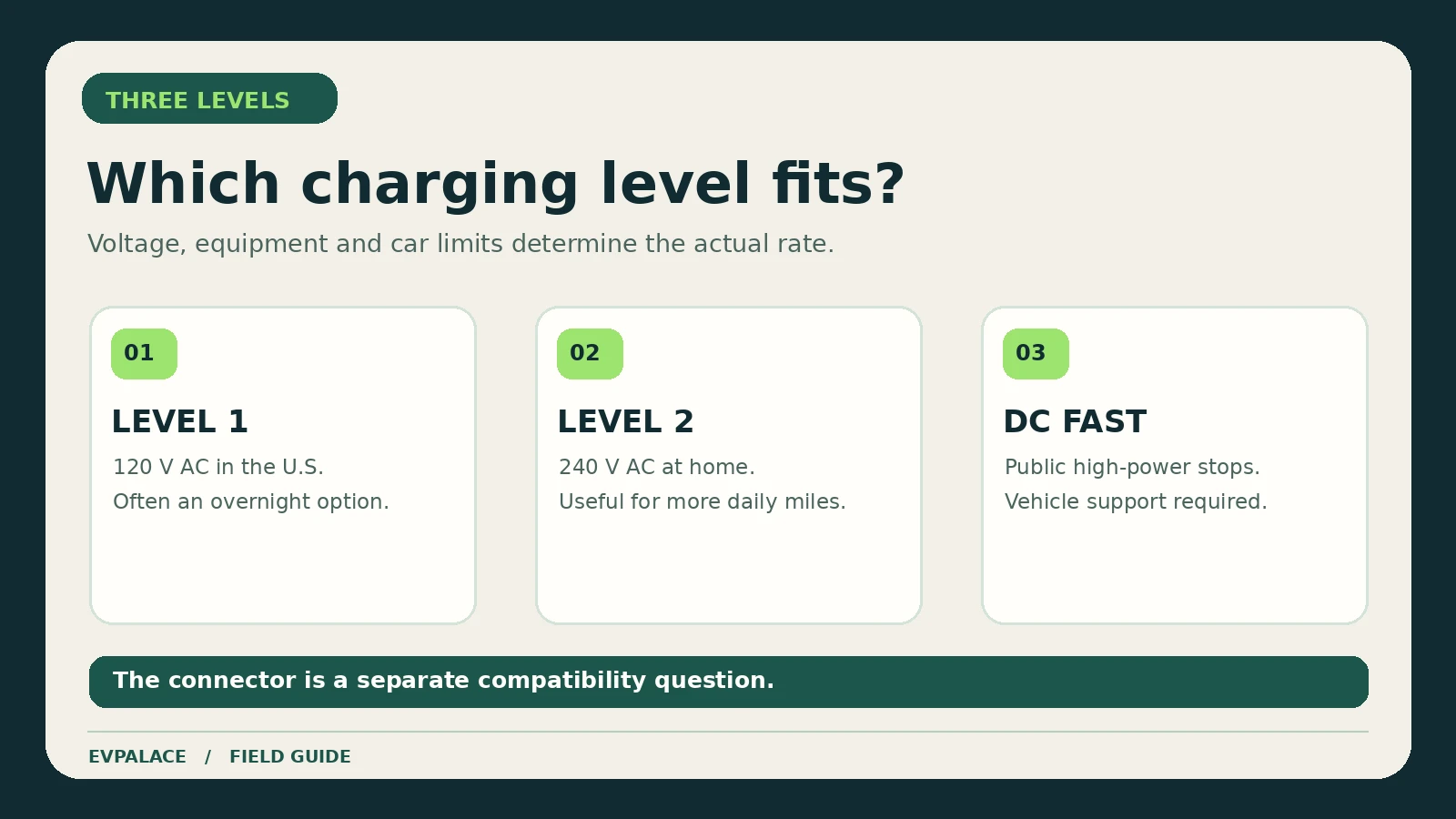
Level 1 uses compatible electric vehicle supply equipment (EVSE) connected to a suitable 120 V outlet. It is the slowest of the three options, but a vehicle that remains parked all night may still recover a meaningful amount of daily driving. The EPA gives a broad illustration of around 3–5 miles of range added per hour. The real figure depends on vehicle efficiency, current setting and other conditions.
A short commute or a PHEV can make Level 1 a practical first option. The AFDC notes that many EV owners can meet daily requirements overnight if an appropriate outlet on a dedicated branch circuit is available. Do not assume a nearby old or shared outlet is automatically suitable for repeated charging. Follow the vehicle and cordset instructions; ask an electrician to inspect uncertainty about the outlet or circuit.
Level 1 is about available parking time. If you drive much farther than you can replace each night, the shortfall accumulates. Calculate your actual miles and parking hours before deciding it is either sufficient or insufficient.
Level 2: faster AC charging
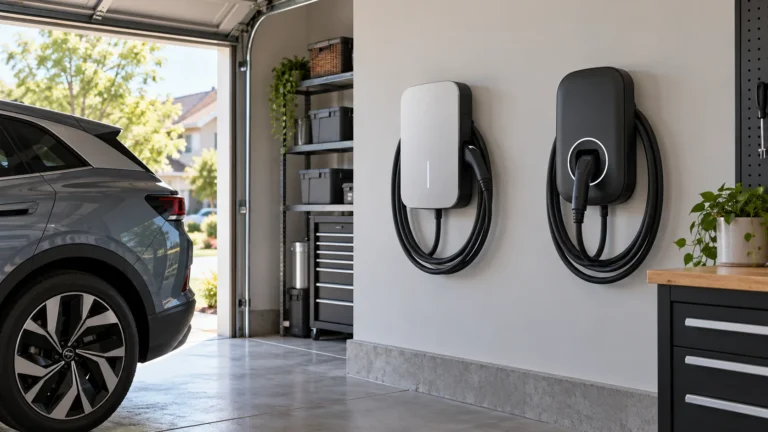
At home, Level 2 usually draws from a 240 V circuit; commercial sites often use 208 V. A wall-mounted or portable EVSE can deliver more power than typical Level 1 equipment, within the limits of the circuit and vehicle. The EPA gives a broad 25–40 miles of range per hour illustration for some Level 2 arrangements, but actual power varies widely.
Level 2 is useful when you need to replenish more daily miles during an overnight window, share charging among cars, or charge at a workplace or destination while parked. A qualified electrician should assess a new home circuit, the panel and equipment. Higher amperage on a product box is not automatically better. Our home charging guide walks through the planning steps, while the installation readiness guide will address the electrical assessment in more detail.
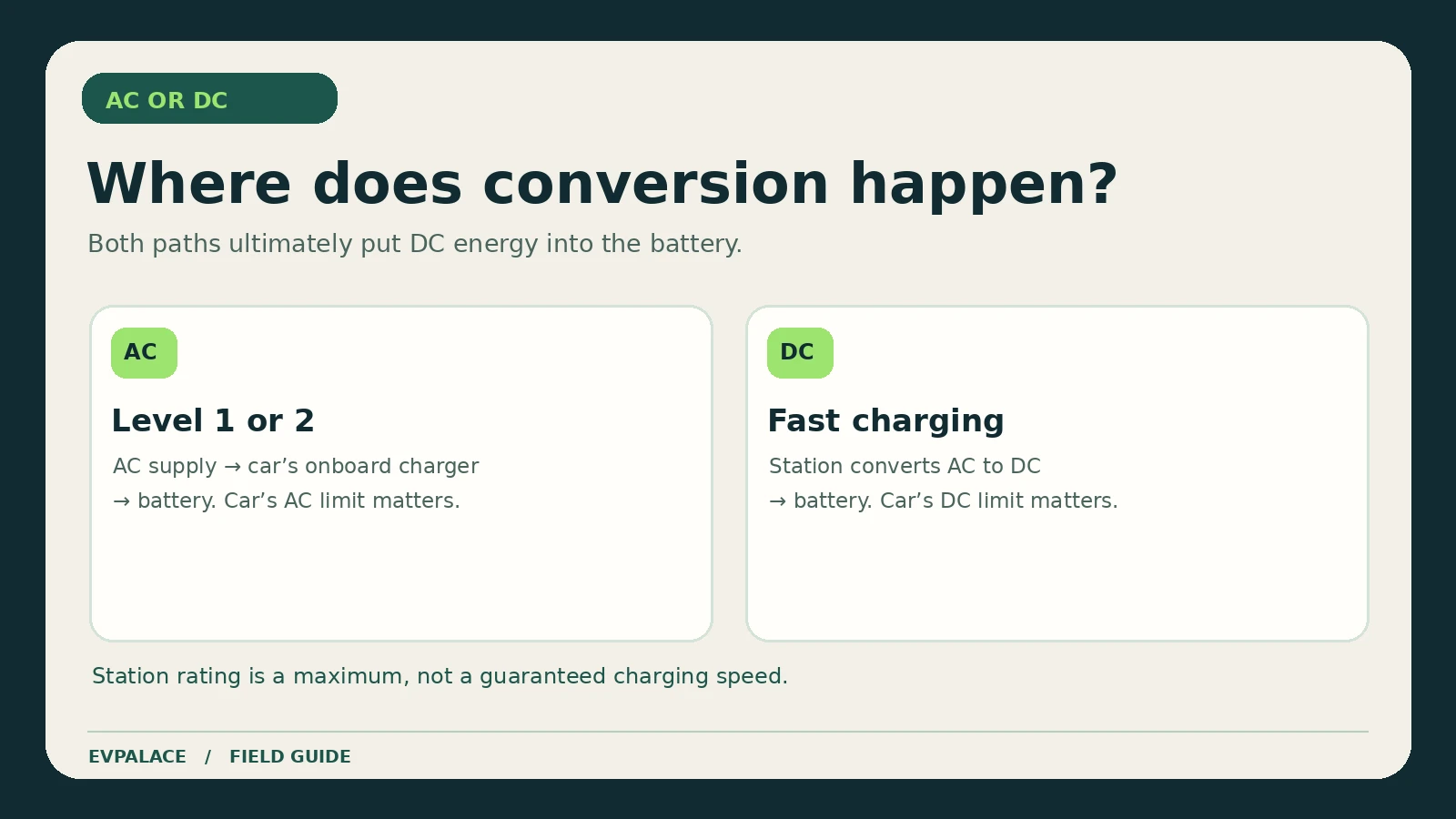
AC charging passes electricity through the car’s onboard charger, which converts AC to DC for the battery. If a vehicle’s AC charging limit is lower than the EVSE’s maximum output, the car sets the ceiling. The circuit and EVSE can also limit the session. Check all three rather than shopping by one kW number.
DC fast charging: the road-trip option
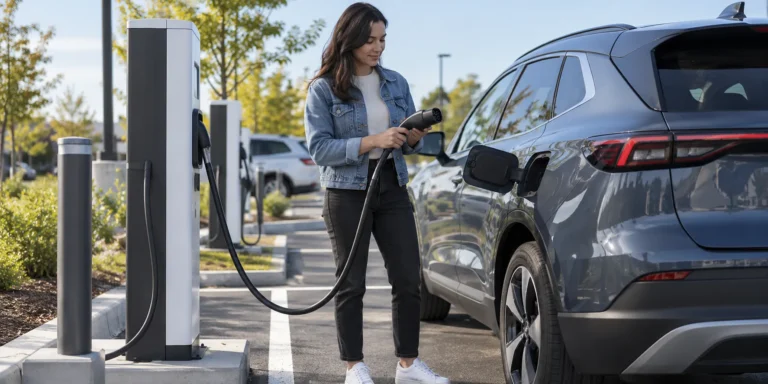
A DC fast-charging station converts electricity outside the car and sends DC power through a compatible charging system to the battery. It is generally found at public sites rather than ordinary homes. Stations and vehicles come with different power ratings; a 350 kW station does not make a car with a much lower DC limit accept 350 kW. DC fast charging also needs an appropriate connector and, where applicable, authorized network access or adapter.
The term “Level 3” is often used in conversation for DC fast charging, but DC fast charging is the clearer label for a driver. Some PHEVs cannot use DC fast charging at all. Check the exact car’s specifications. Our DC fast charging guide will cover charging stops, taper and route planning in depth.
Fast charging is particularly sensitive to battery conditions. A cold pack, a very high state of charge, vehicle limits or station load can reduce delivered power. The station’s advertised peak is not its output for every minute of a session. The EPA’s detailed charging guide explains why a vehicle’s maximum acceptance matters.
Why does charging slow down near a full battery?
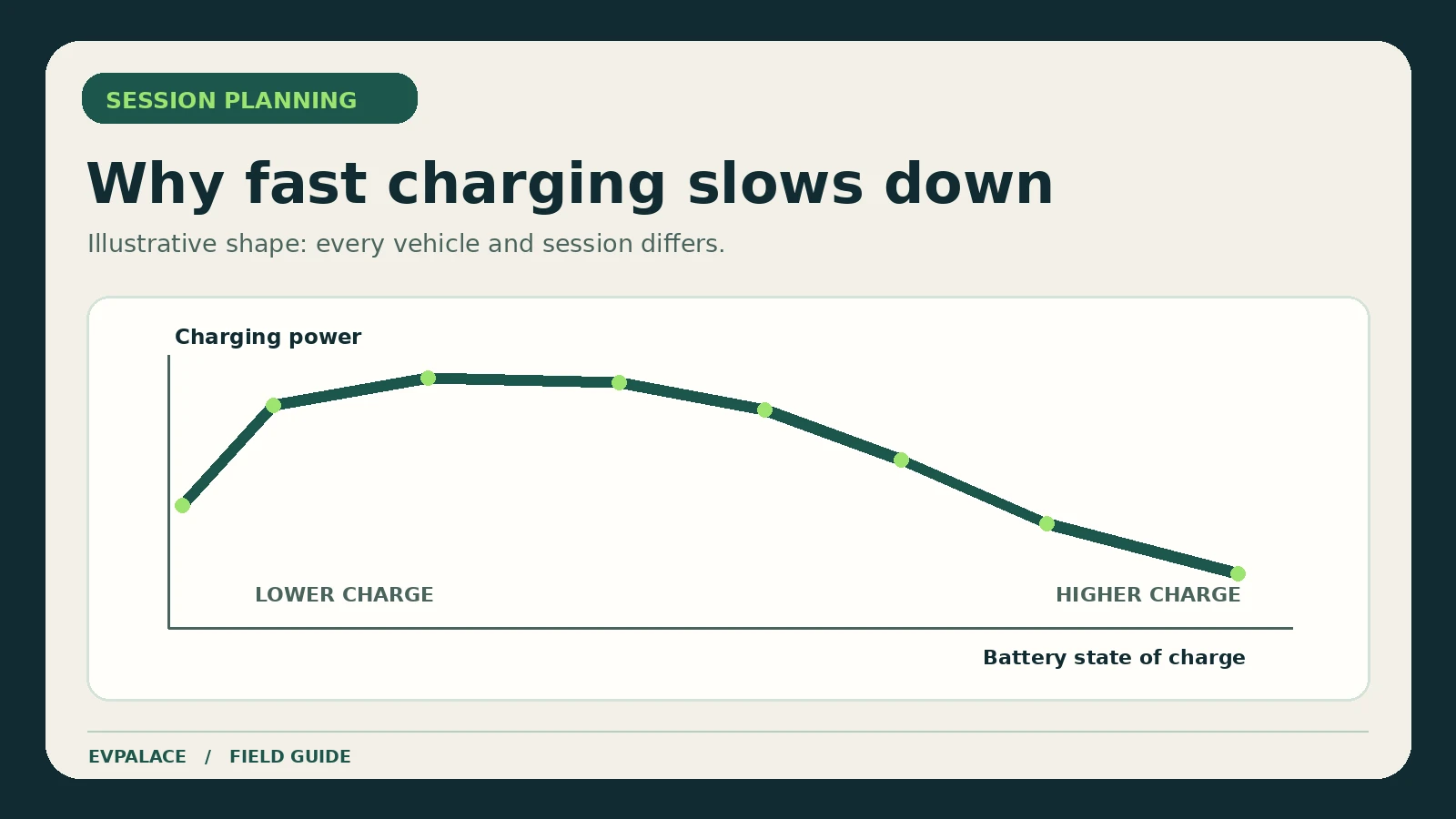
DC fast-charging power commonly changes over a session. A vehicle may accept high power in part of its lower or middle state-of-charge range, then reduce power as the battery fills. Its control system also responds to temperature and other conditions. The exact curve varies by car, battery and session. It is therefore misleading to divide the battery’s capacity by a station’s peak kW and promise a fixed 0–100% time.
A manufacturer’s 10–80% estimate, when supplied with defined conditions, can be useful for trip planning, but it is not guaranteed at every charger or in every season. On a long trip, stopping when you have enough range for the next leg may sometimes be more efficient than waiting for the last portion of the battery. Verify route, reserve and station reliability for the actual drive.
Charging speed, connector and station access are different questions
A Level 2 station may have the electrical output you need but the wrong vehicle-side connector. A DC station may be compatible in principle but require an approved adapter or network access for your model. In the U.S., common AC connector families include J1772 and J3400/NACS; DC compatibility involves the car’s hardware and the particular station. Do not assume one adapter makes all charging equipment universal. We will cover the model and adapter checks in our connector compatibility guide.
For a public session, verify the connector, the station’s status, pricing, payment method and parking rules before arriving. Level 2 is often found where cars sit for hours; DC fast charging is more useful when time is limited. See the AFDC public charging overview.
How should you choose a level for your routine?
- Daily miles: Estimate the energy you use between charging opportunities, not just the battery’s full capacity.
- Parking hours: An overnight or workday window can make slower AC charging useful.
- Electrical suitability: Have a qualified electrician assess any proposed home installation and follow manufacturer instructions.
- Vehicle limits: Check the AC onboard charger, DC capability and connector on the exact model.
- Long trips: Map compatible DC stops with a reserve; advertised peak power alone is not a route plan.
- Cost: Compare your home utility rate and public station price. Speed does not by itself determine the cost per kWh.
A driver with reliable overnight parking and modest mileage may be happy with Level 1. Another household may benefit from Level 2. A DC fast charger is usually a travel or occasional convenience decision, not a substitute for assessing a feasible everyday routine. For a full calculation of energy and tariffs, read our charging cost guide when it is published.
Sources
- U.S. Department of Energy, AFDC: Electric Vehicle Charging Stations
- AFDC: Charging Electric Vehicles at Home
- AFDC: Charging Electric Vehicles in Public
- U.S. EPA: Getting Started with Home EV Charging
- U.S. EPA: Plug-In Electric Vehicle Charging Details
Frequently asked questions
What is the difference between Level 1 and Level 2 EV charging?
Both deliver AC electricity to the car. Level 1 typically uses a suitable 120 V circuit in the U.S.; Level 2 uses 240 V at home or commonly 208 V at commercial sites and can deliver more power.
Is DC fast charging the same as Level 3?
People often use “Level 3” for it, but DC fast charging is the clearer driver-facing term. Its equipment, vehicle compatibility and power delivery differ from AC Level 1 and Level 2.
Can every electric car use DC fast charging?
No. Check the exact model’s DC charging capability and connector. Many PHEVs do not support DC fast charging, and compatible BEVs accept different maximum rates.
Does a higher-kW charger always charge faster?
No. The car’s AC or DC acceptance, state of charge, temperature, station and electrical setup can limit power below the equipment’s rating.
Which charging level is best for home?
Compare daily miles and overnight parking time first. Suitable Level 1 can cover some routines; Level 2 offers faster replenishment when needed. Have the home circuit assessed before installation.