What Does EV Stand For? A Beginner’s Guide to Electric Cars
Quick answer: EV stands for electric vehicle. In everyday car shopping, “EV” often means an all-electric car that plugs in and drives on battery power. The wider term can also include a plug-in hybrid, which has both a battery and a gasoline engine. A conventional hybrid uses electricity too, but it does not plug in. Look for the letters BEV when you specifically mean a fully electric car.
If those names sound too similar, start with one question: does the car plug in, and does it also have a gasoline engine? That answer tells you more about how you will use it than the badge on the trunk. Here is the vocabulary, followed by the charging and ownership basics.
What does EV mean in cars?
“Electric vehicle” describes a vehicle propelled partly or entirely by an electric motor. Usage is not perfectly uniform. The U.S. Department of Energy’s Alternative Fuels Data Center (AFDC) notes that battery-electric vehicles (BEVs), plug-in hybrids (PHEVs), and conventional hybrids (HEVs) may all be called electric-drive vehicles or EVs in casual conversation. For a shopping comparison, it is clearer to say which type you mean.
On EVPalace, all-electric car or BEV means a car with no gasoline engine. When we use the broader “EV,” we identify the type if the distinction affects charging, fuel use or ownership.
EV versus BEV: what is the difference?
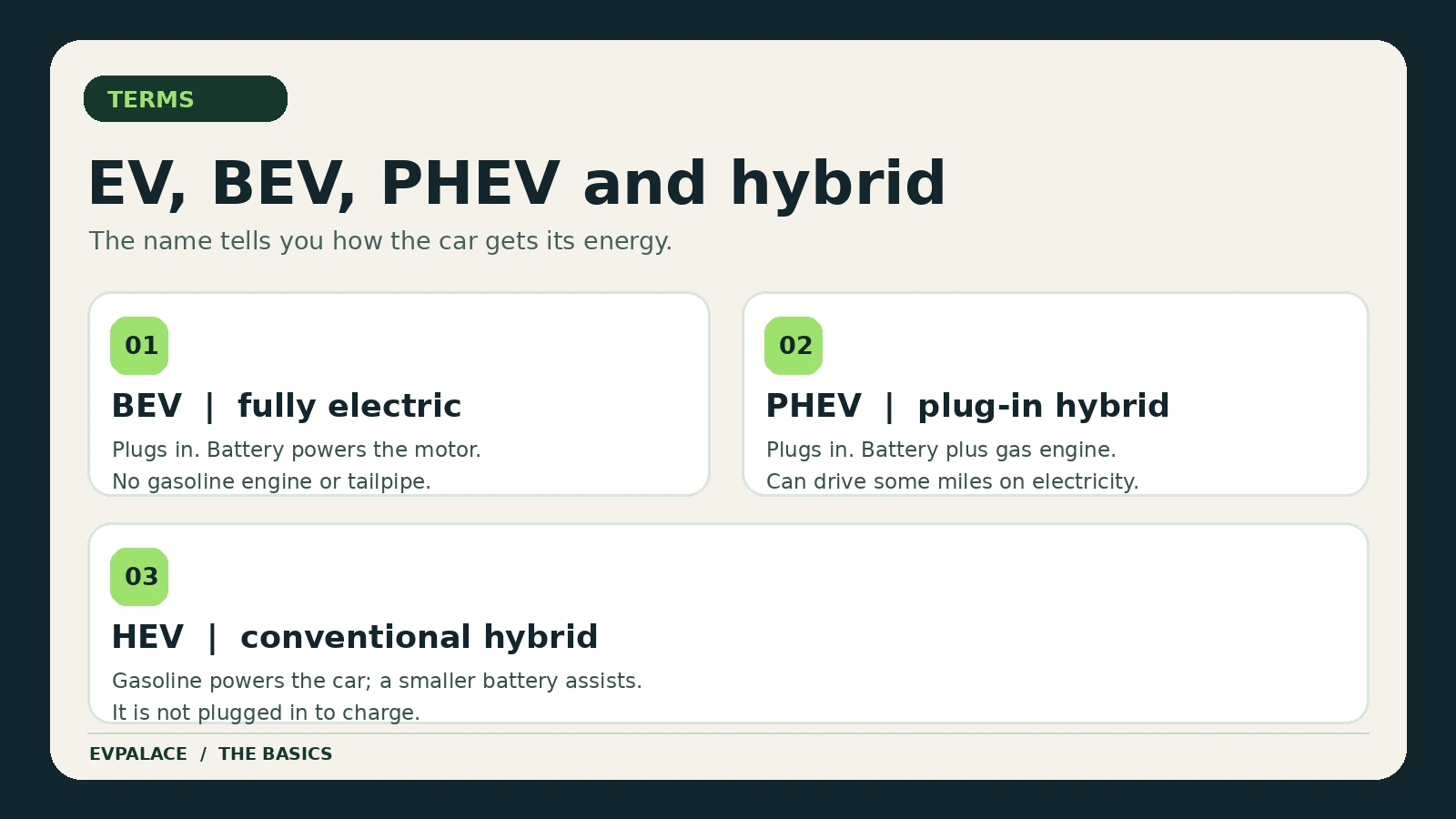
BEV stands for battery-electric vehicle. It is the most specific label for an all-electric car. Its battery pack stores electricity from an external source; one or more electric motors propel the vehicle. There is no gasoline engine or tailpipe. BEVs are also called all-electric vehicles. The AFDC’s all-electric vehicle guide explains the distinction.
The letters “EV” are sometimes used as shorthand for BEV, especially in a listing that contrasts an electric model with a gasoline model. But an EV can be a broader label in technical or policy contexts. If a listing simply says “electric,” check its fuel type and whether it has a gas tank before assuming it is a BEV.
| Term | What powers the wheels? | Plug it in? | Gasoline engine? |
|---|---|---|---|
| BEV / all-electric | Battery and electric motor | Yes | No |
| PHEV / plug-in hybrid | Battery and motor, plus gasoline engine | Yes | Yes |
| HEV / conventional hybrid | Gasoline engine plus electric assistance | No | Yes |
A hydrogen fuel-cell vehicle also uses an electric motor, but it stores hydrogen and generates electricity onboard. It has a different refueling setup from a plug-in battery EV, so this beginner guide focuses on the three common car-shopping labels above. The AFDC overview describes the wider electric-drive family.
What about plug-in hybrids and regular hybrids?
PHEV: a battery you plug in, with an engine for longer trips
A plug-in hybrid electric vehicle has a charge port, a battery, an electric motor and an internal-combustion engine. It can drive on electricity for part of a trip, then use gasoline when needed; exact operation depends on the model and conditions. Plugging it in regularly is what lets an owner make meaningful use of its electric range. The AFDC PHEV guide explains its operating modes and charging.
A PHEV can suit a driver who can charge frequently but wants the flexibility of a gasoline engine. It also means managing two energy sources and the maintenance associated with an engine. Its electric range is much shorter than the total range quoted with a full tank and charge, so compare the right number for your daily commute.
HEV: electric assistance without plugging in
A hybrid electric vehicle combines a gasoline engine with an electric motor and a smaller battery. The battery is replenished by the engine and by regenerative braking; a conventional HEV is not connected to an external charger. It cannot be treated as an all-electric car for home-charging plans. See the AFDC definition of hybrids for the terminology.
The simple shopping rule: if you want to replace gasoline use entirely, look for a BEV. If you want to plug in for some trips but retain an engine, look for a PHEV. If you cannot plug in and want a gasoline car with electric assistance, a conventional hybrid is the relevant category. Our electric versus hybrid comparison will cover the trade-offs in detail when that guide is ready.
How does an all-electric car move?
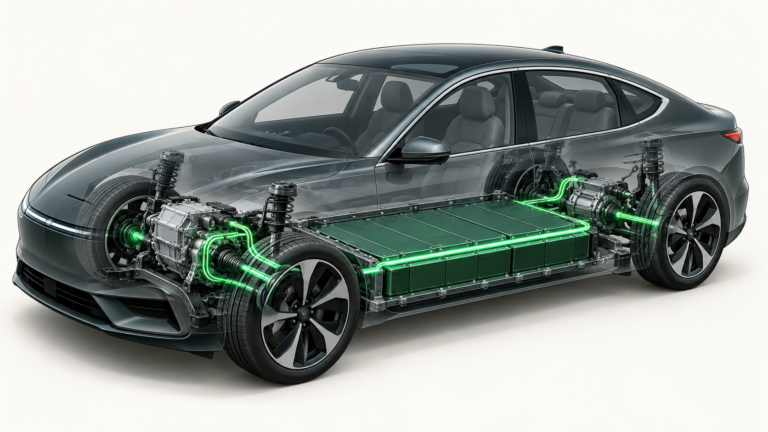
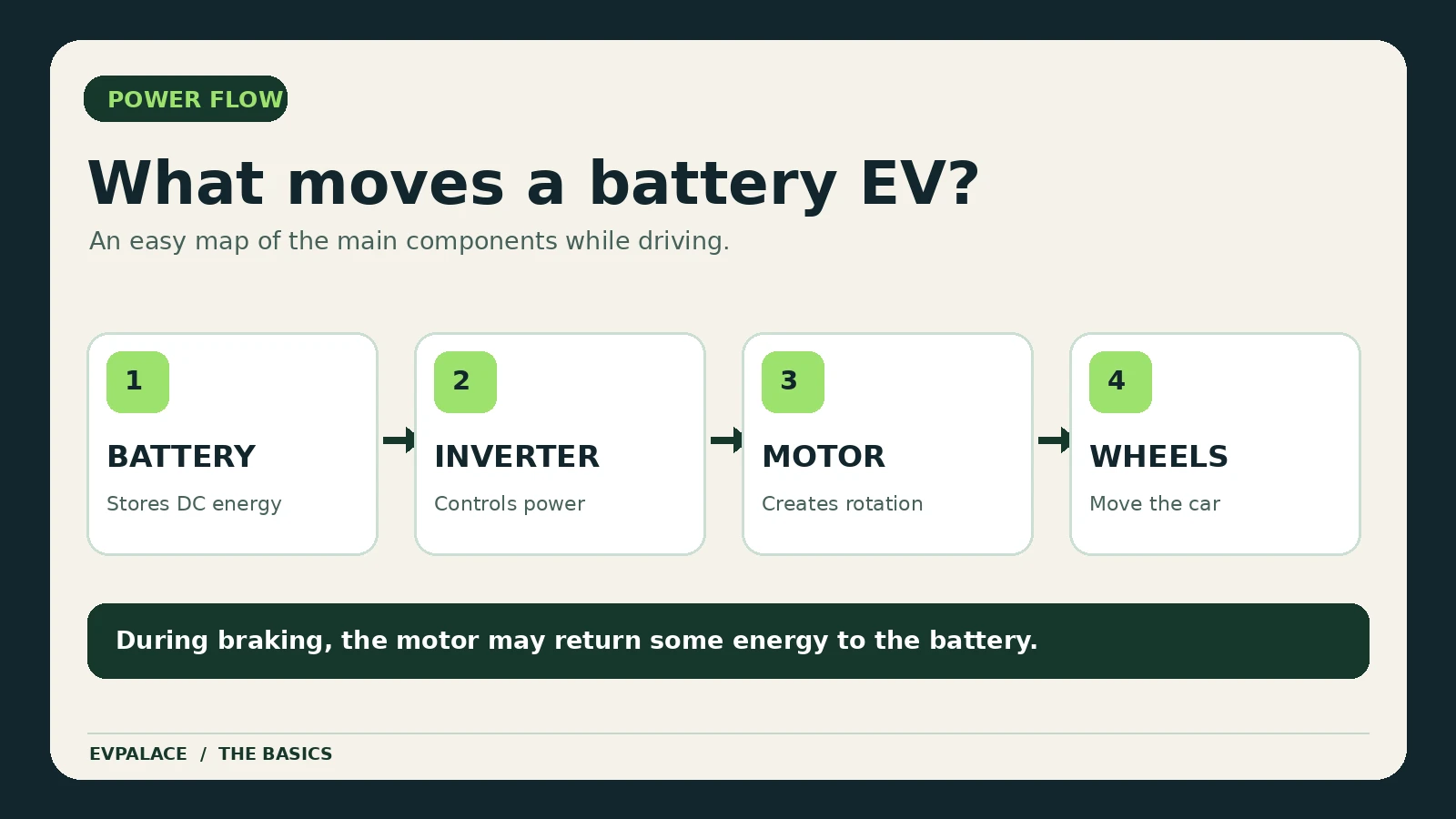
In a BEV, the traction battery stores direct-current electricity. Power electronics control delivery to the motor; in many designs an inverter converts battery DC into the controlled AC used by the traction motor. The motor turns the drivetrain and wheels. A smaller low-voltage battery supports accessories and vehicle electronics. Component layouts vary by vehicle.
When the driver slows down, regenerative braking can make the motor act as a generator and return some motion energy to the battery. It cannot recover all the energy used while driving, and the car still has friction brakes. For a component-by-component explanation, read how electric cars work. The AFDC component diagram is a useful technical reference.
How do you charge an EV?
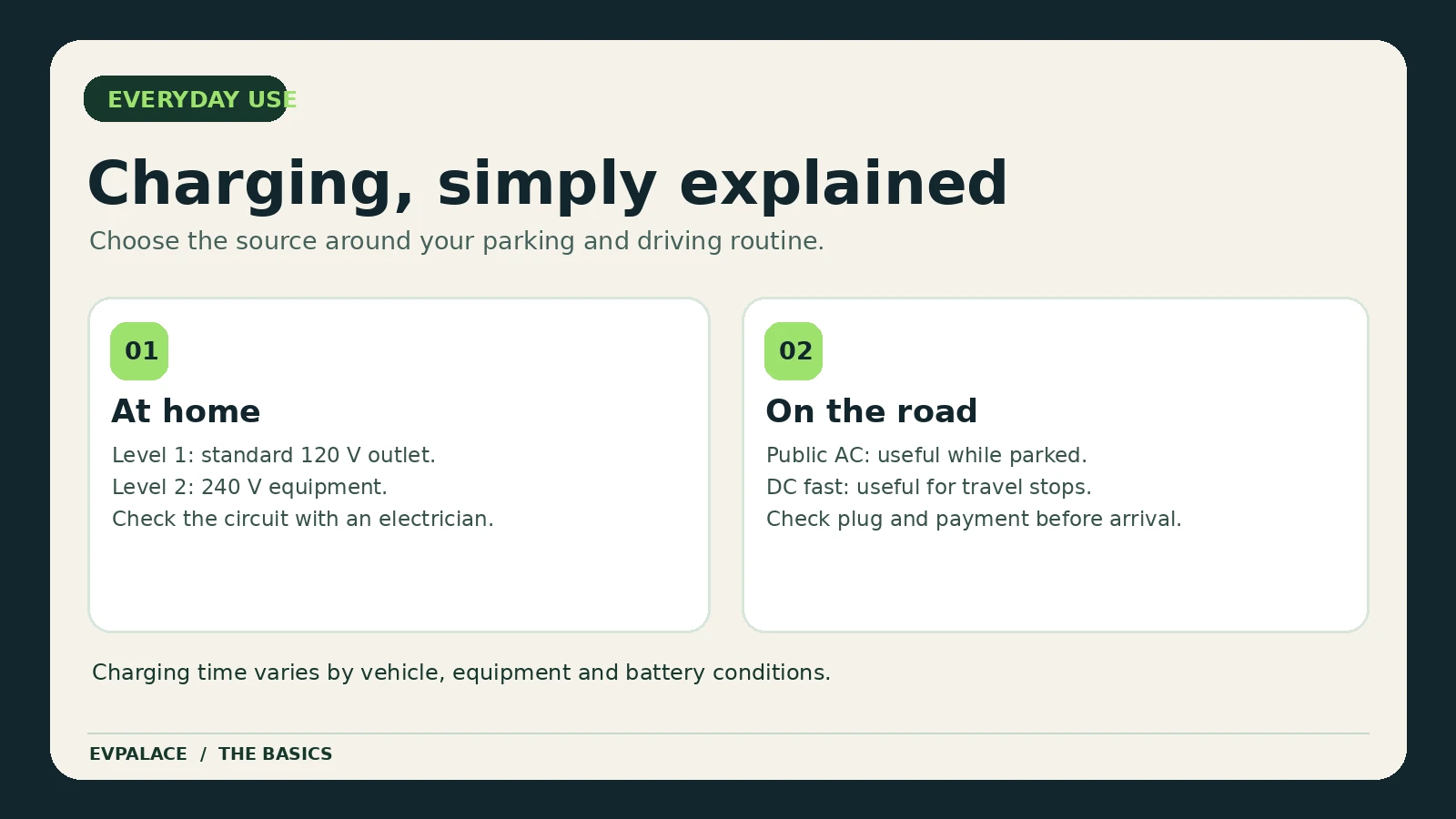
A BEV or PHEV connects to an external electricity source through its charge port. Level 1 generally uses a 120-volt household outlet in the United States; Level 2 uses 240-volt equipment and is commonly chosen for regular home charging. Public AC charging is also available. Compatible DC fast charging can add energy much more quickly for many BEVs, but the actual rate depends on the vehicle, battery conditions and station. The AFDC charging guide explains the levels and the factors behind charging time.
Charging is often built around parking time. If you can reliably plug in where you park overnight, you may start many days with the battery at your chosen charge target. If you park on the street or rent, inspect the public chargers near your regular destinations before choosing a vehicle. For home equipment and electrical work, use the car and charging-equipment manuals and a qualified electrician. Our home charging guide will walk through those decisions when published.
How far can a BEV drive?
Range is the estimated distance a vehicle can travel on a charge. It varies widely by model, battery, efficiency and conditions. The AFDC describes many current all-electric vehicles in a broad 150 to 400 mile typical-range span, but that is not a promise for any individual car. Use the specific vehicle’s EPA estimate as a comparison point, then leave room for weather, speed, terrain and heating or air conditioning.
A larger battery can help range, but efficiency matters too: two cars with similar battery capacities may travel different distances. When comparing listings, check the model year, trim, wheel and tire setup, and the official rating for that exact version. A used EV may also have a different battery condition from when it was new. We cover the underlying factors in our EV range guide, which will be added to this series.
Is an EV cheaper to run or maintain?
The answer depends on local electricity and gasoline prices, your driving, charging location, vehicle price and maintenance schedule. A BEV has no engine oil changes and generally fewer engine-related service items, but tires, brakes, filters, fluids where specified and other components still need care. Public fast charging can cost more than home charging. Avoid comparing a generic “cost per charge” with a generic “cost per tank” unless you also compare the distance covered.
For a quick electricity example, if an EV uses 30 kWh per 100 miles and electricity costs $0.15 per kWh, the energy cost for 100 miles is about $4.50 before charging losses, fixed fees and taxes. Those are illustrative inputs, not a current national tariff or a rating for a particular car. A practical comparison should use your utility bill, the car’s efficiency, expected charging mix and local fuel prices. Our charging cost guide will provide the full calculation.
What should a first-time buyer check?
- Charging access: Identify a dependable place to charge before deciding on a BEV or PHEV. Check electrical suitability with a professional for home installations.
- Daily and occasional trips: Compare your longest regular drives with the exact vehicle’s range and the charging stops available on longer journeys.
- Connector and network access: Confirm the car’s port and any manufacturer-approved adapters against the stations you expect to use; compatibility can vary.
- Total cost: Include the vehicle price, insurance, home setup if needed, electricity or gasoline, and your likely public-charging use.
- Used-car condition: Review battery warranty terms, service history and the particular vehicle’s condition, rather than assuming every used EV behaves like a new one.
The useful next step is to make a short list of cars and map them against your parking and driving, not to choose by an acronym alone. Start with our drivetrain explainer if you want the mechanics, or browse EV Charging for the next ownership questions.
Sources
- U.S. Department of Energy, Alternative Fuels Data Center: Electric Vehicles
- AFDC: All-Electric Vehicles
- AFDC: Plug-In Hybrid Electric Vehicles
- AFDC: Electric Vehicle Charging Stations
- AFDC: How Do All-Electric Cars Work?
Frequently asked questions
Does EV always mean a fully electric car?
No. Many car listings use EV to mean a fully electric BEV, while broader electric-drive usage can include plug-in hybrids and sometimes conventional hybrids. Check whether the vehicle has a gasoline engine and whether it plugs in.
What does BEV stand for?
BEV means battery-electric vehicle. It runs on electricity stored in a rechargeable battery and has no gasoline engine.
Can an EV use gasoline?
A BEV cannot. A plug-in hybrid can use gasoline because it has an internal-combustion engine. A conventional hybrid also uses gasoline, even though an electric motor assists it.
Do all electric cars need a home charger?
A BEV needs a way to recharge, but that does not have to be a dedicated home Level 2 unit. Whether Level 1 or public charging works for you depends on your driving, parking, vehicle and local stations. Check access and timing before buying.
Is a hybrid the same as a plug-in hybrid?
No. A conventional hybrid does not plug in; its battery is charged onboard. A plug-in hybrid can receive electricity from an external charger and drive some distance on battery power.