Dual EV Charger for Home: Options and Power Sharing
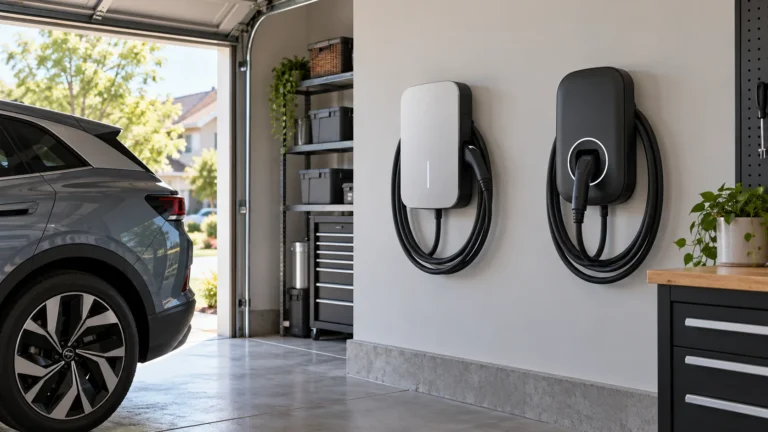
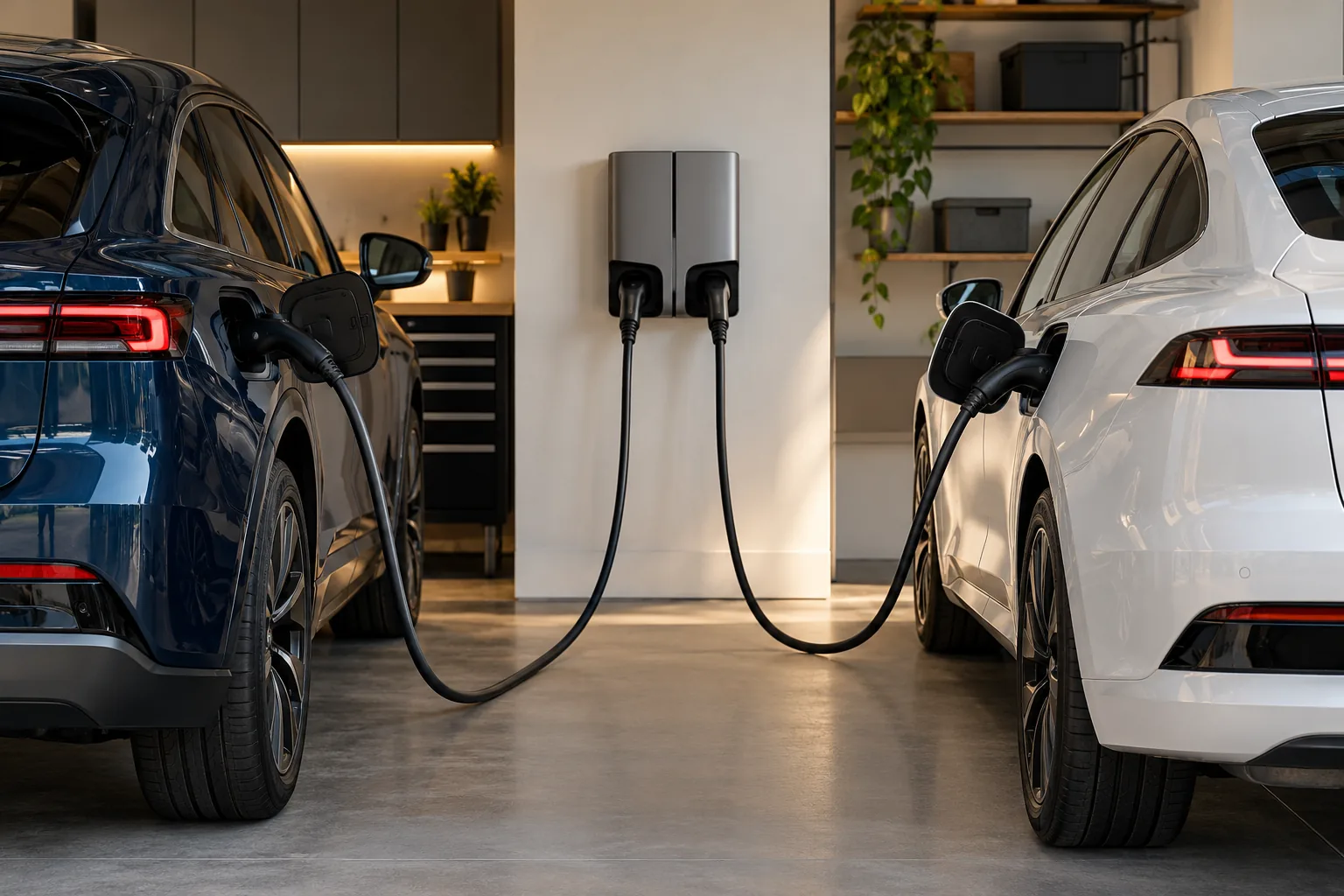
A two-EV household does not automatically need two full-power circuits. The right setup depends on how much energy each car uses, when both are parked, and how the home’s electrical capacity is assessed. A dual EV charger for home can mean one station with two connectors or two compatible wall units configured to share available power. Those are different designs, with different wiring and operating behavior.
First, calculate the two cars’ real overnight demand
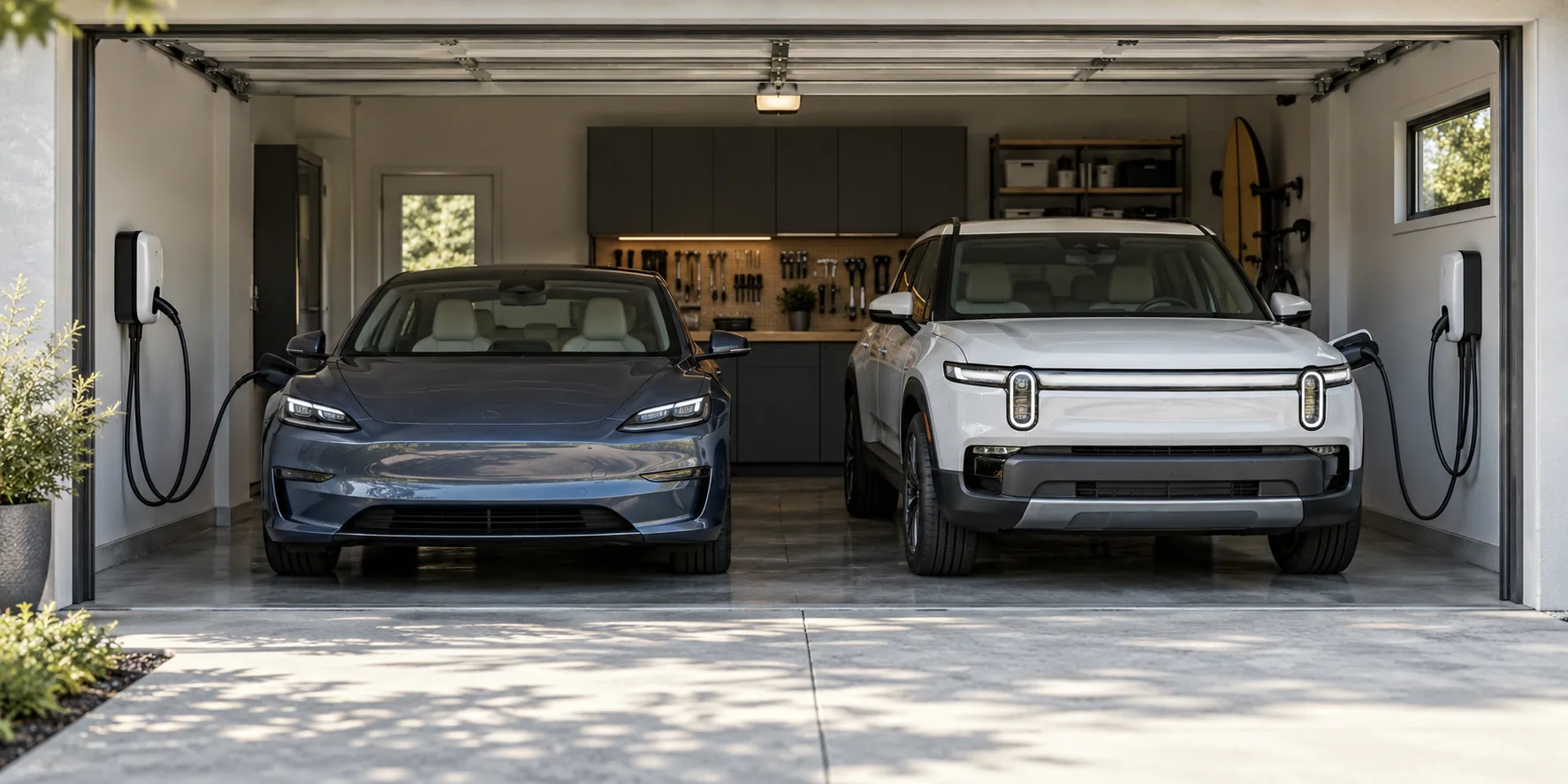
Write down each vehicle’s typical daily miles or energy use, arrival and departure time, charging-port location and AC charging limit. If one car uses 12 kWh and the other 18 kWh on an ordinary day, they need roughly 30 kWh returned to their batteries, plus charging losses. Across a ten-hour common parking window, that is a much smaller average load than two chargers running at their maximum throughout the night. Peak needs still matter on days when both cars arrive nearly empty.
A basic charging schedule can sometimes be enough if the vehicles are parked for long periods and drivers can reliably move one cable. Two connectors remove that daily handoff. Whether simultaneous charging is worth the added equipment and installation cost is a household decision, not a universal speed contest.
Three practical ways to charge two EVs
One charger, shared in sequence
This is the lowest equipment count. Charge the first car, then move the cable to the second or alternate nights. It works best where both drivers have predictable commutes and a convenient shared parking spot. The main risk is human: a missed swap can leave one car short the next morning. Do not split a connector with improvised adapters or extension cords.
One dual-port unit
A dual-connector EVSE gives each parked vehicle a cable from one unit. Check the exact product manual to see how its total output is allocated when both cars are connected. Some products share a fixed total, while others have configurable behavior; two advertised maximums may not be available simultaneously. Also confirm connector compatibility, cable length to both charge ports, outdoor rating if relevant, and whether it needs one or more branch circuits. The answer is model-specific.
Two chargers with coordinated power sharing
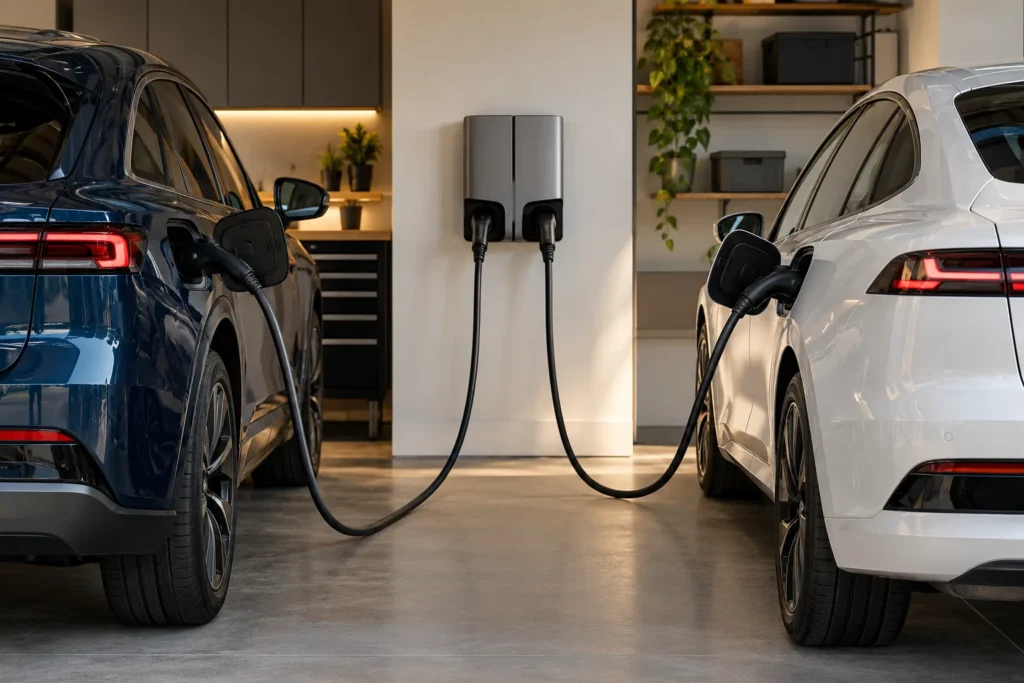
Some manufacturers support two or more compatible wall units operating as a managed group. The units divide a configured site allowance among active vehicles, allowing each to receive more when the other finishes or is unplugged. Tesla’s group power-management guidance, for example, describes a network limit configured during commissioning and says an electrician must determine the available current. This is evidence for that system, not proof that unrelated brands can share power together.
Two independent chargers without power coordination are another option if the electrical design supports their combined demand. A pair of 48 A capable boxes must never be assumed safe on existing service simply because both circuits fit in the panel. A qualified electrician assesses the service and the proposed concurrent load.
Power sharing, load management and scheduling are not identical
Power sharing allocates a defined charging allowance among compatible EVSEs or ports. Dynamic load management may monitor other household loads and adjust the EV charging allowance as those loads change. Simple scheduling controls when charging starts but may not limit the combined draw if both units run at once. Product names and features differ, so ask the installer exactly what gets measured, what gets limited and how the system behaves when communication fails.
Two vehicles can also have different AC charging limits. A power-sharing system may give unused capacity to the car that can accept it, but only if the particular equipment and configuration provide that behavior. Read the maker’s documentation for minimum current, grouping size, network requirements and fallback behavior.
How to choose the layout
- Map the two parking positions and each car’s charge-port side. A central dual-port box is useful only when both cables reach without crossing a walking or driving path.
- Estimate energy each car needs on a busy day and the hours both can charge. Ask whether concurrent or alternating charging meets the departure times.
- Check the available electrical capacity with a qualified electrician. Ask for a comparison of one shared station, two managed stations and any necessary service work.
- Confirm connector types, adapters approved by the vehicle and charger makers, outdoor rating if applicable, and the ability to replace or service one unit.
- Have the installer document the final output limit, commissioning settings and how either driver changes schedules without defeating the electrical design.
Our EV charger amperage guide explains output versus circuit rating. The installation guide covers the site assessment and permits that apply before any hardware choice.
Example scenarios
Two short commutes with long nights: A single station and alternating schedule may be sufficient. A dual-port unit can be a convenience upgrade, even if its shared total power is modest. One long commute, one occasional driver: prioritize the car that needs energy each morning and use a schedule or managed system that supports that priority. Two late arrivals with early departures: simultaneous charging and a higher available site allowance may be valuable, but the electrical work should be assessed before buying hardware.
Do not calculate an exact breaker, conductor or service size from these examples. Vehicle efficiency, charging losses, equipment settings and existing household load differ. Obtain a site-specific design from a qualified professional.
Questions to ask before buying
- What is the total output when both connectors are active, and does it change after one car finishes?
- Does the system require a wired link, Wi-Fi or cloud service for sharing? What happens if it disconnects?
- Can the two chargers have different connector types, and are any adapters approved?
- Is the proposed mounting location within both cable reaches without a trip hazard?
- What equipment and installation costs are included in the electrician’s quote?
The most useful two-EV setup is the one that reliably returns each driver’s daily energy by departure time. Choose the hardware after the parking layout and electrical assessment have established that requirement.
Estimate each car’s overnight demand before deciding whether two connectors are needed. Review home charging planning. Use electricity-use calculations and home charger features to check the related decisions before choosing equipment or a charging routine.
Sources
- Tesla: Group power management and network limit
- U.S. DOE AFDC: Charging at home
- U.S. EPA: Getting started with home EV charging
Frequently asked questions
Can two EVs charge on one circuit?
Some purpose-built dual-port systems are designed around a specified shared supply. Two separate chargers cannot simply be connected to one circuit without a design and manufacturer approval. Have an electrician follow the exact equipment instructions and local rules.
Will power sharing make both cars charge at half speed?
Not necessarily. The allocation depends on the product, configured total, vehicle demand and whether both are actively charging. Review the manufacturer’s documented behavior for the exact system.
Do I need two chargers for two EVs?
No. One charger can be shared in sequence if its overnight energy and your routine are sufficient. Two connectors mainly remove the need to move the cable and can support simultaneous charging with an appropriate system.