Best EV for Families: 7 U.S. Picks With Real Space
The best EV for families is the one that fits your actual family, not the one with the biggest number on the window sticker. For most U.S. families, that means the Hyundai Ioniq 9 S, at $58,955 with 335 miles of EPA range and 7 seats, or the Kia EV9 Light Long Range, at $57,900 with 305 miles of EPA range and 7 seats.
Both are three-row electric SUVs with a native NACS charging port, real cargo space behind the third row, and a price under $60,000 before destination. This guide compares 7 new family EVs you can buy in the U.S. in 2026, with the exact trim behind every price and range figure, so the cheapest price and the longest range are never from two different cars.
Every price below is MSRP before destination unless stated otherwise. Destination fees are not settled for most of these models, so we do not quote delivered prices where the fee is unverified, and every cost-per-mile figure uses the same MSRP basis. EPA range is for the exact configuration named. The federal $7,500 new-EV credit is unavailable for vehicles acquired after September 30, 2025, so no price below subtracts it. If you are also weighing a used family EV, our parent guide to buying a used EV covers the checks that matter before you pay.
The 7 picks at a glance
| Pick | Trim | MSRP | EPA range | Seats | Cargo behind 3rd row |
|---|---|---|---|---|---|
| 1. Kia EV9, value | Light Long Range RWD | $57,900 | 305 mi | 7 or 6 | 20.2 cu ft |
| 2. Hyundai Ioniq 9, best all-rounder | S RWD | $58,955 | 335 mi | 7 | 21.9 cu ft |
| 3. Rivian R1S, adventure | Premium Dual Large | $83,990 | 329 mi | 7 | Not published by Rivian |
| 4. Tesla Model Y, cheapest 7 seats | Premium AWD, 7-seat option | $52,490 | 327 mi | 7, child-sized 3rd row | Not published by Tesla |
| 5. Volvo EX90, premium | Twin Motor AWD | $79,995 | 305 mi | 6 or 7 | 11.4 cu ft |
| 6. Cadillac Vistiq, mid-luxury | 2027, from | $78,400 | 305 mi | 7 | 15.2 cu ft |
| 7. Lucid Gravity, longest range | Touring | $79,900 | 337 mi | 5, 7 optional | Not published by Lucid |
The EX90 price is before destination, worked out by subtracting the $1,395 destination fee Volvo includes in its listed $81,390 price. The Gravity figures are for the 2-row 5-seat form; Lucid has not published a range for the 7-seat Gravity, so do not read 337 or 450 miles as a 7-seat figure. The Model Y total is $49,990 plus the $2,500 seven-seat option, $54,130 with Tesla’s $1,640 destination and order fees.
Do you need a three-row EV, or is a big two-row enough?
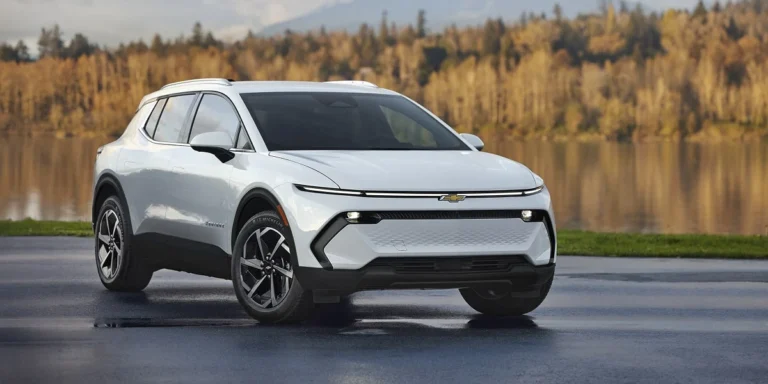
Most families of 4 or 5 are better served by a roomy two-row EV, with more cargo behind the seats they use and more range per dollar. A big two-row such as the Chevrolet Equinox EV costs $34,995 and gives 319 miles of EPA range, while the cheapest three-row here costs $52,490. Buy a third row only if you regularly carry 5 or more people, or if you want a rear-facing infant seat installed while older children still sit behind it. A third row you use twice a year costs you cargo space, range and money every day.
1. Kia EV9: the value three-row
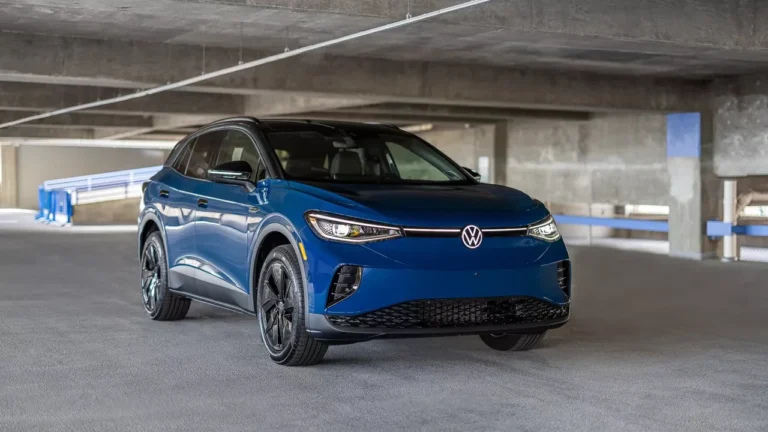
The EV9 is the cheapest genuine three-row electric SUV in this guide, and the one most families should start with. The Light Long Range RWD costs $57,900 and gives 305 miles of EPA range from its 99.8 kWh battery, which works out to $189.84 per EPA mile on MSRP. The cheaper Light costs $54,900 but only gives 230 miles of EPA range, so the $3,000 step up to the Long Range buys 75 more miles. That is the trim to compare, not the base price with the longest range.
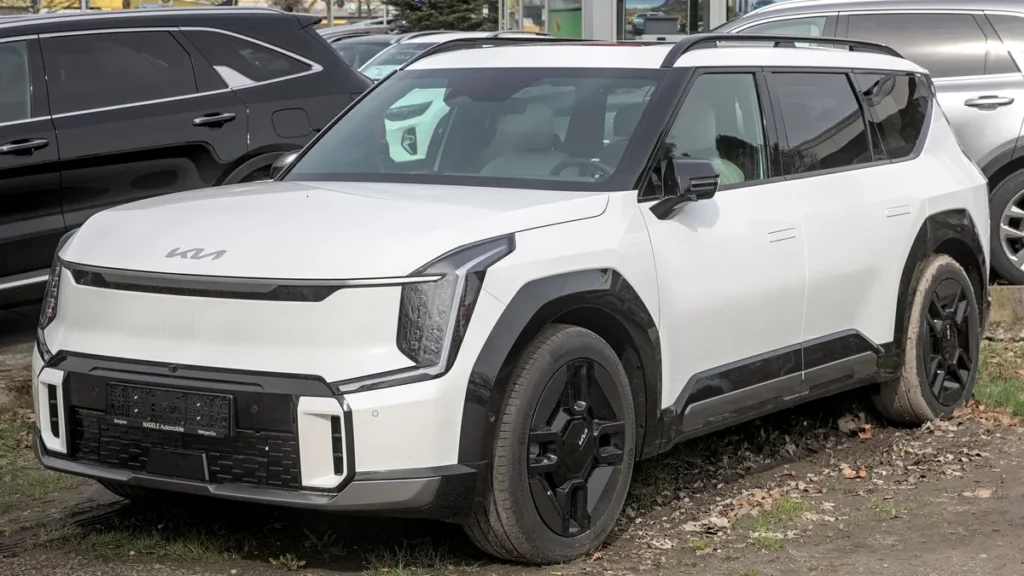
Seating is where you need to read the trim list. The Light and Wind seat 7 with a bench second row. The Land seats 6 with captain’s chairs as standard, and the GT-Line seats 6 only. The Light Long Range offers both a 7-seat bench and a 6-seat captain’s chair layout, so confirm which layout the car on the lot actually has before you sign. Third-row legroom is 30.8 inches with the bench and 32.0 inches with captain’s chairs, which is adult-usable for a short trip and comfortable for children. Kia’s owner’s manual places the LATCH lower anchors in the outboard second-row seats only, never the centre seat, with a 65-pound combined limit for the child plus the restraint.
Cargo is the EV9’s honest strength. There are 20.2 cubic feet behind the third row, 43.5 cubic feet behind the second row, and 81.7 cubic feet at maximum. The front trunk adds 3.2 cubic feet on rear-wheel-drive cars and 1.8 on all-wheel-drive cars. For a family of 7, 20.2 cubic feet behind the third row holds a folded full-size stroller and soft bags, but not a stroller plus hard suitcases, so bring your stroller to the dealer and try it before you buy.
Charging is simple on the EV9. The 2026 car has a native NACS port, so it plugs into Tesla Superchargers with no adapter. For CCS fast chargers you need a CCS adapter, which Kia does not price on its public pages. On a 350 kW DC charger, the Long Range trims charge from 10 to 80 percent in about 24 minutes, and the Light in about 20 minutes.
The peak draw is 210 kW on the Long Range trims. The Wind costs $63,900 with 283 miles of EPA range, the Land $68,900 with 283 miles, and the GT-Line $71,900 with 280 miles, all all-wheel drive. Every one of those figures is for the exact trim named, from the EPA record for that configuration.
2. Hyundai Ioniq 9: the best all-rounder
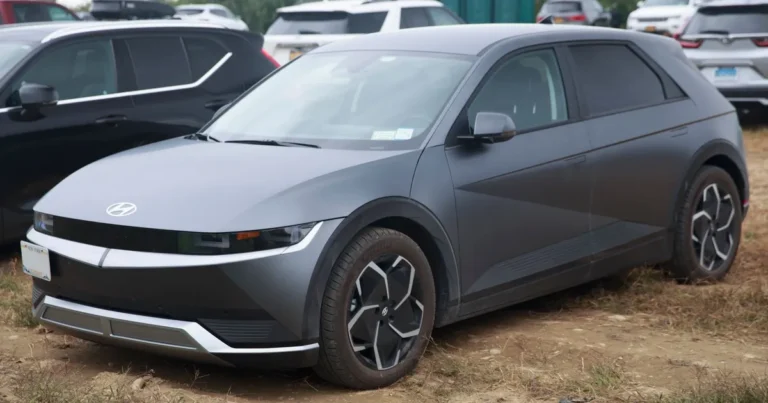
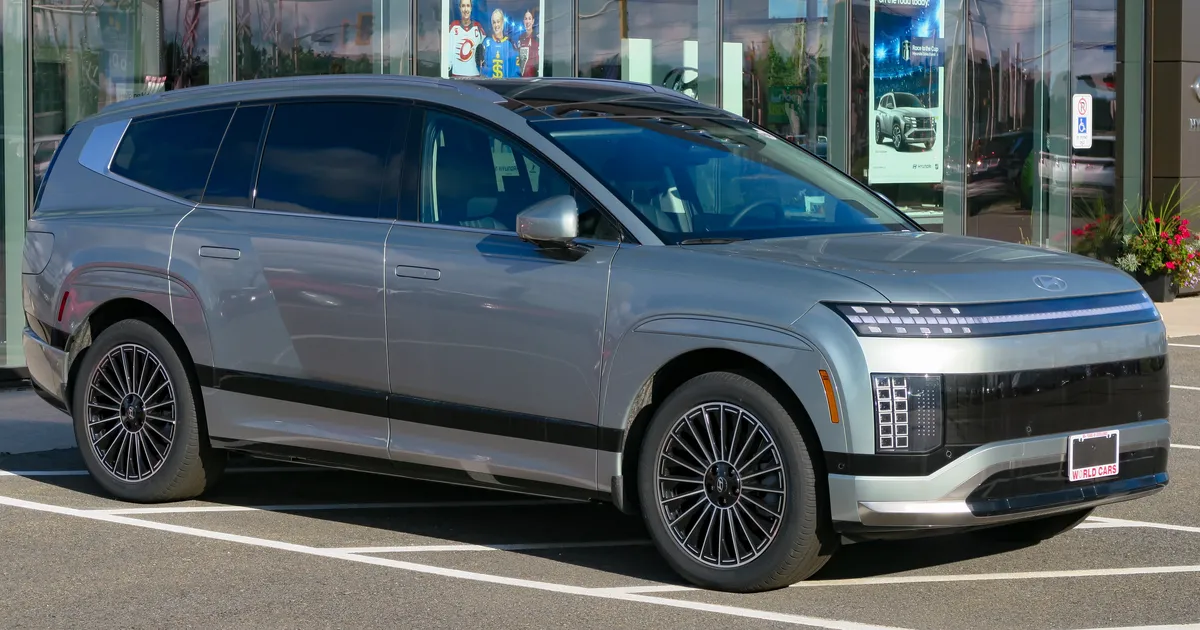
The Ioniq 9 is the best all-rounder in this guide because it leads the mainstream picks on range, cargo and charging flexibility at the same time. The S RWD costs $58,955, only $1,055 more than the EV9 Light Long Range, and gives 335 miles of EPA range, 30 miles more. That works out to $175.99 per EPA mile on MSRP, the lowest figure among the three-row picks. It seats 7 as standard, with a bench second row, and every trim uses the same 110.3 kWh battery.
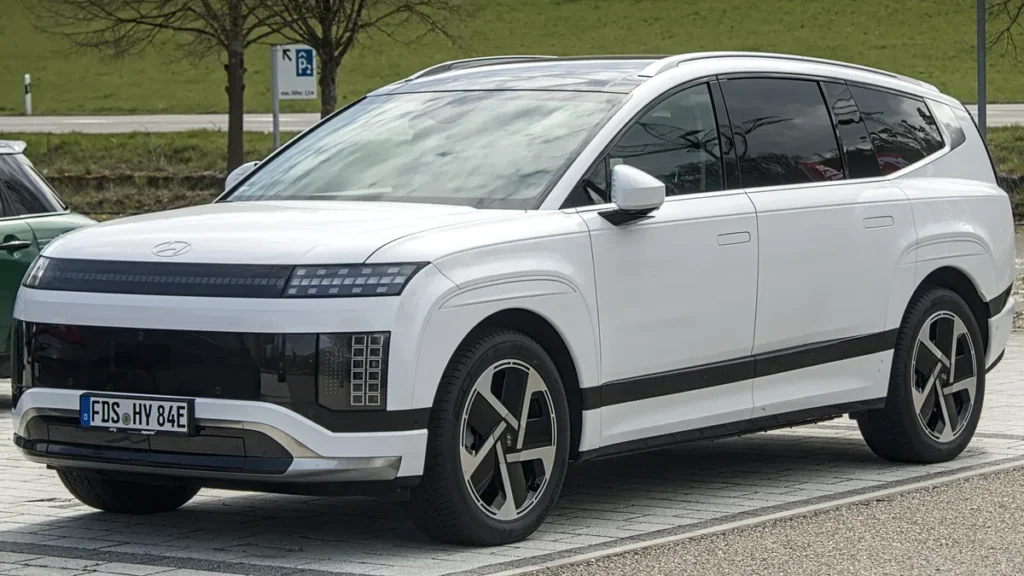
Cargo is the best in its class here. There are 21.9 cubic feet behind the third row, 46.7 cubic feet behind the second row, and 86.9 cubic feet at maximum.
That is 1.7 cubic feet more than the EV9 behind the third row and 5.2 cubic feet more at maximum, which is the difference between a stroller plus bags and a stroller plus bags plus a cooler. The higher trims trade seats for comfort: the SE costs $62,765 with 320 miles of EPA range and 7 seats, the SEL costs $66,320 with 320 miles and 7 seats, and the Limited, Calligraphy and Calligraphy Design seat 6 with power captain’s chairs, at $71,250, $74,990 and $76,490, all with 311 miles of EPA range.
Charging is where the Ioniq 9 shows its work. It has a native NACS port, so Supercharger access needs no adapter, and Hyundai includes a CCS adapter in the car for CCS DC fast chargers. The 10 to 80 percent charge takes about 24 minutes on a 350 kW charger, but about 40 minutes on a Tesla V3 Supercharger, because the V3 runs at 400 volts while the Ioniq 9’s 800-volt system charges faster on a 350 kW charger.
That 16-minute difference is the single most useful fact in this guide for a family that road-trips: pick the 350 kW charger when you can, and budget the extra time when you cannot. The 2026 Ioniq 9 is also an IIHS Top Safety Pick+, the only pick here with that award confirmed.
One trap to avoid: Hyundai’s complimentary NACS adapter offer does not apply to the Ioniq 9. That offer was only for CCS-port Hyundai EVs bought or leased on or before January 31, 2025, and the Ioniq 9 already has a native NACS port, so there is nothing to claim. If a dealer mentions a free adapter, ask which program it belongs to.
3. Rivian R1S: the adventure pick
The R1S is the pick for a family that drives beyond the pavement and tows, and it is the most expensive pick to justify on family grounds alone. The 2027 Premium with the Dual motor and Large battery costs $83,990 before the $1,895 destination fee, $85,885 delivered, and gives 329 miles of EPA range on 22-inch wheels, which works out to $255.29 per EPA mile on MSRP
The Premium Long Range costs $90,990 and gives 410 miles, the Performance costs $106,990 with 371 miles, and the Quad costs $121,990 with 374 miles. Rivian renamed its trims for 2027, so Dual is now Premium and Tri is now Performance, and the old Dual Standard is discontinued, so do not accept $75,900 or $79,900 as the current entry price. Those figures are from the discontinued trim.
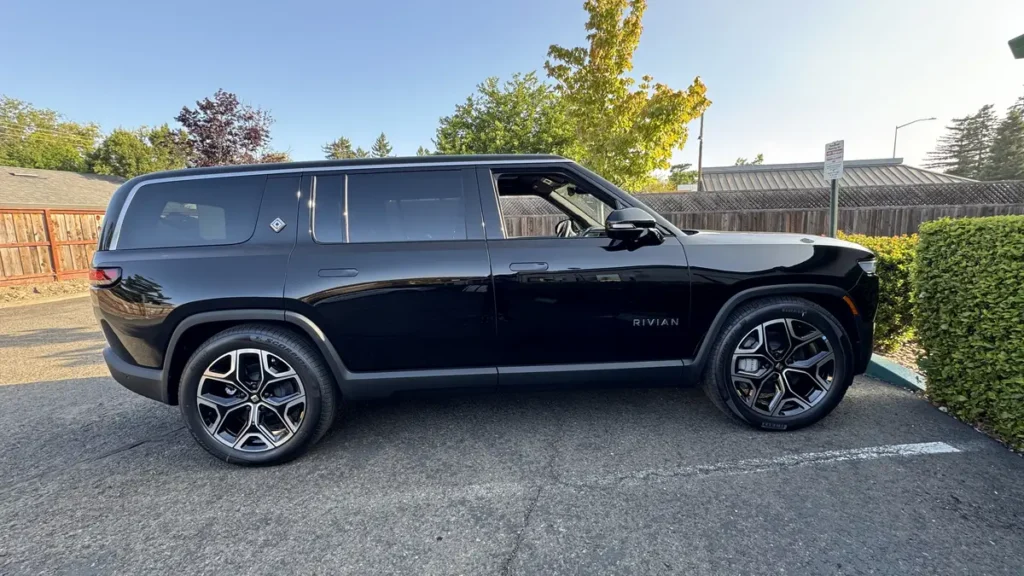
Seating is 7 as standard, with a bench second row and two third-row seats. Second-row captain’s chairs are new for 2027 and make it a 6-seater, priced by trim and interior bundle, so ask for the exact figure on the configuration you want rather than taking a single number from a guide. Child-seat fit is the best documented here: Rivian’s owner’s guide puts LATCH lower anchors in the outboard seats of both the second and third rows, so the third row can hold up to 2 child seats, with top tethers in both rows. That is a real difference from the Model Y, whose third row has no LATCH at all.
Cargo is the one figure we could not verify for the R1S. Rivian does not publish a cargo table we could find, and secondary guides disagree widely, from 10.4 to 20.3 cubic feet behind the third row, so we publish no figure rather than guess. If cargo behind the third row decides your purchase, measure it at the delivery centre with your stroller before you commit. The front trunk is about 11 cubic feet by secondary reports.
Charging is native NACS from model year 2026 onward, including the 2027 cars, so Supercharger access needs no adapter. For CCS fast chargers you need a CCS1 DC adapter, reported at $200 by secondary sources and not verified on a Rivian page. Rivian states only that its Adventure Network can add up to 150 miles in 20 minutes, so we do not quote a peak kW or a 10 to 80 percent time for the R1S. Rivian’s own footnote also warns that some of its published range figures are preliminary EPA-cycle estimates rather than official EPA values, so treat the 329-mile figure as Rivian’s EPA-cycle figure on 22-inch wheels.
4. Tesla Model Y: the cheapest way to seven seats
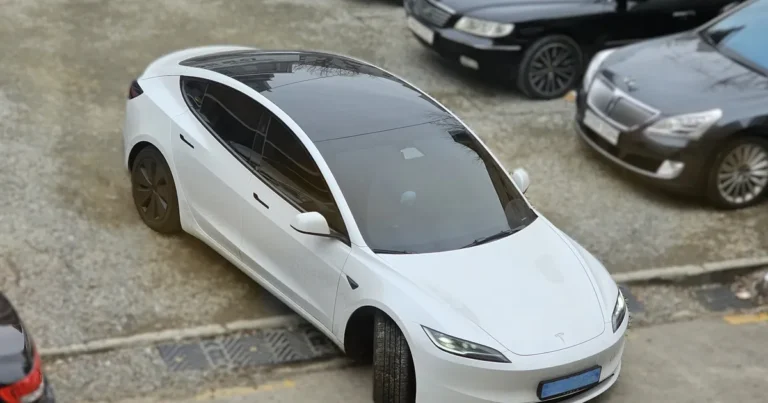
The Model Y is the cheapest route to 7 seats in this guide, and the one with the smallest third row. The Premium AWD costs $49,990, and the seven-seat layout is a $2,500 option on that trim only, so the 7-seat car costs $52,490 before fees, or $54,130 with Tesla’s $1,640 destination and order fees.
It gives 327 miles of EPA range, the same for the 5-seat and 7-seat versions, which works out to $160.52 per EPA mile on MSRP. No other trim offers 7 seats: the RWD at $39,990 and the Premium RWD at $45,990 are 5 seats only, and the $41,990 all-wheel-drive version was removed from the configurator on November 12 to 13, 2026, so the Premium AWD is now the cheapest all-wheel-drive Model Y.
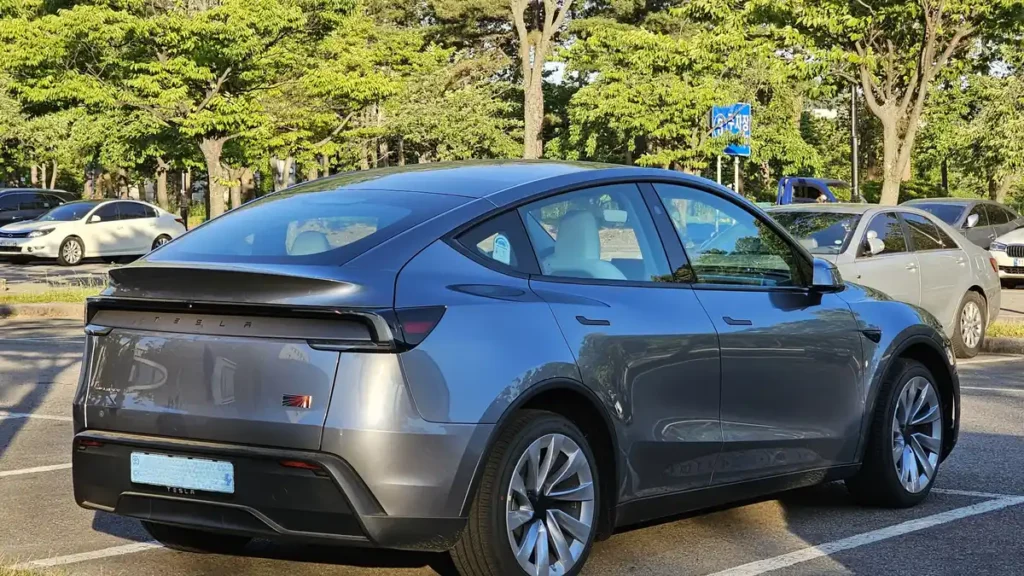
The third row is child-sized, and you should buy it only on that understanding. Third-row legroom is 25.8 inches and headroom is 34.6 inches, against 31.0 and 38.1 inches in the longer Model Y L. The third row has no LATCH anchors, so a child seat there must be installed with the seat belt, and Tesla’s manual says not to use LATCH if the child plus the restraint weighs more than 65 pounds.
The second row outboard seats do have LATCH. Tesla’s current manual lists cargo only for the 5-seat car, 29.0 cubic feet behind the second row and 75.5 cubic feet at maximum, so we do not quote a 7-seat cargo figure here. Bring your stroller to a Tesla store and try it.
If the third row matters more than the price, look at the Model Y L instead. It is a separate, longer car with 6 seats in a 2 plus 2 plus 2 layout, captain’s chairs in the middle row, a $61,990 price and 332 miles of EPA range. It costs $9,500 more than the 7-seat Premium AWD, and for a family that regularly carries 6 people, the extra legroom is worth that gap.
Charging needs no adapter: the Model Y has a native NACS port and plugs into Superchargers directly, and Tesla states up to 169 miles added in 15 minutes for the Premium AWD. If you are weighing a Tesla as a first car rather than as a family car, our first-time Tesla buyer’s guide covers insurance, charging access and the driver-assistance limits in detail.
5. Volvo EX90: the premium pick
The EX90 is the premium pick for a family that values cabin quiet and safety equipment over cargo space, and its cargo figure is the warning. The Twin Motor AWD costs $81,390 including the $1,395 destination fee, which is $79,995 before destination, and gives up to 305 miles of EPA range on 21-inch wheels, or 298 miles on 20 or 22-inch wheels.
That works out to $262.28 per EPA mile on MSRP before destination. The Single Motor costs $78,090 including destination, with up to 293 miles in Volvo’s specifications table, but Volvo’s main page gives 291 miles on 21-inch wheels and 276 miles on 20 or 22-inch wheels, so use the wheel-specific figure for the car you are buying. The Twin Motor Performance costs $86,390 including destination, also with up to 305 miles.
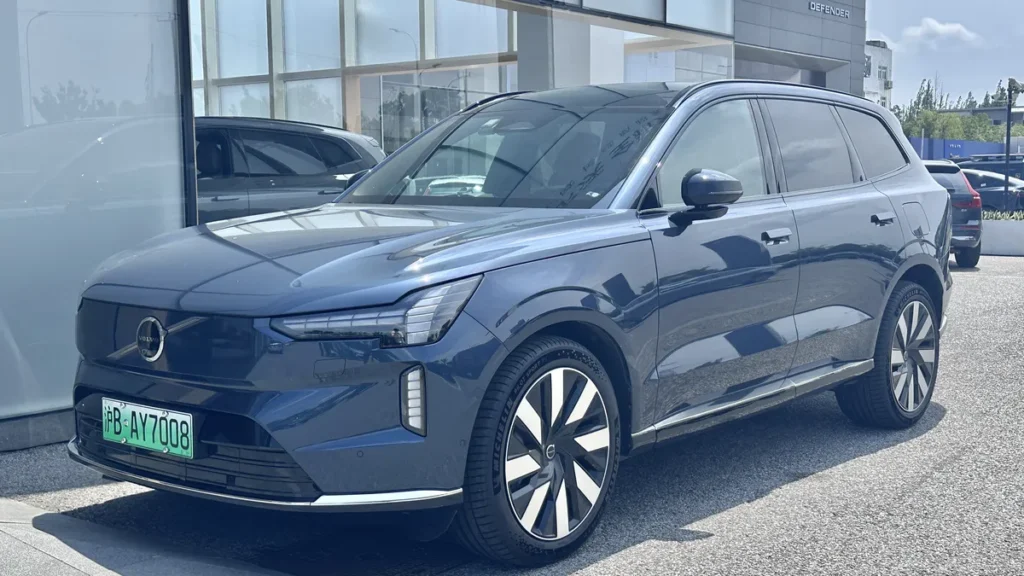
Seating is 7 as standard on the Single Motor, and 6 or 7 on the Twin Motor trims, with the third row standard in the 7-seat form. The problem is cargo: there are only 11.4 cubic feet behind the third row, barely half the Ioniq 9’s 21.9, and 73.5 to 75.4 cubic feet at maximum depending on the seat layout, plus a 1.6 cubic foot front trunk. A family of 7 that travels with luggage will need a roof box or a trailer, which is a real cost and a real hassle, so the EX90 only makes sense if your third row is for children on short trips and your luggage travels in the roof box.
Charging is the EX90’s other compromise. The 2026 car has a CCS1 port, not native NACS, so Supercharger access needs Volvo’s approved NACS DC adapter, and only at V3 and later Superchargers. Volvo does not publish the adapter’s price, so budget for it and confirm the figure with the dealer. The car charges from 10 to 80 percent in about 22 minutes, which is quick, but the adapter is one more thing to carry, lose and pay for. The battery is 92.0 kWh on the Single Motor and 106.0 kWh usable on the Twin Motor trims.
6. Cadillac Vistiq: the mid-luxury three-row
The Vistiq is the mid-luxury three-row for a family that wants a Cadillac cabin without the Escalade IQ’s price. The 2027 model starts from $78,400, and the 2026 launch prices were $77,395 for the Luxury trim, so do not mix the two model years in one comparison. It gives 305 miles of EPA-estimated range with dual-motor all-wheel drive, or 300 miles with the available 19.2 kW onboard charger that is standard on the Premium Luxury and Platinum trims. That works out to $257.05 per EPA mile on MSRP. The destination fee is not verified from a Cadillac primary source, so no delivered price is quoted here.
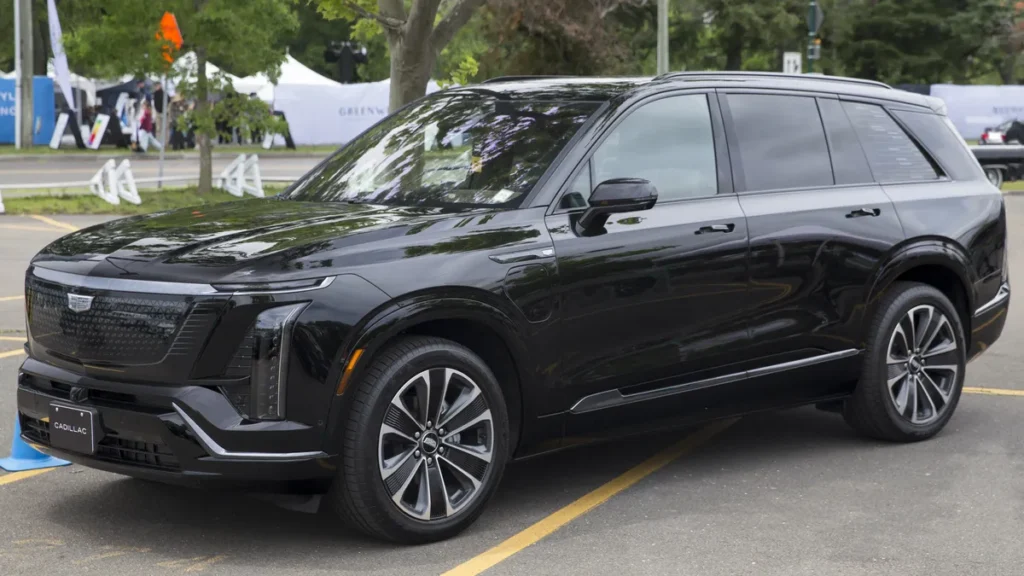
Seating is 7 as standard across the trims, in 3 rows, with 30.63 inches of third-row legroom, which is close to the EV9’s 30.8 inches and usable for children and shorter adults. Cargo is 15.2 cubic feet behind the third row, 43 cubic feet behind the second row, and 80.2 cubic feet at maximum. That sits between the EX90’s 11.4 and the EV9’s 20.2 behind the third row, so the Vistiq fits a stroller and bags, but not a stroller plus hard suitcases.
Charging is native NACS, so Supercharger access needs no adapter, and Cadillac counts over 29,000 Tesla Superchargers reachable through the myCadillac app, plus over 250,000 public chargers in the U.S. and Canada. For CCS1 DC chargers, GM’s approved CCS1 DC adapter costs $299 on GM Energy’s current store. The Vistiq charges at up to 190 kW and adds up to 80 miles in about 10 minutes. The battery is 102 kWh. One model-year trap to note: the 2026 Equinox EV and Escalade IQ are CCS cars that need the $299 GM adapter, while the 2027 versions are native NACS, so the model year on the window sticker decides whether you need an adapter at all.
7. Lucid Gravity: the longest range, with a 7-seat caveat
The Gravity has the longest range in this guide, and the biggest caveat, because the headline range belongs to a 5-seat car. The Touring starts from $79,900 with 337 miles of EPA-estimated range, and the Grand Touring starts from $94,900 with 450 miles, both in the 2-row 5-seat form on 20-inch front and 21-inch rear wheels.
The 7-seat layout is optional, and Lucid has not published a range for the 7-seat Gravity, so do not quote 450 miles for a 7-seat car. Third-party summaries put the third-row option at $2,900, which is not verified on a Lucid page, so confirm it with Lucid before you budget for it. On MSRP, the Touring works out to $237.09 per EPA mile, but that figure is for the 5-seat car.
What the Gravity does offer is space. Maximum cargo reaches up to 120 cubic feet, plus an 8.1 cubic foot front trunk in the Touring, which is the largest maximum in this guide. Lucid has not published a cargo figure behind the third row, so we do not quote one.
Charging is native NACS, with a J1772 to NACS adapter and a CCS1 to NACS adapter included in the car, so Supercharger access needs no extra purchase. The Grand Touring charges at up to 400 kW and adds up to 200 miles in under 11 minutes at a 400 kW charger, while the Touring charges at up to 300 kW on 1,000-volt stalls and adds up to 200 miles in 15 minutes. The Touring battery is 89 kWh. The Gravity is the right pick only if you can confirm the 7-seat range and price with Lucid first, because the headline numbers do not describe the family car.
Which 7-seater EV has the most cargo behind the third row?
Among the verified figures in this guide, the Hyundai Ioniq 9 leads the mainstream picks at 21.9 cubic feet behind the third row, ahead of the Kia EV9 at 20.2 cubic feet. The Cadillac Escalade IQ leads overall at 23.6 cubic feet, at more than $127,000. The Rivian R1S figure is unsettled in secondary sources, and the Tesla Model Y and Lucid Gravity figures are not published by their makers, so no honest ranking can place them.
The Volvo EX90 trails the mainstream picks at 11.4 cubic feet. Cargo behind the third row is the figure that decides whether a 7-seat car works for a family trip, and it is the figure most often missing, so check it on the car you buy, not in a brochure summary.
Can these family EVs use Tesla Superchargers?
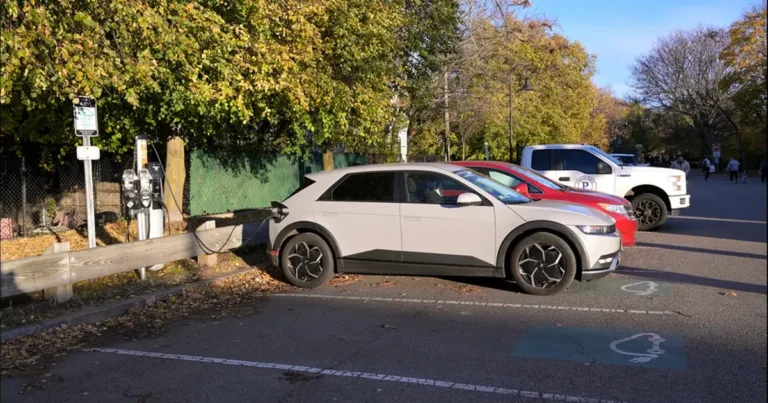
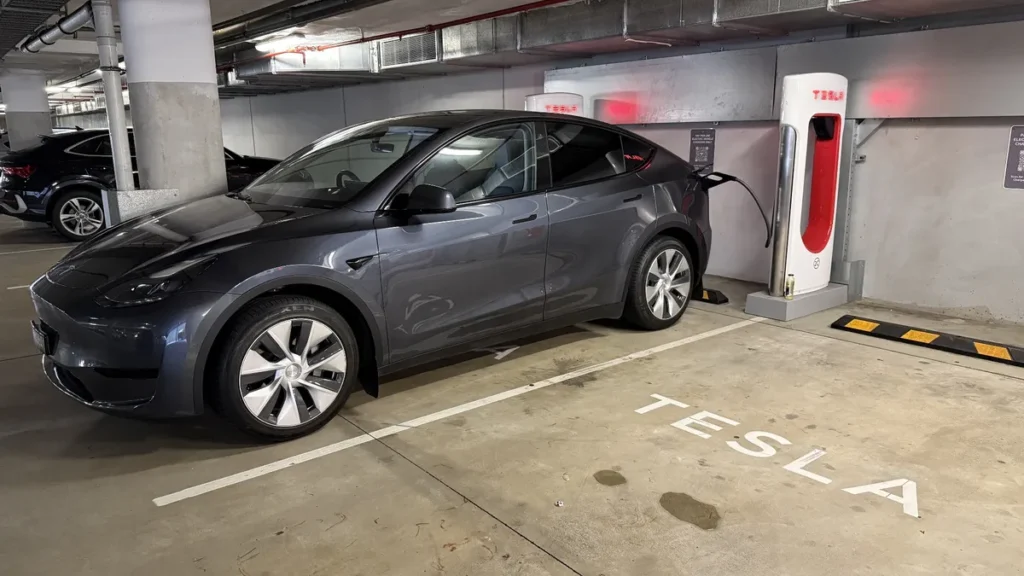
It depends on the model year, and the answer has three separate parts: the port, the adapter, and the network. The 2026 EV9, Ioniq 9 and R1S, and the 2027 GM EVs, have a native NACS port and plug into Superchargers with no adapter. The 2026 Equinox EV, Escalade IQ, Volvo EX90 and the 2025 ID. Buzz need a maker-approved NACS DC adapter, and the adapter, its price and its access rules differ per maker. A plug that fits does not prove access, so confirm the network access for your exact model year before you rely on it.
| Model | Charging port | Adapter needed for Superchargers | Network access |
|---|---|---|---|
| Kia EV9 2026 | Native NACS | None, CCS adapter needed only for CCS chargers | Yes, native |
| Hyundai Ioniq 9 2026 | Native NACS | None, CCS adapter included for CCS chargers | Yes, native |
| Rivian R1S 2027 | Native NACS | None, CCS1 DC adapter needed only for CCS chargers | Yes, native |
| Tesla Model Y | Native NACS | None | Yes, native |
| Volvo EX90 2026 | CCS1 | Volvo approved NACS DC adapter, price unverified | Yes, V3 and later only |
| Cadillac Vistiq 2027 | Native NACS | None, GM CCS1 DC adapter $299 for CCS chargers | Yes, native |
| Lucid Gravity 2026 | Native NACS | None, J1772 and CCS1 adapters included | Yes, native |
| VW ID. Buzz 2025 | CCS1 | VW approved NACS DC adapter, DC only | Yes, NACS Partner Sites only |
| Chevrolet Equinox EV 2026 | CCS1 | GM approved NACS DC adapter, $299 | Yes, with adapter |
| Chevrolet Equinox EV 2027 | Native NACS | None | Yes, native |
The GM approved NACS DC adapter costs $299 on GM Energy’s current store. Chevrolet’s support page still says $225 in one place, and that page is stale. The 2025 ID. Buzz gained Supercharger access on November 18, 2025, with the VW approved NACS DC adapter, at Tesla Supercharger sites identified as NACS Partner Sites, and only with the Tesla app, account and payment method. The adapter is DC only and must not be used with Level 1 or Level 2 AC chargers, including Tesla Destination chargers.
Worked example: a 300-mile family trip in the EV9 and the Ioniq 9
Take a family of 5 driving 300 miles for a weekend, in the two cheapest three-row picks, and plan the trip the way the earlier guides in this series plan it: leave home at 90 percent charge and keep a 20 percent reserve, so 70 percent of the battery is the usable planning window. These are illustrative figures from the EPA ranges, not a test, and cold weather, speed and hills will change them.
The EV9 Light Long Range gives 305 miles of EPA range, so the 70 percent window is 213.5 miles. Drive 213.5 miles, then stop and charge from 10 to 80 percent, which takes about 24 minutes on a 350 kW charger. The remaining 86.5 miles fit easily inside the next window, so the trip needs one stop of about 24 minutes.
The Ioniq 9 S gives 335 miles of EPA range, so the 70 percent window is 234.5 miles. Drive 234.5 miles, then stop and charge from 10 to 80 percent, which takes about 24 minutes on a 350 kW charger, or about 40 minutes on a Tesla V3 Supercharger. The remaining 65.5 miles fit inside the next window, so the trip also needs one stop, but the charger you choose changes the stop by 16 minutes. On a family trip, that is the difference between a quick snack stop and a full meal stop, and it is why the charging table above matters more than the peak kW number on a spec sheet.
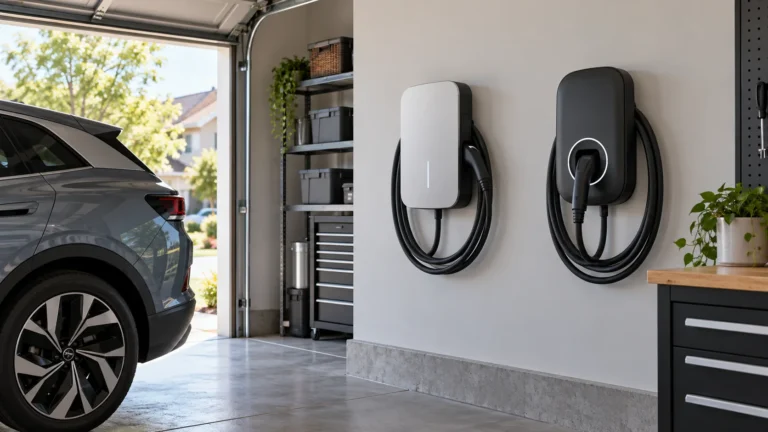
Home charging is the other half of the trip. Both cars charge overnight on a Level 2 home charger, so the 90 percent departure charge costs nothing in waiting time, and the only stop that costs your family time is the one on the road. If you cannot charge at home, the maths changes: every charge becomes a road stop, and the car with the faster 10 to 80 percent time and the cheaper per-mile figure wins by more. For a family that rents or parks on the street, the Ioniq 9’s 24-minute stop and $175.99 per EPA mile beat the EV9’s $189.84, and the Model Y’s $160.52 only wins if its child-sized third row fits your children.
Does it fit your family? A checklist before you buy
Use this checklist at the dealer, with your own car seats and stroller, before you sign. No guide can answer these questions for your children.
- Seven people plus a stroller: sit all 7 seats up, put the folded stroller in the cargo area, and see what is left. The Ioniq 9 gives 21.9 cubic feet behind the third row and the EV9 gives 20.2, but your stroller decides whether that is enough.
- Car seats in row 2: install your seats on the LATCH anchors and check the centre seat. The EV9 and R1S put LATCH in the outboard second-row seats only, and the Model Y third row has no LATCH at all.
- Third-row access with a rear-facing seat installed: fit the infant seat in row 2, then climb into row 3. If you cannot get in without removing the seat, the third row is for older children only.
- Home charging overnight: confirm you can charge at home, or that a reliable charger sits within a short drive. Without home charging, every charge is a road stop.
- The adapter for a Supercharger stop: check the port on the exact model year you are buying, and whether the adapter is included, costs $299, or is not sold yet. The 2026 Equinox EV needs the GM adapter, the 2027 does not, and the EX90’s adapter price is not published.
- The price on the window sticker: confirm the destination fee and the trim on the car, because the MSRP in this guide is before destination, and the cheapest price and the longest range often belong to different trims.
What we left out, and why
The Tesla Model X is not a new buy. Tesla’s own page says the Model X is no longer in production, and that pre-owned non-Signature Edition inventory vehicles may still be available. Production ended after the announcement on January 28, 2026, with the final cars built in the second quarter of 2026. If you see a new Model X listed, it is remaining inventory, and no current new-order price is published, so we do not quote one. The GMC Hummer EV SUV is not a family pick either: it has 5 seats in 2 rows only, and GMC states it does not have third-row seating.
Two luxury mentions are worth a line each. The Cadillac Escalade IQ starts from $127,405, seats 7, gives 23.6 cubic feet behind the third row, and its 465-mile figure is a Cadillac estimate, not an EPA rating, so do not compare it with the EPA figures above. It has a CCS1 port and needs the $299 GM adapter for Superchargers. The Mercedes-Benz EQS SUV starts from $89,950 for the EQS 400, offers 7 seats as an option, and includes the NACS DC adapter as standard equipment for 2026, but we do not quote an EPA range for it because its single-vehicle EPA page was not opened for this guide.
Two budget two-rows are worth a line each for smaller families. The Chevrolet Equinox EV starts from $34,995 with 319 miles of EPA range in front-wheel drive and 307 miles in all-wheel drive, seats 5, and gives 57.2 cubic feet at maximum. The 2026 car has a CCS1 port and needs the $299 GM adapter, while the 2027 car is native NACS.
Our city-driving guide covers it in more detail. The 2027 Chevrolet Bolt is a second-car note only, never a family pick: the LT costs $27,600 plus a $1,395 destination fee, $28,995 delivered, with 262 miles of EPA-estimated range, a 65 kWh LFP battery and a native NACS port, in a limited production run. It seats 5 in a small hatchback.
The Volkswagen ID. Buzz is the minivan in this family, and it has its own guide. The 2025 Pro S costs $59,995 with 234 miles of EPA range and 7 seats, and there is no 2026 U.S. model, only leftover 2025 stock. It has a CCS1 port and charges at compatible Tesla Superchargers with VW’s approved NACS DC adapter, DC only, from November 18, 2025. Read the full minivan guide before you choose between a minivan and a three-row SUV.
If you want the wider non-Tesla comparison, our best non-Tesla EV guide compares 8 alternatives matched to the Tesla you would otherwise buy.
How we checked
Checked November 17, 2026. Prices are MSRP before destination unless stated, from the maker’s U.S. pages, and EPA range is for the exact configuration named, from fueleconomy.gov single-vehicle pages or the maker’s specifications. Seating and cargo are from the maker’s specifications pages, and charging port and adapter rules are from the maker’s charging pages.
Where a figure could not be verified from a primary source, this guide says so and publishes no figure, rather than repeating a secondary number. Destination fees are unresolved for the EV9, Ioniq 9, Vistiq and Gravity, so no delivered price is quoted for them. The Rivian R1S cargo figures, the Tesla Model Y 7-seat cargo figure, the Lucid Gravity 7-seat range and third-row option price, and the Volvo EX90 adapter price are all unverified from a primary source and are not quoted as facts here.
Sources: Kia EV9 specifications and EPA records for the EV9 Light Long Range and other trims; Hyundai Ioniq 9 specifications and welcome centre; Rivian R1S page and owner’s guide; Tesla Model Y configurator readings and owner’s manual; Volvo EX90 specifications and support page; Cadillac Vistiq specifications; Lucid Gravity pages and charging guide; Volkswagen ID. Buzz technical data; Chevrolet Equinox EV and Bolt pages; GM Newsroom NACS announcement of August 13, 2026; GM Energy adapter store; Tesla Model X page.
The EV9 prices are from a Kia dealer pricing guide citing Kia America, because Kia’s primary price page was not retrieved for this guide. The EV9 LATCH positions are from Kia’s owner’s manual. The R1S range figures are Rivian’s EPA-cycle figures on 22-inch wheels, and Rivian’s own footnote calls some of them preliminary estimates rather than official EPA values.
This guide was prepared with substantive AI assistance from the research and drafting above, and no vehicle in it was test-driven, no dealer stock was audited, and no price was confirmed on a window sticker. Prices and ranges change, so confirm the trim, the model year and the destination fee on the car you buy as you pick the best EV for families for your household. Sam Wilson is the editorial pen name for EVPalace.
What is the best EV for families?
The Hyundai Ioniq 9 S is the best all-rounder for most U.S. families, at $58,955 with 335 miles of EPA range, 7 seats and 21.9 cubic feet behind the third row. The Kia EV9 Light Long Range is the value pick at $57,900 with 305 miles of EPA range and 7 seats. Both have a native NACS port and charge from 10 to 80 percent in about 24 minutes on a 350 kW charger.
Which 7-seater EV has the most cargo behind the third row?
Among the verified figures in this guide, the Hyundai Ioniq 9 leads the mainstream picks at 21.9 cubic feet, ahead of the Kia EV9 at 20.2 cubic feet. The Cadillac Escalade IQ leads overall at 23.6 cubic feet, at more than $127,000. The Rivian R1S figure is unsettled in secondary sources, and Tesla and Lucid do not publish one, so no honest ranking can place them.
Can these family EVs use Tesla Superchargers?
It depends on the model year. The 2026 EV9, Ioniq 9 and R1S, and the 2027 GM EVs, have a native NACS port and plug in with no adapter. The 2026 Equinox EV, Escalade IQ, Volvo EX90 and 2025 ID. Buzz need a maker-approved NACS DC adapter, and the adapter, its price and its access rules differ per maker. The GM adapter costs $299 on GM Energy’s current store.
Is the $7,500 federal EV tax credit still available?
No. The federal new-EV credit is unavailable for vehicles acquired after September 30, 2025, and the used-EV credit ended on the same date. No price in this guide subtracts it. Some state and local incentives may still apply, so check your state’s program before you buy.
Is a 7-seat Tesla Model Y big enough for a family?
It is big enough for children on short trips, not for adults. The third row has 25.8 inches of legroom and 34.6 inches of headroom, and no LATCH anchors, so a child seat there must be installed with the seat belt. If you regularly carry 6 or 7 people, the Model Y L costs $9,500 more at $61,990 and gives a roomier 6-seat layout with 31.0 inches of third-row legroom, or pick the EV9 or Ioniq 9 instead.